The Material Hidden Behind the Imagined Place
A themed environment asks visitors to accept a constructed place as a coherent world. Stone may be simulated, a tree may conceal a support, and an oversized object may contain a cellular body rather than the substance it appears to represent. Foam became useful within this art of transformation, but it did not invent scenery, artificial landscapes, or amusement parks. Nor was every imitation rock made from foam. The history is best approached through the changing relationship between sculptural volume, surface illusion, workshop collaboration, and maintenance. Public records document some of these relationships clearly, while leaving the earliest uses and many proprietary construction details unresolved.
A: That cannot be inferred from appearance; individual construction records are needed.
A: No. Repairs and rebuilding can introduce later materials.
A: It documents a particular practitioner's experience, not the origin of an entire industry.
A: No. Company history and material priority are different questions.
A: Yes. The design model and final assembly can use different media.
A: The documented fabrication mix still includes multiple hands-on trades.
A: One belongs to the fictional setting; the other belongs to the object's material condition.
A: Yes. Mismatched relief, sheen, or color can break visual continuity.
A: Frames, coatings, hardware, and mechanisms also contribute mass.
A: Project specifications, dated workshop images, named testimony, and maintenance files.
Themed Illusion Predates Cellular Plastics
There is an important difference between the history of an effect and the history of one material used to make it. An artificial landscape can be built by several methods. Once foam becomes familiar, it is tempting to read it backward into every older example of convincing scenery. A photograph cannot usually establish the concealed composition of a mountain, cave, or oversized figure. The material history needs records from that construction, not a guess based on resemblance.
This is especially relevant to famous attractions whose visual identity has survived rebuilding. An opening date identifies the attraction, not necessarily the age of every visible surface or hidden component. A repair, replacement, or later expansion can introduce a material absent from the original scheme. Conversely, a modern-looking finish can cover an older construction. Attraction history and component history must be read together rather than treated as one date.
The surviving evidence is uneven. Publicity emphasizes the guest experience; project drawings and fabrication records may remain private. A retired artisan’s account can illuminate a workshop practice without supplying a complete inventory of an entire park. These limitations do not make the history impossible. They call for a scale of claim that matches what is actually documented, particularly when discussing early adoption.
Cellular Volume Offered a Particular Kind of Freedom
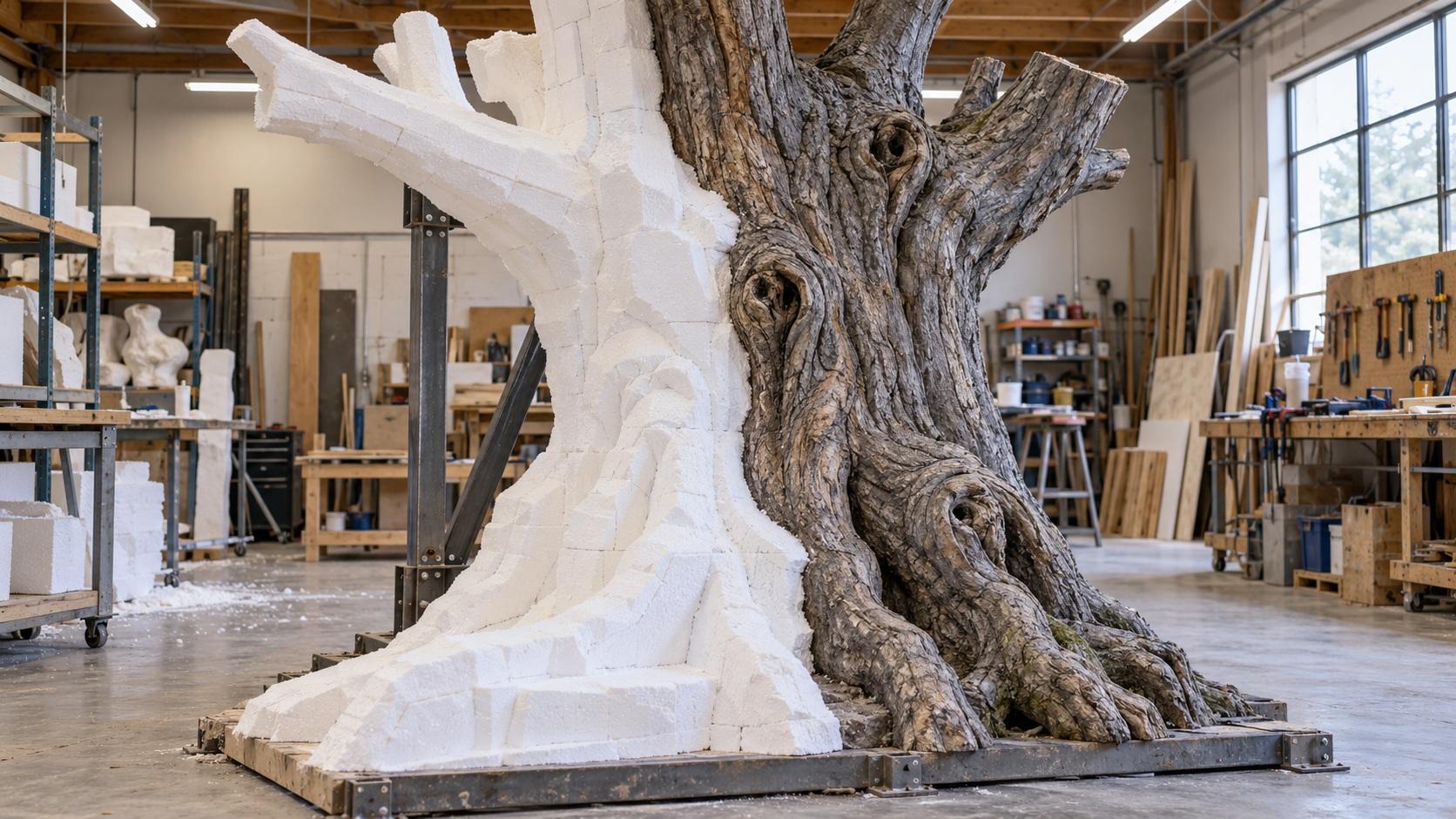
In scenic work, a material can be valued for the shape it supports rather than for the identity it displays. Carved foam can establish a broad volume beneath a different surface. This allows the represented object and its physical construction to diverge. A viewer sees an apparently solid relic or weathered trunk; the fabrication team deals with a shaped body, attachments, coatings, and whatever support the project requires.
That divergence is not mere deception in a negative sense. It is one of the conventions of theatrical and themed space. The material’s job is to contribute to an encounter, not necessarily to announce itself. Foam fits that tradition as one possible means of producing dimensional form. Its significance changes from fine art that exposes softness or cellular texture as the subject of the work.
Low mass can matter during fabrication and movement, but it does not eliminate the mass of the completed assembly. A metal frame, dense skin, hardware, or internal mechanism can contribute substantially. Calling a scenic object lightweight is therefore a comparison that needs a reference. The presence of foam alone does not prove that a completed feature can be moved by hand or attached without engineered support.
Scale also changes the practical meaning of detail. A face viewed across a plaza needs a different visual organization from a small object examined in a queue. Broad forms, surface marks, and painted contrasts work together at particular distances. Foam’s contribution may lie in the major volume, while paint carries much of the apparent age or material character. The illusion is an assembly of decisions rather than the achievement of one substrate.
Practitioner Accounts Reveal a Collaborative Trade
Scenic sculptor Brian R. Owens describes learning themed fabrication in central Florida during the first decade of the 2000s. His firsthand account identifies carved foam, coatings, and frequently internal metal structures, while stressing that projects differed and credits should be read individually. This documents a working practice in a particular professional setting. It should not be promoted into evidence that he or those firms introduced foam to all theme parks.
The account is valuable because it restores the middle ground between a concept image and an installed feature. A dimensional sculptor may interpret a drawing while another team designs support, applies a finish, or integrates movement. The visible result can be unified even though its production was distributed. Historical credit should preserve those different contributions instead of assigning an entire environment to the most recognizable designer alone.
Attribution can be particularly difficult when an artisan works through several employers. A portfolio may show an object under the name of the person who shaped one portion, while the client remembers only the prime contractor. These records need not contradict one another. Reading the stated role alongside the project credit can recover individual labor without overstating who designed or fabricated the entire feature.
A Specialized Fabrication Network Took Shape
Nassal’s company history and service account dates its themed work to 1984 and describes fabrication across theme parks, aquariums, zoos, and other destinations. Its listed services include rockwork, custom fabrication, scenic painting, and architectural metals. This is evidence of a specialized industry serving several kinds of immersive setting. It does not identify the material of every project or establish a first use of foam in 1984.
The network matters because sculptural knowledge can move between different clients. A technique learned in one commercial setting may inform another without appearing in a museum chronology. Suppliers, freelancers, specialty contractors, and operators all participate. The history of themed foam cannot be written solely through famous attractions; it also includes the less visible workshops that made ambitious forms repeatable and installable.
These workshops did not handle foam in isolation. Their work could bring together metal fabrication, millwork, molding, painting, and field installation. The material’s usefulness depended on those connections. A carved form still needed to become part of a place with circulation, access, and a coordinated visual story. Understanding the production network explains why a simple-looking prop could embody several kinds of expertise.
Terminology can complicate research. Sculpting may mean shaping a cellular original, carving a final applied surface, or developing a model for another material. Fabrication may cover an even wider range. A historical source that says sculpture does not automatically establish foam, and a source that says foam may describe only one intermediate. Captions, specifications, and project credits help distinguish these possibilities.
The proper historical question is not which single material replaced all the others. It is how an expanding palette was assigned to different roles. Foam could coexist with cementitious rockwork, metal structures, molded surfaces, and natural landscape elements. The resulting environment could appear seamless precisely because the production team coordinated many unlike materials. Its visual unity should not be mistaken for material uniformity.
Models and Digital Tools Changed Translation
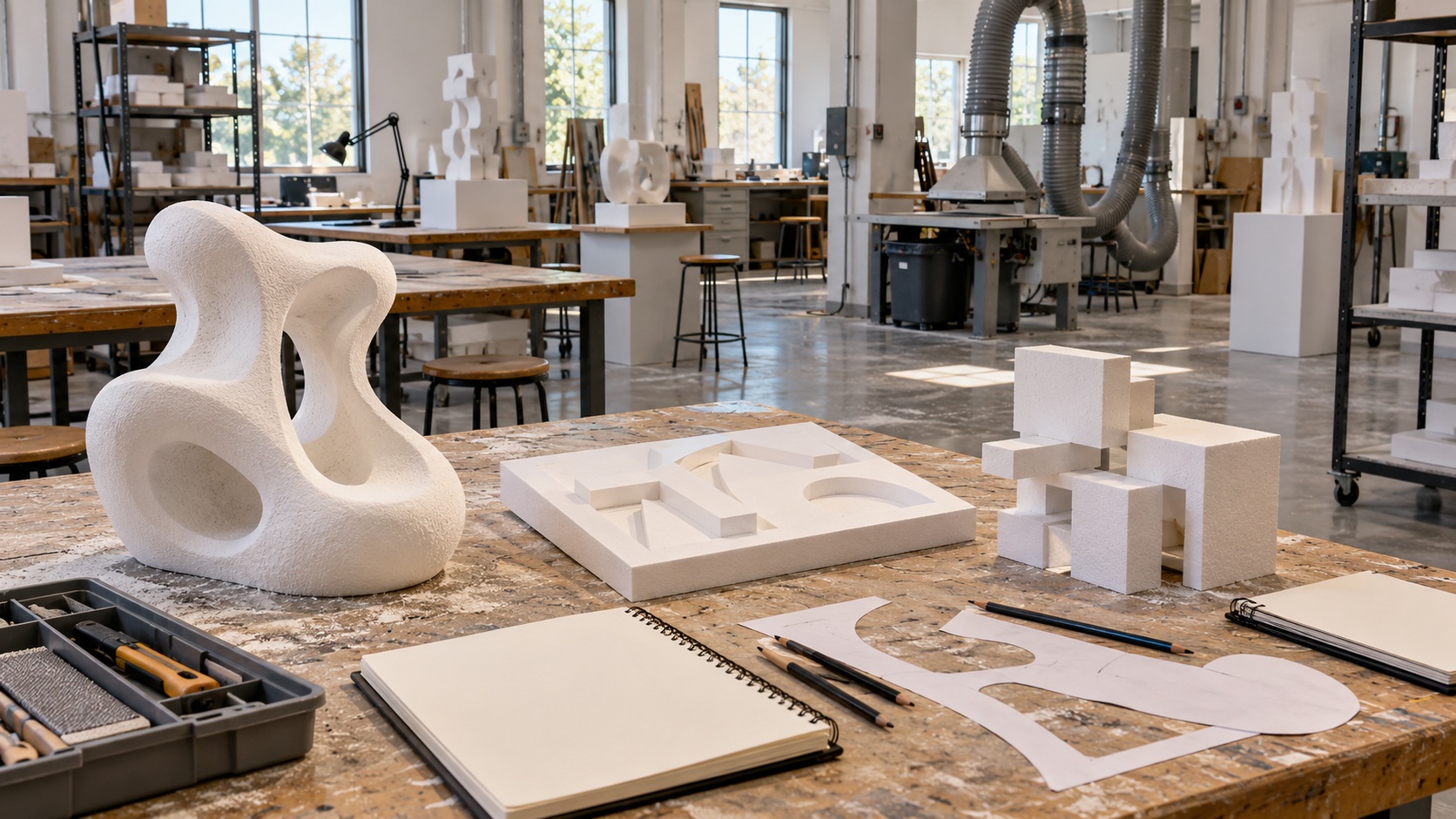
Small models allow a team to discuss silhouettes, views, transitions, and scale before full-size work is complete. Their value is not confined to a charming miniature. They can coordinate several contributors around a dimensional proposition. Yet the model itself may use a different material from the installation. A foam study is evidence of foam in design development, not automatically evidence of foam remaining in the attraction.
Disney’s 2024 Imagineering fact sheet identifies extensive archives of artwork, photographs, and scale models, alongside digital tools used in design and project management. This supports the importance of physical and digital representation in the organization. It does not supply a material specification for every model or a chronology in which computers simply replaced hand sculpture.
Nassal’s account of its fabrication facility places robotic sculpting and digital tooling beside casting, millwork, metals, and scenic paint. The combination suggests an integrated making system rather than a clean division between old craft and new machinery. A machined form can still require assembly and hand finishing; a hand-shaped model can still participate in a digital translation.
The Finish Carries the Fictional History
A themed surface often represents events that never happened to the actual object: weathering, use, erosion, repair, or archaeological discovery. Painted and sculpted marks create an imagined past. This is distinct from the genuine age of the feature. A newly fabricated relic can look ancient, while an old installation can be repainted to look newly built within the story. Material history and narrative history must remain distinguishable.
Foam can support the general shape beneath that fiction, but the finish may carry the decisive cues. A broad contour suggests a boulder; texture and color organize its geology for the visitor. A wooden-looking object may depend on painted grain rather than wood. The historian should therefore consider surface specialists alongside sculptors, especially where the substrate was intended to disappear from perception.
Consistency across separate pieces is another artistic task. A prop, a facade, and a landscape feature may be made in different shops yet need to appear to belong to one world. Shared samples and coordinated art direction can connect them. That coherence does not mean the pieces have identical construction. In fact, different exposure and access conditions may lead to different assemblies under visually related finishes.
The distinction also explains why a repair can be visually delicate even when the underlying damage seems small. Replacing a patch is not only a matter of filling volume. Its color, sheen, relief, and fictional aging must rejoin the surrounding story. A technically sound replacement can still interrupt the illusion. Scenic maintenance therefore preserves both a physical assembly and a designed visual continuity.
Lighting belongs to the same visual system. Relief that reads convincingly under one direction of light may appear flatter under another, and colored illumination can alter a painted surface’s apparent hue. Historical installation photographs therefore record both the fabricated object and a particular presentation. They are valuable evidence of the guest-facing effect, but not a neutral material sample from which every underlying finish can be reconstructed.
Operating Attractions Have Continuing Material Histories
Unlike an isolated object in a collection, a themed feature can remain within a heavily used environment. Access for inspection, cleaning, repair, and eventual replacement becomes part of its history. Foam-containing assemblies vary, so one cannot infer a service life from the material name. Nor should a decorative skin be described as structural protection or fire protection without evidence specific to the installed system.
Maintenance records can reveal changes absent from opening publicity. A component may be remade, strengthened, relocated, or retired while visitors continue to recognize the same fictional object. The question of originality becomes layered: the design, finish, internal assembly, and visitor memory can persist differently. Recording those changes helps future researchers distinguish an original scheme from the current physical version.
These later interventions deserve historical attention rather than being dismissed as routine upkeep. They show how a constructed world remains convincing over time and how operators balance access, visual continuity, and changing practical requirements. A complete history would combine project records, artisan testimony, and maintenance evidence. Where those records are unavailable, the account should leave uncertainty visible instead of replacing it with a confident origin legend.
Recover the Workshop Behind the World
Foam helped some themed objects acquire volume without dictating their entire construction. Its history becomes clearer when models, supports, finishes, collaborators, and later repairs are documented alongside the guest-facing illusion.