Why a Finished Foam Sculpture Is Hard to Recycle
The recycling problem begins before a sculpture reaches the waste bin. A clean foam block is one material; a finished sculpture may combine that block with paint, filler, adhesive, mesh, timber, fasteners, and a protective shell. Those additions make the object useful and visually convincing, but they can make its components difficult to recover. Even an uncoated offcut needs a collection program willing to accept its particular polymer, condition, and quantity. Calling foam recyclable therefore answers only a narrow technical question. A sculptor needs a practical answer: who will take this exact material, how must it be prepared, and what will happen if that outlet changes? Designing around those questions can reduce discarded material, but it cannot guarantee that a complex finished object will become feedstock for another product. Consider two deliveries leaving the same studio after an exhibition. One contains unpainted blocks trimmed during fabrication; the other contains the sculpted remainder with its textured coating and concealed framework. They may share a purchase origin yet require entirely different destinations. Tracking them as a single foam total hides the most important distinction. The clean blocks might meet a specialist collector’s specification, while the finished form might be useful only as an intact object or require disposal. A responsible plan makes that distinction before ordering material, assigns room for separation during fabrication, and includes time for dismantling after the exhibition. It also names the person who will complete the transfer. Without that ownership, even a well researched recovery option can disappear when the installation crew leaves and the venue needs its loading dock cleared for the next event.
A: Do not assume so. Ask the local provider about the finished composite, not just the foam polymer.
A: No. The receiving program's current material and contamination rules still govern acceptance.
A: Only after assessing suitable feedstock, throughput, operating requirements, costs, and an established buyer.
A: No. An improvised solvent process is not an established collection or recovery route.
A: Keep it separate unless the receiving facility explicitly authorizes that mixture.
A: An identified recipient who wants the object and understands its condition and requirements.
A: No. Compare how each complete design is made, used, transported, and retired.
A: During design and again near the actual collection or delivery date.
A: Use an approved local disposal route and record that outcome honestly.
A: Prevent clean fabrication scraps from becoming mixed with coatings, adhesives, and general rubbish.
Identify the Polymer Instead of the Appearance
White, lightweight, cellular material is not a single recycling category. Expanded polystyrene, extruded polystyrene, polyethylene foam, flexible polyurethane, and rigid polyurethane can all appear in studios, often alongside products whose identity is unknown. A recycler equipped for clean expanded polystyrene does not necessarily accept the others. Color, flexibility, bead texture, product documentation, and supplier information may help establish identity, but appearance alone is not a reliable acceptance rule. Keep the original product information when purchasing blocks and record the material in the project file. That small administrative step is much easier than trying to identify an unmarked pile after a busy installation has been dismantled. Recovered packaging introduces an additional uncertainty. One delivery can contain several kinds of protective foam, films, molded inserts, and adhesive labels. Separate them when unpacking rather than treating the entire shipment as a future sculptural resource. If the foam cannot be identified, ask the receiving facility before incorporating it into a recovery plan. Do not attempt improvised burn or solvent tests to identify a plastic. A studio can decide that an unknown piece is usable for a particular prototype without claiming that it has a known recycling route. Material reuse and material identification are related decisions, but one does not establish the other.
Understand the Collection Bottleneck
A large sculpture occupies considerable vehicle and warehouse space even when its mass is modest. Collection programs must handle that volume, keep material contained, and move it to suitable processing equipment. Densification can make some foam streams more practical to transport, but access to a densifier is not universal. The economics depend on collection density, contamination, equipment, markets, and the distance involved. For an individual studio, the relevant unit may be a van load or a storage cage rather than a kilogram. A plan that requires six months of accumulated scraps needs enough room to keep those scraps clean and separated for six months.
The EPA’s recycling guidance advises checking with the local provider because most recyclers do not accept foam commonly called Styrofoam. That is a reason to verify a route, not a statement that no foam can ever be recycled. Municipal examples show why local detail matters: some places operate dedicated drop off programs, while ordinary mixed recycling bins remain unsuitable. Confirm whether a listed service accepts commercial studio waste, not merely residential packaging. Ask about maximum dimensions and quantity before transporting a sculptural offcut that is much larger than the containers the facility normally receives.
Obtain acceptance instructions close to the date of delivery. Equipment downtime, an operator change, or a revised buyer specification can interrupt an otherwise legitimate service. Keep a second disposition option in the project budget rather than assuming the nearest listed facility is an unconditional promise. Written confirmation should describe the actual material, including its coatings and attachments. A photograph helps a facility distinguish a clean block from a painted composite. If acceptance is uncertain, report that uncertainty in environmental statements to a client. A proposed recovery route should not be counted as completed recycling before the material has actually been received.
Coatings Turn Simple Blocks into Composites
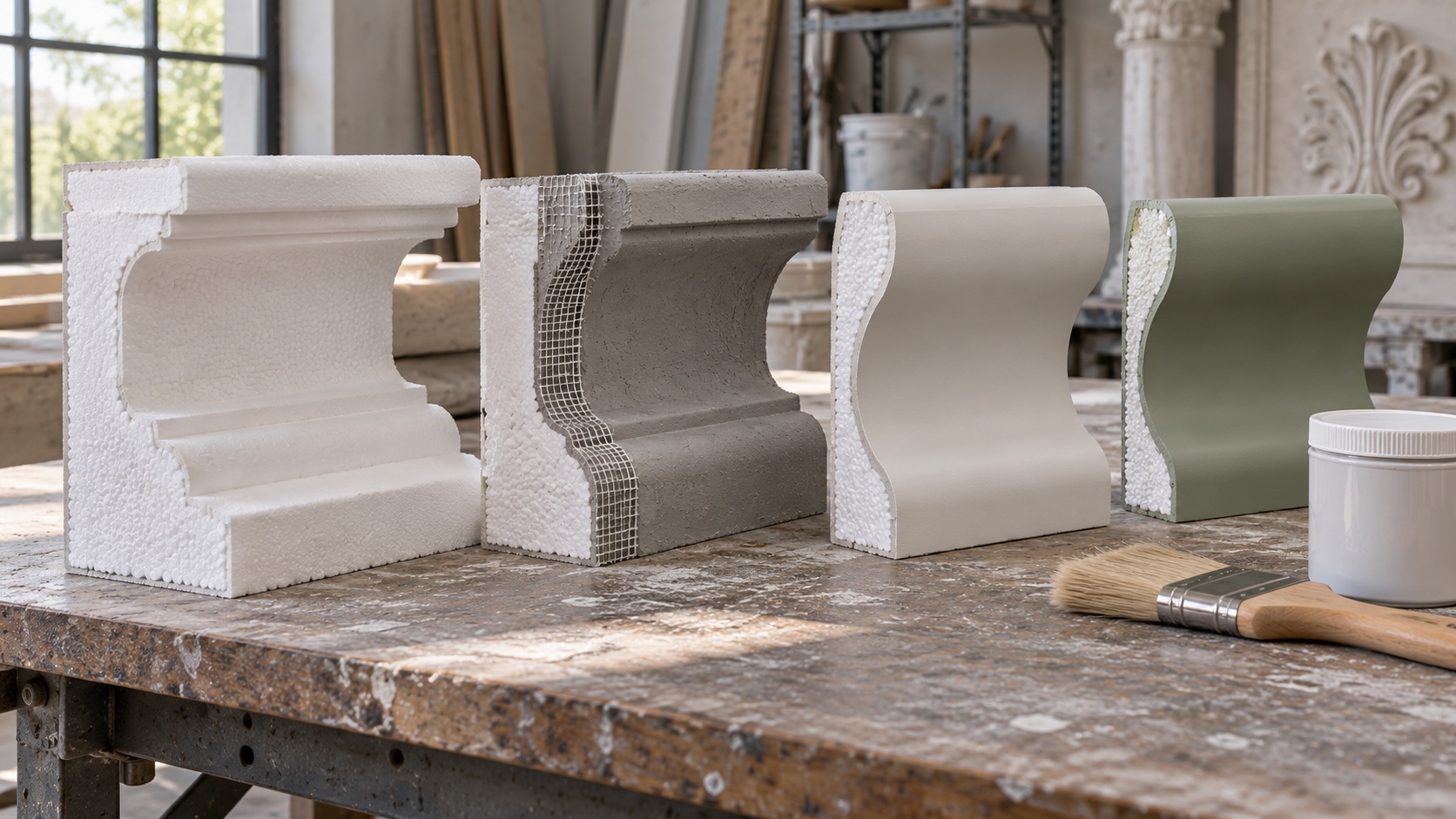
Scenic construction often depends on a hard shell. The shell spreads abrasion, bridges joints, and gives paint a continuous surface, but it can also bind unlike materials into a structure that cannot be separated economically. Mesh embedded in a coating is not comparable to a screw that can be removed. Peeling away the skin may tear the foam into contaminated fragments rather than recover a clean core. A thick coating can account for a meaningful share of the object’s mass even when the foam dominates its volume. Neither volume photographs nor the original block invoice describe the finished waste stream adequately.
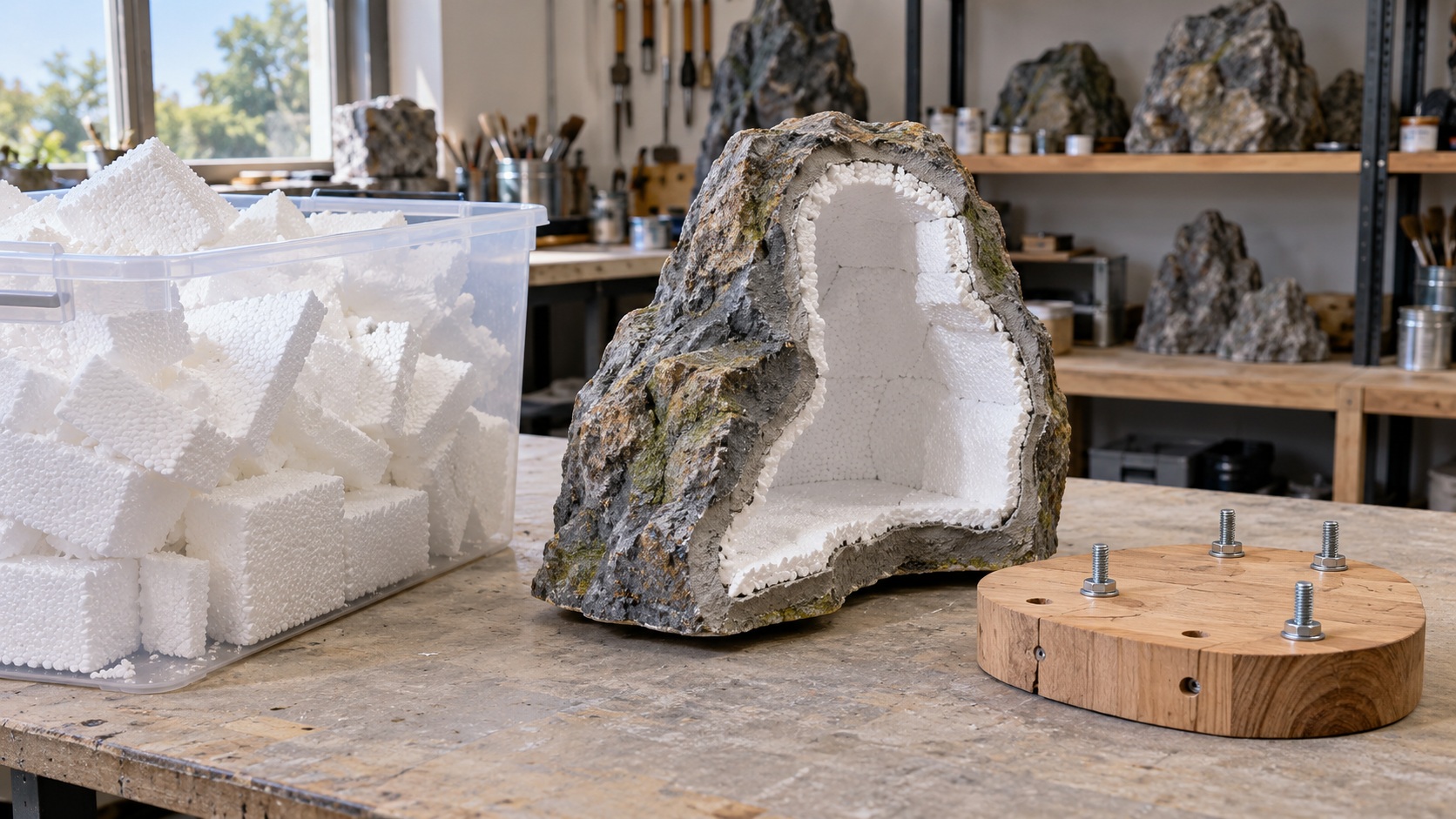
Consider a carved animal with a timber base, a reinforced coating, and several paint layers. The base may be recoverable if it is bolted on and accessible. The shell may be inseparable from the carved core without destroying both. That does not mean the object should never have been built; it means the environmental claim must match the assembly. A detachable base is a design improvement with a specific benefit, not proof that the entire sculpture is circular. Before adding a decorative layer, ask whether it solves a real requirement and whether a replaceable or mechanically attached element could achieve the same purpose with less material permanently bonded together.
Keep Fabrication Waste Separate from Finished Waste
The best opportunity to recover clean foam often occurs during cutting, before adhesives and coatings enter the workflow. Use separate containers for identified clean offcuts, coated fragments, and mixed sweepings. Place collection containers where the cutting happens so separation does not depend on sorting a dirty bag later. Protect useful pieces from spilled paint and sanding residue. A clean material stream can be lost through one convenient but poorly labeled bin. Workers should know which material belongs in each container and who is responsible for arranging collection when it fills.
Measure what the project actually produces. Weigh or otherwise consistently record purchased stock, usable offcuts, rejected parts, and final discarded assemblies. The method need not resemble an industrial life cycle study, but its limits should be explicit. A count of full bags does not describe polymer mass unless bag size and packing are comparable. Record the destination as well as the amount: reuse in the next project, transfer to another maker, confirmed recycling, or disposal. This separates real outcomes from attractive intentions and reveals where design changes might prevent waste more effectively than improved sorting.
Fragment containment is part of waste management, not a cosmetic housekeeping issue. Lightweight pieces can escape during storage, loading, and unloading. Use suitable closed containers and check collection requirements for bagging or packaging. Do not leave loose scraps outside in an open skip while waiting for a pickup. The King County foam-block guidance illustrates that even disposal routes can impose containment conditions. Its instructions apply locally, but the underlying planning question travels: what must the generator do to deliver this material without creating litter along the way?
Design for Another Use Before Material Recovery
A sculpture that can serve another exhibition may retain more practical value than one that must immediately be reduced to raw material. Design detachable lettering, interchangeable decorative elements, and bases that fit more than one configuration. A neutral rock form might be repainted for another production if its dimensions, storage requirements, and mounting arrangement are documented. Reuse should be plausible, however. An oversized piece with a single client’s name molded permanently into its face may be difficult to place elsewhere. Keeping it indefinitely does not by itself produce an environmental benefit; it may simply postpone a disposal decision while occupying valuable space.
Make disassembly visible in the construction drawings. Place accessible fasteners where people can reach them during strike, and distinguish them from permanent joints. Avoid concealing every connection beneath a continuous finish if components are meant to separate later. Label modules discreetly and provide a packing arrangement that supports the second use. The receiving organization needs to know what it is accepting, including dimensions, condition, repair needs, and any restrictions on display. A donation without those details can transfer storage and disposal costs to another group rather than deliver a useful object. Ask the recipient what it actually needs before building a reuse claim around the transfer.
Compare Alternatives Without Simple Green Rankings
Foam is not automatically the worst choice, and another material is not automatically the best. A reusable rented object, a timber framework with a fabric skin, a paper based form, or a smaller installation may satisfy the same brief differently. Compare the required function, the number of anticipated uses, transport, finishing, and the likely end of service. Do not judge a substitute only by whether its raw material can enter a familiar recycling bin. A heavily coated paper assembly may also be a composite, and a durable object used once may never realize the benefit of its potential longevity.
Be equally careful with recycled content claims. Material made with some recovered feedstock can still be difficult to recycle after fabrication. Recycled content describes an input; recyclability describes a possible output route. Neither establishes the overall environmental performance of a particular sculpture. Ask suppliers which product and percentage a claim covers and whether supporting documentation applies to the purchased batch. Avoid presenting a marketing phrase as a quantified carbon saving. A credible comparison may conclude that there is not enough information for a numerical ranking, while still identifying useful changes such as fewer coatings, smaller purchased blocks, and reusable mounting hardware.
Client reporting should distinguish avoided purchases from recovered waste. If a studio reused an existing form, describe that reuse and the new material added to it. If offcuts went to a specialist facility, retain the receipt and state the accepted material and amount. If the coated remainder was discarded, include that outcome rather than hiding it behind the clean offcut success. A short, accurate account is more useful than a broad claim that the project was zero waste. Over several jobs, these records can show which briefs, assembly methods, and procurement decisions consistently create difficult waste, giving the studio a practical basis for changing its work.
Make the Exit Route Part of the Design
Foam recycling is a conditional route, not an automatic property of a finished sculpture. Identify materials, protect clean scraps, build for credible reuse, and describe the final outcome without overstating what was recovered.