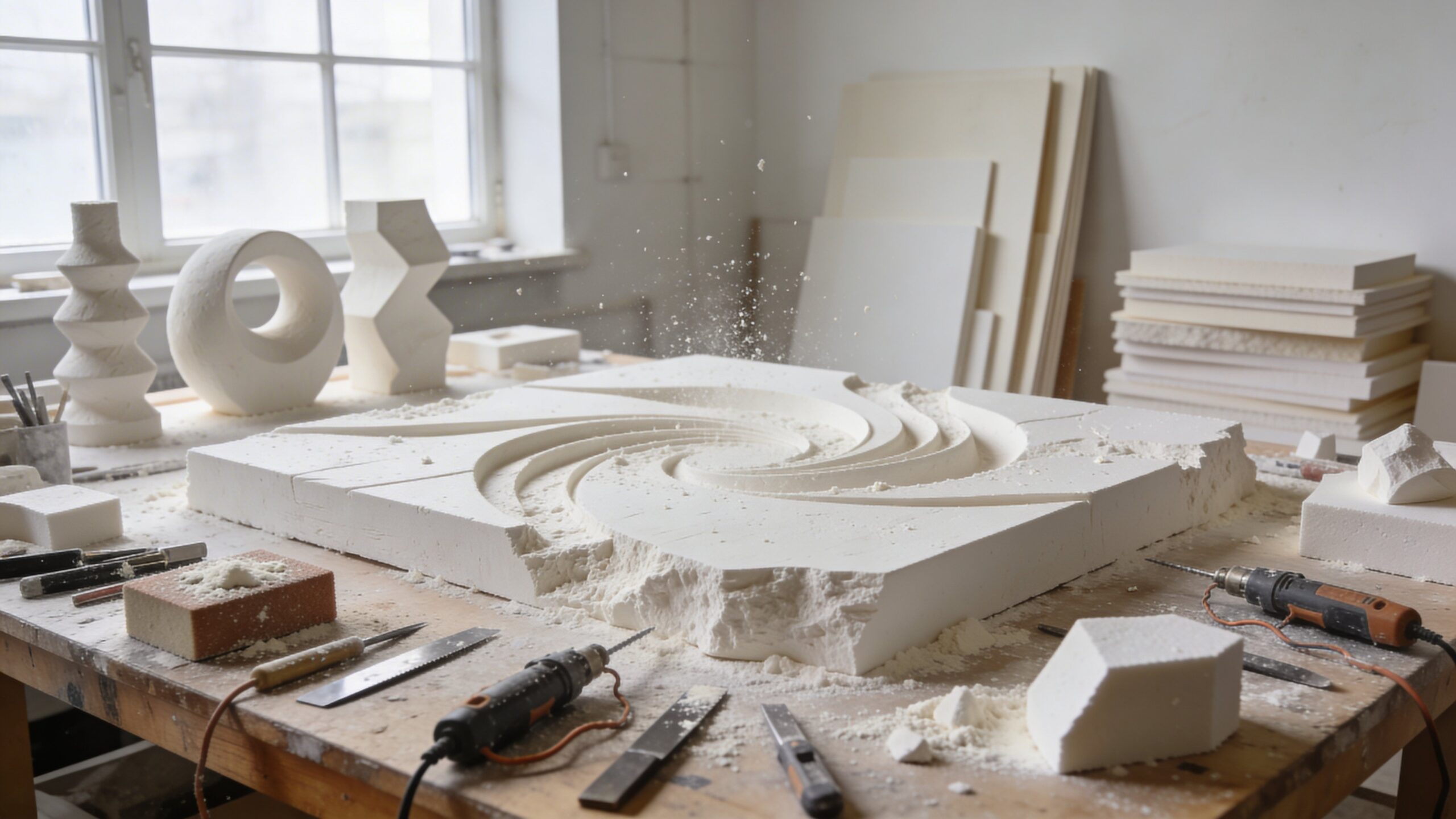
Foam is everywhere. It clings to the top of a cappuccino, cushions your furniture, insulates buildings, cleans your dishes, and even plays a role in industrial chemistry and environmental science. Yet despite how familiar it feels, foam is one of the most fascinating and complex structures studied in chemistry. It sits at the intersection of physics, materials science, and colloid chemistry, defying simple definitions while revealing deep insights into how matter behaves at interfaces. To understand foam is to understand how gases, liquids, and solids interact in beautifully unstable balance.
A: Foam is a colloidal system combining properties of all three.
A: Drainage, gas diffusion, and film rupture destabilize them.
A: Surfactants, viscosity, and elastic films.
A: No, solid foams can be long-lasting.
A: Higher temperatures usually reduce stability.
A: The growth of large bubbles at the expense of small ones.
A: Yes, from insulation to firefighting.
A: It reveals how interfaces control material behavior.
A: A bubble is a single unit; foam is a collective system.
A: Yes, especially in water treatment and material design.
Defining Foam in Chemical Terms
In chemistry, foam is defined as a colloidal system in which gas bubbles are dispersed throughout a continuous liquid or solid phase. Unlike a simple gas trapped in a container, foam consists of millions of microscopic bubbles, each separated by thin films of liquid or solid material. These films form a complex network that gives foam its structure, elasticity, and surprising strength.
What makes foam chemically distinct is its reliance on interfaces. Each bubble creates a boundary between gas and liquid or gas and solid, and it is these boundaries that govern foam’s behavior. The chemistry of foam is therefore the chemistry of surfaces, where molecules behave differently than they do in bulk materials. Surface tension, intermolecular forces, and molecular orientation all play central roles in foam formation and stability.
Foam as a Colloid
Foam belongs to a broader class of materials called colloids. A colloid is a mixture in which one substance is dispersed evenly throughout another at a microscopic scale without fully dissolving. In foams, the dispersed phase is gas, while the continuous phase is either liquid or solid. This places foam alongside emulsions, gels, and aerosols as a key category of soft matter in chemistry. The colloidal nature of foam explains why it behaves neither like a pure liquid nor like a solid. Foams can flow, deform, compress, and rebound depending on their composition and structure. From shaving cream to polymer insulation, these properties arise from how gas bubbles interact with the surrounding material and with each other.
Bubbles: The Fundamental Building Blocks
At the heart of every foam are bubbles. A bubble is a pocket of gas surrounded by a thin film of liquid or solid. In isolation, a bubble is inherently unstable because surface tension forces the surrounding film to shrink, reducing surface area. This is why a single soap bubble eventually collapses. Foam, however, is not made of isolated bubbles but of tightly packed ones that support each other.
When bubbles pack together, their spherical shapes deform into polyhedral structures. This geometric rearrangement minimizes total surface energy and allows the foam to exist temporarily or, in some cases, for years. The geometry of these bubbles has fascinated scientists for centuries, leading to mathematical rules about how bubbles meet, how edges form, and how films intersect at precise angles dictated by energy minimization.
The Role of Surface Tension
Surface tension is one of the most important forces in foam chemistry. It arises because molecules at a surface experience different intermolecular forces than molecules in the bulk. In liquids, molecules at the surface are pulled inward by neighboring molecules, creating a tension that resists surface expansion.
For foam to form, surface tension must be reduced. This is where surfactants come into play. Surfactants are molecules with two distinct parts: one that is attracted to water and one that repels it. When added to a liquid, surfactants migrate to the surface and align themselves in a way that lowers surface tension. This allows bubbles to form more easily and prevents them from collapsing immediately.
Surfactants and Foam Stability
Surfactants are essential to almost all foams encountered in everyday life. Soap, detergent, proteins, and synthetic polymers can all act as surfactants. By stabilizing the thin liquid films around bubbles, surfactants slow down processes that would otherwise destroy foam, such as liquid drainage and bubble merging. In chemical terms, surfactants stabilize foam by creating a balance of forces. They reduce surface tension, increase film elasticity, and sometimes introduce electrical charges that cause bubbles to repel each other. This delicate equilibrium determines whether a foam lasts for seconds, minutes, or years.
Liquid Foams vs Solid Foams
Foams can be broadly classified into liquid foams and solid foams. Liquid foams, such as whipped cream or soap suds, consist of gas bubbles dispersed in a liquid matrix. These foams are usually temporary and evolve continuously as gravity causes liquid to drain and bubbles to merge or collapse.
Solid foams, on the other hand, form when the continuous phase solidifies around the gas bubbles. Examples include polymer foams, metal foams, and ceramic foams. In these materials, the bubble structure is “frozen” in place, giving rise to lightweight solids with unique mechanical, thermal, and acoustic properties.
Drainage and Foam Aging
Foam is inherently unstable, and its evolution over time is a major focus of foam chemistry. One key process is drainage, in which gravity pulls liquid downward through the network of films and channels between bubbles. As liquid drains away, films become thinner and more prone to rupture.
Another important process is coarsening, also known as Ostwald ripening. In this phenomenon, smaller bubbles shrink while larger bubbles grow due to differences in internal pressure. Gas diffuses from high-pressure small bubbles into lower-pressure large ones, gradually reducing the number of bubbles and changing the foam’s structure.
The Science of Foam Rupture
Eventually, most foams collapse. Film rupture occurs when a thin liquid layer becomes too thin to withstand thermal fluctuations or mechanical stress. At the molecular level, this is a battle between attractive forces that hold the film together and disruptive forces that tear it apart. Understanding foam rupture is critical in industries where foam is either desired or unwanted. In firefighting, stable foams are essential for smothering flames. In industrial reactors, uncontrolled foam can cause dangerous overflows. Chemistry provides the tools to tune foam behavior by adjusting surfactant composition, viscosity, and environmental conditions.
Foam in Polymer Chemistry
In polymer chemistry, foam plays a central role in creating lightweight, high-performance materials. Polymer foams are produced by introducing a blowing agent that releases gas during polymerization or curing. As the polymer solidifies, gas bubbles become trapped, forming a cellular structure.
The chemical composition of the polymer, the rate of gas release, and the curing conditions all influence foam properties such as density, stiffness, and thermal insulation. From packaging materials to construction insulation and cushioning, polymer foams are engineered at the molecular level to meet specific performance goals.
Metal and Ceramic Foams
Foam chemistry extends beyond soft materials into metals and ceramics. Metal foams are created by injecting gas into molten metal or by using chemical reactions that release gas during solidification. The result is a rigid, lightweight structure with high strength-to-weight ratio and excellent energy absorption.
Ceramic foams are formed using similar principles but with inorganic materials. These foams are highly resistant to heat and corrosion, making them valuable in filtration, catalysis, and thermal insulation. In all cases, the fundamental chemistry of gas dispersion and interface stabilization remains the same.
Biological Foams
Foam is not limited to synthetic systems. Biology offers striking examples of natural foams, from sea foam stabilized by organic molecules to protective foams produced by insects and amphibians. These biological foams often rely on proteins and lipids as surfactants, creating highly stable structures under harsh conditions. Studying biological foams has inspired new materials and applications. The chemistry behind these systems demonstrates how nature exploits colloidal principles to create functional, adaptive structures using minimal resources.
Foam in Food Science
Food chemistry is another domain where foam plays a starring role. Whipped cream, meringue, bread, and ice cream all rely on controlled foam formation. In these systems, proteins act as surfactants, stabilizing air bubbles during mixing, heating, or freezing.
The stability and texture of food foams depend on molecular interactions between proteins, fats, and water. Understanding these interactions allows food scientists to manipulate flavor release, mouthfeel, and shelf life through precise chemical control of foam structure.
Environmental and Industrial Implications
Foam chemistry also has important environmental and industrial implications. In wastewater treatment, foams can interfere with processing and require chemical control. In oil recovery, foam is sometimes injected into reservoirs to improve extraction efficiency. Firefighting foams, meanwhile, must balance performance with environmental safety.
The chemistry behind these applications involves not only foam formation but also foam suppression. Antifoaming agents work by disrupting film stability, either by changing surface tension locally or by introducing substances that puncture bubble walls.
Mathematical and Physical Models of Foam
Beyond chemistry, foam has inspired extensive theoretical work in physics and mathematics. Models describe how bubbles pack, how forces distribute across films, and how structures evolve over time. These models rely on chemical principles such as surface energy minimization and molecular interactions. Foam thus serves as a bridge between abstract theory and tangible material behavior. It offers a rare opportunity to observe complex systems where simple chemical rules give rise to intricate, dynamic patterns.
Why Foam Matters in Chemistry
Foam may appear simple, even playful, but it represents one of the most elegant manifestations of chemical principles in action. It shows how molecular forces shape macroscopic materials, how interfaces govern stability, and how energy minimization drives structure.
By studying foam, chemists gain insights into colloidal systems, material design, and surface chemistry. These insights, in turn, inform technologies ranging from everyday consumer products to advanced industrial processes.
Foam as a Gateway to Soft Matter Science
Foam occupies a central place in the broader field of soft matter science, which explores materials that are easily deformed and dominated by thermal and surface effects. Alongside gels, emulsions, and biological tissues, foam reveals how chemistry operates in systems that are neither rigid solids nor simple fluids. Understanding foam helps chemists and materials scientists design smarter, lighter, and more sustainable materials. It also deepens our appreciation for the hidden complexity of substances we encounter every day.
Conclusion: The Chemistry Behind the Bubbles
Foam is far more than trapped air. It is a dynamic, intricate system governed by the principles of colloid chemistry, surface tension, and molecular interaction. From liquid foams that vanish in moments to solid foams that last decades, these materials embody the delicate balance between stability and change. By exploring foam in chemistry, we uncover the science behind bubbles, the power of interfaces, and the remarkable ways matter organizes itself. What begins as a simple froth ultimately reveals a rich landscape of chemistry, physics, and material innovation—proof that even the lightest structures can carry deep scientific weight.