
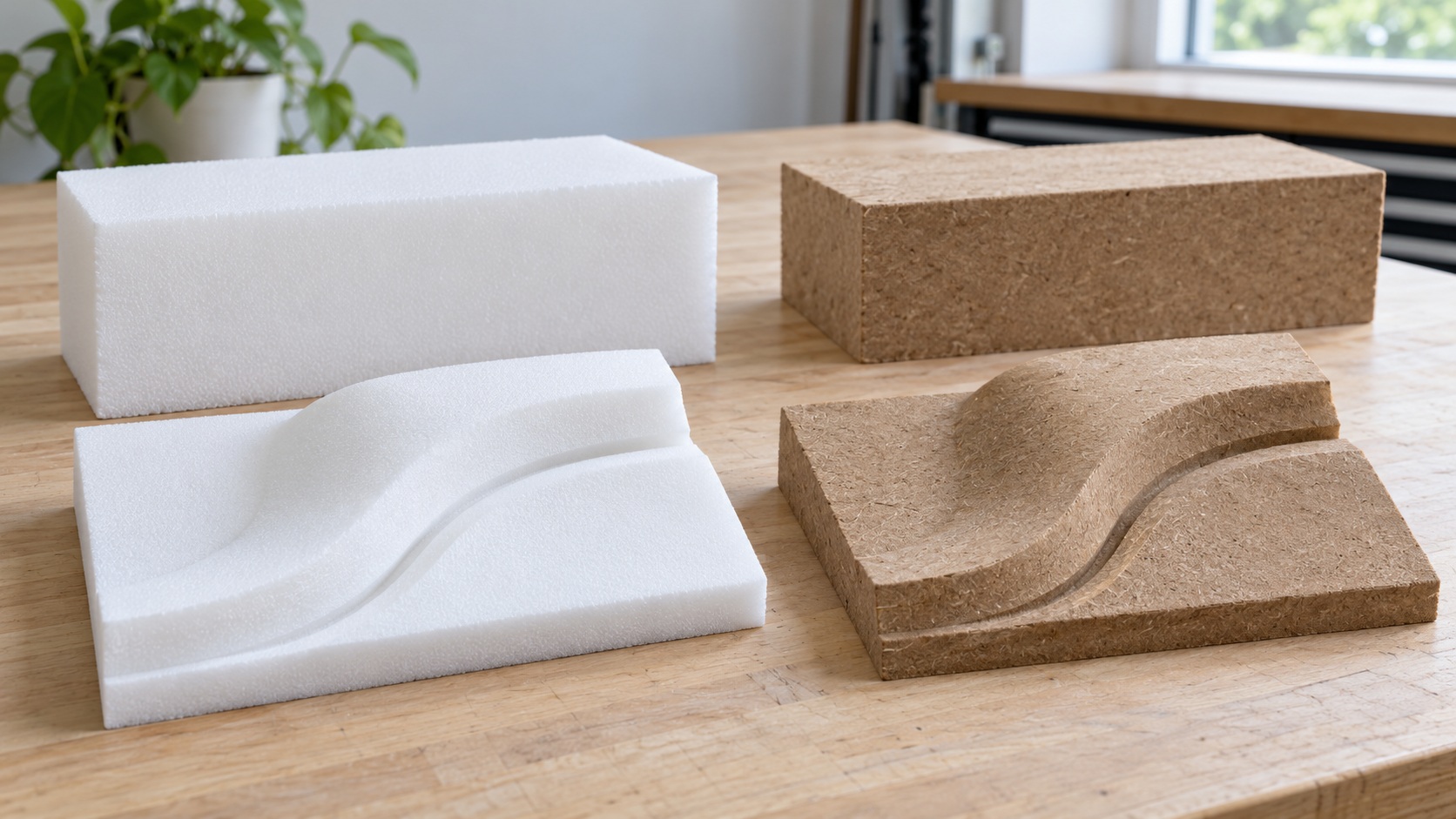
Compare Two Finished Sculptures, Not Two Material Labels
Foam and wood-fiber panels can both supply shape for a sculpture, but the comparison is rarely a simple choice between plastic and nature. Each category contains products with different densities, binders, surface structures, and intended uses. A soft wood-fiber insulation board is not the same thing as dense machining board, and a bead-foam block is not interchangeable with every fine-cell carving stock. The relevant question is which identified material system produces the required artwork with acceptable processing, support, finish, service life, and end-of-life options. Compare equivalent outcomes before making an environmental claim. A promising panel may be excellent for a shallow relief and awkward for a deep freestanding form, while a lightweight foam solution may require added layers that change its apparent advantage.
A: No. Intended use, density, composition, and supported processing vary.
A: No. Assess the actual cutting and sanding operations and their controls.
A: Compare equivalent finished geometry; starting stock requirements may differ.
A: Use actual grades and complete-system measurements rather than a universal category claim.
A: No. Its product scope and declared unit need interpretation for the finished function.
A: Not reliably without compatible methods, boundaries, units, and function.
A: No. Identify its composition and confirm a valid receiving route.
A: Yes. Its source, condition, avoided purchase, and realistic next use belong in the assessment.
A: Service and maintenance can change the material and labor needed over the object's life.
A: No. Explain which identified system best meets this artwork's actual requirements.
Define the Wood-Fiber Product First
Wood fiber describes an ingredient and manufacturing family, not one carving behavior. Panels may be designed for insulation, sheathing, underlay, furniture, or other uses. Density, binder, waxes, surface treatment, and fiber structure can vary. Ask the manufacturer what processing is supported and obtain the current technical and safety information. Do not infer a sculptural specification from a photograph of a brown board.
For instance, STEICO publishes technical information for its protect dry wood-fiber insulation boards that includes cutting, storage, and handling guidance for that product. Such a sheet identifies a real board and its intended context. It does not automatically establish that the board is suitable for every carved face, thin ornament, or public sculptural assembly.
Apply the same discipline to foam. Record polymer, grade, density where provided, facings, and the actual supplier reference. A comparison between unidentified leftover foam and a fully documented panel mixes material behavior with procurement quality. If reclaimed stock is part of the proposal, make its condition and uncertainty explicit. Reuse may be valuable, but it changes what is known about the starting material.
A useful supplier question is whether the board can retain the particular detail the artist intends, rather than whether it can be cut at all. Building instructions for straight sizing do not necessarily address sculptural undercuts or repeated abrasion. Send a small drawing or representative profile and ask which published information is relevant.
Keep product changes visible during procurement. If the specified stock is unavailable, a replacement with a similar name or thickness should return to the comparison process. Otherwise the project can finish with a different board from the one that justified its carving method, weight estimate, or environmental explanation. That is a design change, not merely a purchasing detail.
Let Geometry Expose the Practical Difference
A broad shallow relief can often begin close to its final thickness. A large freestanding figure may require stacked layers, a deep block, cavities, or a separate support. Draw the material volume required by each approach. A panel-based construction can create many seams when the shape is deep; a block-based construction can produce substantial removed material when the final object is thin. Neither starting format is efficient in every geometry.
Compare the difficult regions: a narrow nose, a deep concavity, a thin rim, or a long projection. These features may determine the material choice more strongly than the broad torso. A product that shapes quickly across a large plane can still be poor at retaining a fragile edge. Rather than averaging the sculpture into one general hardness requirement, identify the details that cannot be compromised.
Make the Same Small Relief in Both Materials
Use a common design containing a broad curve, an inside corner, a thin edge, and a shallow groove. Match the finished geometry rather than merely giving the samples equal starting dimensions. Select appropriate tools and controls for each identified product. Do not penalize one material by forcing it through a technique suited only to the other. The trial should represent a realistic workflow in the actual shop.
Record the surface before finishing. Does the edge remain coherent? Do fibers pull, cells tear, or the tool compress the surface ahead of removal? What is the smallest detail that remains useful at the intended viewing distance? These are observations to make on the chosen stock, not universal conclusions about all wood or all plastic. Keep photographs and the actual specimens for comparison.
Track time by operation. Rough shaping, detail work, cleanup, filling, priming, and final finishing can favor different systems. A board that takes longer to carve might require less later correction; another might shape quickly but need a substantial skin. The cost of the material alone cannot reveal that difference. Include equipment setup and any support work that would be needed on the full sculpture.
Do not confuse a preferred surface with a technically superior one. Some artworks benefit from visible fiber texture, while others need a continuous smooth finish. An expressive cellular edge can also be intentional. Let the design choose the acceptable surface, then compare how each material reaches it. A trial that requires both to imitate polished stone may exclude qualities the artist actually wants.
Mass, Support, and Transport Belong Together
Weigh representative finished specimens and estimate the full construction through an appropriate method. Include adhesive, armature, backing, skin, paint, and mounting hardware. Avoid declaring a universal weight ratio between broad material categories. The actual grade and geometry matter, and removing material or changing the assembly can change the outcome. A finished-system estimate is more useful than comparing two nominal densities in isolation.
Handling can determine whether the weight difference matters. A small protected wall relief may be manageable in either system. A large touring piece may need different crates, equipment, or crew arrangements as mass and dimensions change. Compare the route through doors and vehicles as well as the display position. Lower mass can be useful without proving that every other property is favorable.
Neither an insulation board nor a carving foam should inherit structural duties beyond the designed assembly. Attachments, suspension, stability, and foreseeable public contact need appropriate review. Do not convert a product’s compression figure into a general permission to make a beam or a lifting point. The support system may be independent of the sculpted material, and that division should remain clear in the drawings.
Processing Controls Do Not Vanish With a Natural Feedstock
Cutting or sanding wood-fiber products can create airborne wood dust. OSHA’s wood-dust overview identifies health concerns associated with exposure. Product binders and additives also belong in the task assessment. Do not assume a renewable feedstock means that an uncontained sanding operation is acceptable. Obtain suitable collection, equipment, training, and personal protection through the actual product and process review.
Foam processing has its own questions about particles, thermal methods, adhesives, and finishes. Compare the two proposed workflows rather than calling one dusty and the other clean in the abstract. A cold shaping process and a hot-wire operation are different tasks. Choosing one material may remove a particular operation while introducing another, so examine the whole production plan.
Housekeeping also affects material efficiency. Uncontrolled debris can contaminate clean offcuts and neighboring surfaces, reducing reuse options. Keep suitable stock identified and separate from coating or adhesive waste. Plan collection during processing rather than after the entire room is involved. A well-managed trial can reveal how the shop would handle the full job and whether a proposed substitution actually fits its facilities.
Review tooling needs honestly. If a panel requires equipment the studio does not have, include outside machining or another suitable service in the comparison. Do not improvise a hazardous technique simply to avoid that cost. Conversely, do not assume a familiar foam tool is appropriate for a denser fibrous product. A material substitution may be feasible only when the processing arrangement changes with it.
Moisture and Finish Need Product-Level Evidence
The USDA Forest Products Laboratory’s Wood Handbook provides background on wood-based materials and moisture-related behavior. For a particular panel, use its own technical guidance to evaluate storage, conditioning, surface treatment, and exposure. General wood knowledge is useful context, but a manufactured board’s composition and intended installation still matter.
Test the proposed finish on both systems. Include edges and seams, allow the prescribed development, and examine appearance and adhesion through an appropriate method. A fiber-containing board may need a different preparation from a cellular foam, and the amount of preparation becomes part of the comparison. Do not assume that one common topcoat makes the underlying systems equivalent or establishes exterior service life for either.
Read Environmental Declarations Within Their Boundary
An environmental product declaration supplies structured information about a defined product and scope. STEICO’s declaration for a named wood-fiber product range is an example of evidence to examine rather than a general award declaring every wood-fiber sculpture better. Check the covered products, dates, declared unit, life-cycle modules, and assumptions before using figures.
Comparable declarations need compatible boundaries and a comparison appropriate to the intended function. A figure per unit volume of board may not describe the amount needed for the finished sculpture. Additional support, finish, processing waste, service duration, and transport can change the relevant system. Do not copy the most favorable number from one document and compare it with an unrelated value for a broad foam category.
Biogenic carbon needs careful interpretation too. A product containing wood can include carbon-accounting information, but that is not permission to describe an arbitrary artwork as permanently carbon negative. Avoid making a formal comparative claim without an appropriate method and evidence. If that analysis is beyond the project, report the verified material attributes and limits instead of inventing a simple environmental score.
Consider Reuse and Disposal Before Bonding
A reusable foam core already in stock may compete differently with a new panel than a fresh purchase would. Conversely, a panel format may let the artist make a relief from fewer layers or preserve more useful offcuts. Record the actual source and likely next use. Recycled or renewable content is one attribute, not a complete account of the finished object’s material efficiency.
Ask receivers about the actual retired construction. A wood-containing board with binders, paint, and attachments should not be assumed compostable, and a foam-based composite should not be assumed accepted by a packaging recycler. Keep clean production offcuts separate where that preserves a verified route. Design removable backing or hardware where practical without compromising the assessed assembly.
Maintenance affects the comparison over time. A surface that can be renewed locally may extend useful service; one that requires stripping or wholesale replacement may have a different cost and material demand. Test a repair on the retained specimen and record how it changes appearance. Compare realistic use periods rather than assuming both materials remain perfect indefinitely.
Finally, explain the choice in project terms. A wood-fiber panel may suit a shallow indoor relief because its texture and sheet format support the design. A foam system may suit a large volume because the complete construction meets handling and surface requirements. Neither explanation needs an absolute winner. A transparent comparison is more informative than giving one material a green identity and treating all remaining questions as settled.
Choose the Better Fit for This Form
Compare identified products through equal finished geometry, suitable processing, complete-system mass, and realistic service. Support environmental claims with matching evidence, and keep the practical limits of both materials visible.


