One Material Family Can Support Several Ways of Thinking
Foam’s creative versatility is not the ability of one miracle block to do everything. It comes from a family of materials and processes that can support very different sculptural decisions: removing volume, joining sheets, assembling existing shapes, building beneath a skin, or allowing a reactive material to develop a form. Each route makes some possibilities easier and imposes limits on others. For a sculptor, that variety can loosen the link between an imagined object and one conventional fabrication method. A draped-looking form need not be fabric, a massive-looking volume need not be solid, and a packaging contour can become a new subject. The useful freedom is the capacity to choose a relationship among form, process, and meaning, not an exemption from material behavior.
A: No. Different products and processes offer distinct behaviors and limits.
A: No. Those marks can be part of the intended visual language.
A: Its placement and visibility can organize rhythm, planes, and the reading of construction.
A: The inherited shape can become an active formal element with a recognizable prior history.
A: No. Their source matters, but the sculpture can explore many concerns.
A: It documents a sustained expressive practice using painted polyurethane forms, not a universal foam aesthetic.
A: No. Selection, constraints, placement, and later decisions still shape the work.
A: No. Technical use and exposure controls require appropriate current product information.
A: Not always; scale changes visual emphasis, physical consequences, and the viewer's encounter.
A: No. They are original AI editorial concepts demonstrating distinct methods.
Let the Question Select the Process
Consider how many different questions could lie behind a similar outline. One sculptor may want a precise silhouette, another the evidence of assembly, and another an apparent accumulation that resists a perfectly planned boundary. These aims point toward different ways of using foam. A carved block may offer continuity, while a sheet-built form can make seams and planes active. The decision is aesthetic as well as technical. Selecting a process only because it is familiar can conceal another route whose visible logic better serves the work.
Material categories should stay clear during that choice. Rigid polystyrene, flexible polyurethane cushioning, closed-cell sheet, and a reactive expanding system do not share one set of working instructions. Their differences are part of the creative vocabulary rather than annoying exceptions to it. Specify what behavior the idea needs before choosing a product. A form that must yield, a form that must retain a sharp edge, and a form that should appear to have flowed may require different materials even if they are all described loosely as foam sculpture.
Carving Gives Volume a Continuous Exterior
Subtractive work starts with more material than the final shape requires. It allows the sculptor to search for transitions across a continuous mass, including the relation between broad planes and small interruptions. A suitable foam can make substantial changes manageable without the weight of an equivalent solid mineral block. That does not make every cut reversible. Removing a supporting bridge or narrowing a projection can alter both appearance and integrity, and a later patch may leave a seam that requires its own visual decision.
The surface can retain evidence of carving or receive another treatment. Tool marks, bead texture, and cut facets may contribute to the work’s character rather than being defects that must always disappear. A smooth finish is one option, not the definition of completion. Decide whether the viewer should recognize a worked cellular material, read the form as another substance, or remain uncertain about it. Each intention changes which transitions deserve emphasis and which traces of fabrication should remain legible.
Detail has a scale relationship to the stock. An intricate edge may demand a different grade or a separate component rather than greater force applied to an unsuitable core. That limitation can be productive. It can lead to a broader silhouette, an intentionally simplified feature, or a contrast between coarse and fine elements. The creative choice is not always to defeat the material’s visible structure. Sometimes the more convincing object gives that structure an explicit role and uses its resolution as part of the visual language.
A carved volume can also be a stage rather than the final material. It may become a study, a pattern, or a core beneath another surface. Those roles permit a sculptor to separate development of form from the demands of a later process. They should not be confused when discussing the finished work: a form developed in foam is not necessarily a foam object in service. The distinction helps explain versatility without attributing every property of the final surface to the material used for an earlier model.
Sheets Turn Flat Decisions into Spatial Ones
Sheet construction begins with outlines, thickness, and relationships between edges. It can make a plane curve, surround an opening, or intersect another plane without requiring a large solid blank. The seam becomes a compositional feature. A join can be concealed to suggest continuity, emphasized as a rhythm, or arranged to divide the object into visibly different regions. That is a distinct sculptural language from carving, even when the two processes eventually produce similar external silhouettes.
Thickness affects the reading of a sheet-built object. An edge can reveal the material honestly, exaggerate a sense of solidity, or disappear behind another element. Repetition can make several simple parts produce a complex spatial effect. Negative space becomes especially important because the viewer sees through and around the assembly rather than only across its exterior. A small rotation of one component can change the relationships among several others without requiring each piece to be remade.
Assembly also introduces a possibility for separable or replaceable elements, but only if the connection and intended use permit it. A glued construction may be less reversible than it initially appears. Think of a seam as both an aesthetic decision and a real interface with mechanical limits. The work can acknowledge that interface rather than hide it under ever more finish. This can preserve a sense of constructedness that would be lost if every assembled form were forced to imitate an uninterrupted carved mass.
Existing Shapes Can Offer More Than Convenient Stock
A molded packaging piece already contains a design history: hollows, ribs, recesses, and protective contours originally organized around another object. Reusing that shape can mean accepting parts of its inherited geometry rather than treating it as a blank to erase. Turned, repeated, or combined, an industrial detail can become unfamiliar. The artistic act lies in those relationships and transformations, not merely in replacing a purchase with a discarded material. The source can remain recognizable or become difficult to identify.
Michael Salter’s large robot constructions provide a documented example. The University of Oregon’s account of his 2013 UCCS exhibition reports that the gallery collected donated Styrofoam packing material for the project. Its discussion connects his practice with visual culture, information, and familiar imagery. That establishes a real material source in a particular work, unlike an unsupported assumption that any white sculptural foam must have been rescued from packaging. It also shows how an available shape vocabulary can participate in an identifiable artistic practice.
The university’s exhibition account should not be turned into a universal recipe for assembling large objects. Scale, supports, and connections still require an appropriate design. The relevant artistic lesson is more specific: manufactured remnants can act as formal propositions, not just cheap filler. A repeated recess or angular shell can invite a visual association while preserving the tension between the object’s prior function and its new identity within a sculptural arrangement.
Reuse does not have to remain the only subject of such work. An object assembled from recovered components might address technology, humor, the body, or another concern. Conversely, material origin can be central and deserve clear documentation. Avoid deciding the meaning from the waste category before examining the work. A sculptor has more freedom when the source is acknowledged accurately and then interpreted through the actual arrangement, rather than being confined to a single environmental message every time recovered stock appears.
Expansion Can Introduce an Event into the Form
Reactive foam offers another kind of authorship. Instead of defining every boundary by cutting, the maker works with a process that develops over time. The emerging mass can register flow, expansion, gravity, and the limits of its support. This is not the same as having no control. Product choice, placement, constraints, and subsequent decisions all matter. The interesting question is which aspects of formation the artist determines in advance and which are allowed to become part of the result through the material’s behavior.
Dan Lam’s own artist biography describes painted polyurethane-foam sculptures whose dripping and spiked forms negotiate attraction and repulsion, with inspiration from nature and the human body. That is a specific expressive use, not evidence that foam must always look soft, organic, or brightly colored. Her practice demonstrates how a material choice can become a sustained language through form and surface. Another sculptor can learn from that relationship without copying its recognizable appearance.
Descriptions of an artist’s process are not handling instructions. Reactive systems need product-specific technical information, suitable facilities, and exposure controls. OSHA’s isocyanate guidance is relevant to polyurethane ingredients and some coatings. An artistic interest in chance does not require improvising chemical conditions or reproducing someone else’s demonstration without assessment. Unpredictability can be a formal strategy within an appropriately controlled process; it should not become an excuse for uncertainty about the substances and exposures involved.
A Surface Can Reveal or Contradict the Core
The relationship between interior and exterior is an especially fertile choice. A cellular core can support an image of stone, polished metal, skin, food, or an invented substance. Alternatively, a thin transparent or incomplete treatment can keep the core’s identity visible. Neither approach is inherently more honest or accomplished. What matters is whether the relationship serves the sculpture’s proposition. A deliberate contradiction can be compelling, while an unintended mismatch may distract from an otherwise precise formal idea.
Test the visual decision on a representative sample rather than assuming that more finish creates more meaning. Added layers can soften an edge, fill a texture, change flexibility, or alter how light describes a volume. They can also introduce different maintenance and environmental consequences. A sample should help the sculptor see those tradeoffs as part of authorship, not only as troubleshooting. The best finish may be the one that preserves an essential material behavior instead of maximizing gloss, hardness, or the impression of expense.
Change Scale Without Losing the Sculpture’s Logic
A foam study can help a sculptor explore size, but enlargement is not just multiplication. An opening that is a small visual detail can become a place a viewer looks through. A shallow texture can disappear at distance, while a modest projection can become physically consequential. Evaluate the intended encounter from several positions rather than relying on a close photograph of the model. The larger object may need a revised distribution of emphasis to maintain the relationship that made the small version convincing.
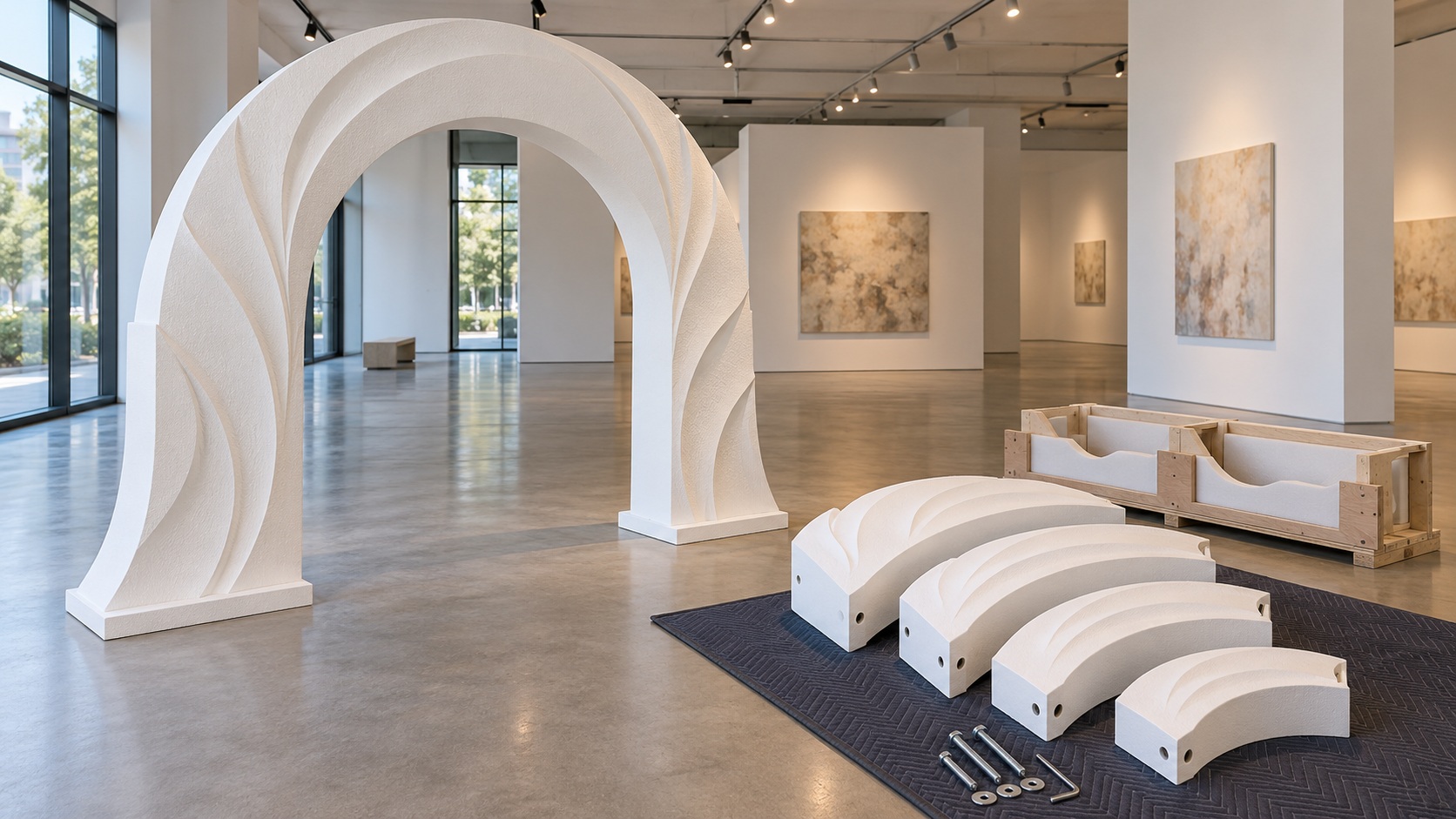
Modular construction can preserve a large gesture while keeping individual components manageable. The divisions may be hidden or become a visible rhythm. Either way, they introduce alignment and connection decisions that belong to the sculpture rather than an unrelated fabrication stage. A seam placed for transport can interrupt a crucial visual passage, while a thoughtfully located division can strengthen the form. Consider the object as both a whole and a sequence of parts that must be made, moved, and assembled.
The final material choice may change during that development. Foam can remain the work, become an internal component, or be replaced by another medium after the study has answered its question. This flexibility is useful only when those roles stay clear. A fragile study cannot validate a public installation, and a protective shell can alter the expression that originally motivated the core. Keep reviewing the artistic purpose as technical requirements become more specific, rather than assuming the first appealing model has settled every later decision.
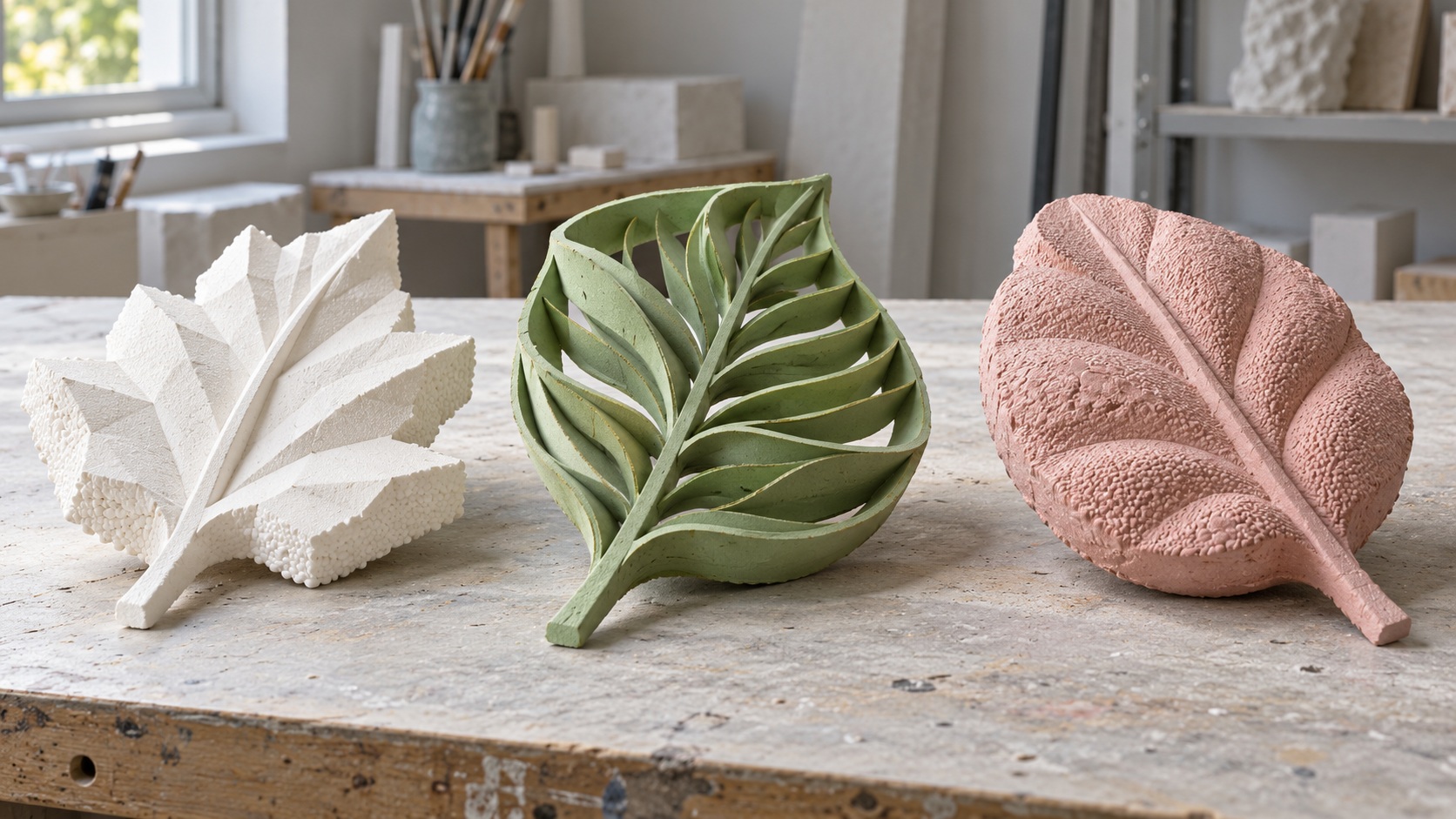
The accompanying image is an AI-generated editorial concept of three original studies using a common leaf motif through carving, layered-sheet assembly, and a textured surface. It is not a reproduction of Lam’s or Salter’s work and does not document a historical studio. Its purpose is to illustrate differences in formal method. The named artists’ actual practices are supported by the linked records, while these generic examples leave room for a sculptor to develop a distinct visual language instead of borrowing a recognizable signature.
Versatility Becomes Freedom Through Deliberate Choice
Foam offers several routes from an idea to a volume, each with a different relationship to control, surface, and structure. Creative freedom grows when a sculptor understands those differences well enough to select, combine, or reject them in service of the work.