A Seating Research Material Acquired an Artistic Afterlife
Memory foam’s connection to NASA is real, but its sculptural legacy needs a more precise explanation than a space-age origin slogan. The material emerged from research into aircraft seating, then developed through commercial products and applications far beyond that initial task. Artists could encounter it as a manufactured cushioning material whose response to contact differed from a rigid carving block. Its temporary impressions offered a particularly suggestive relationship between physical behavior and the language of memory. That relationship is not evidence that NASA designed it for art, or that every soft sculpture uses memory foam. The interesting history lies in the transfer: a material developed around bodily loading became available for objects, encounters, and interpretations that its original research brief did not prescribe.
A: The documented origin is aircraft-seat research, followed by commercial development and other uses.
A: No. Material transfer and adoption of the original complete system are separate questions.
A: Its characteristic temporary depression is a physical response, not a permanent stored record.
A: Shirley Tse discusses that contrast directly in her November 2002 artist statement.
A: No. These records support particular developments and uses, not a universal artistic first.
A: No. Grade, conditions, and the complete assembly affect behavior.
A: Moving images can preserve a duration that a single photograph cannot explain.
A: Not solely on category similarity; the work's technical and conservation evidence must guide the decision.
A: No. Body-support and circulation functions require review of the actual complete design.
A: Nothing historical; it is an explicitly labeled editorial concept illustrating a possible temporary impression.
Put the Aircraft Seat Back into the Origin Story
NASA’s 2005 Spinoff account dates temper foam’s origins to 1966 and describes Charles Yost working through Stencel Aero Engineering Corporation on improved crash and vibration protection for airline seating. Ames Research Center incorporated the material into a seat design. This is an aeronautical research context, not an account of a sculptor requesting a new medium. The material’s unusual response became useful outside that context, but the later diversity of applications should not be projected backward as the original purpose of the research.
The agency’s later reporting also identifies Ames project manager Charles Kubokawa’s involvement. NASA’s 2019 Spinoff volume discusses iterative work on the seat cushion and notes that the seats were not fully integrated into commercial jets. A successful material transfer is therefore not the same thing as universal adoption of its first proposed system. Keeping that distinction visible makes the history more informative: a component can find a large afterlife even when the complete original design does not become standard equipment.
NASA’s institutional role, contractor development, and later manufacturing are all parts of this story. A retail product labeled memory foam is not thereby a NASA-manufactured product, nor is its current formula necessarily identical to the early formulation. The origin explains a research lineage rather than guaranteeing a modern specification. For a museum label or material account, it is more accurate to name the particular product when known and describe the broader lineage separately. A recognizable agency name should not stand in for evidence about the object in front of us.
Commercial Development Changed More Than the Name
Dynamic Systems’ own founder history identifies Yost as a co-inventor of the seating cushions and describes subsequent formulations, including Dynafoam and later cushion materials. Its chronology and NASA’s older summary differ on the date of the company’s establishment. That discrepancy is a reason to avoid making an incorporation date carry the whole narrative. The documented connection is the development and commercialization of a cushioning technology; a precise corporate chronology would require additional records rather than silently choosing whichever summary reads most neatly.
The manufacturer’s account also names the 1969 report Human Survival in Aircraft Emergencies and describes the continuation of research into other cushioning uses. It presents development as a sequence of modifications, not a single formula frozen at the moment of invention. That matters to artists because a family history can explain why products are related while leaving their actual handling properties different. A later cushion cannot be substituted for an earlier artwork component solely because both share an origin narrative.
Commercial naming can blur those distinctions. Memory foam is widely used as a category description, while particular products have their own formulations and performance information. A mattress layer, a specialist cushion, and a sample exhibited for its tactile character may have very different construction details. Their thickness, covering, support beneath, and intended duty also differ. The sculptural question is not whether each qualifies for a space-age label. It is what a specified material does within a specified object and what the maker wants that behavior to communicate.
This is why a material history should preserve mundane information such as supplier names, batch records, and dated technical sheets when they survive. They can establish a more useful connection than a broad origin claim. A sample kept with a work may help future examination, provided its storage and relationship to the installed component are recorded. None of those records replaces the artist’s account of meaning, but together they allow later researchers to distinguish a change in formulation from a change in artistic intention.
The Impression Is a Physical Event, Not Digital Storage
The word memory is metaphorical here. A visible depression after loading does not contain a stored narrative or a permanent recording of a person. It is a temporary material response. In an artwork, that response can nevertheless become meaningful: an absent hand or body can remain perceptible for a while, then disappear. The association with recollection comes from the encounter between an observable trace and a viewer’s interpretation. Confusing the metaphor with a technical description makes both the science and the art less interesting.
Slow recovery also introduces time into an object that might otherwise be understood as a static shape. A participant can leave before the surface has returned, and a subsequent visitor can encounter the remainder of that action. Alternatively, several contacts can overlap before any clear outline is visible. These are possible compositional uses, not a description of every historical installation. They show why a maker might select delayed recovery deliberately rather than regarding it as an unfortunate lack of springiness in an ordinary flexible material.
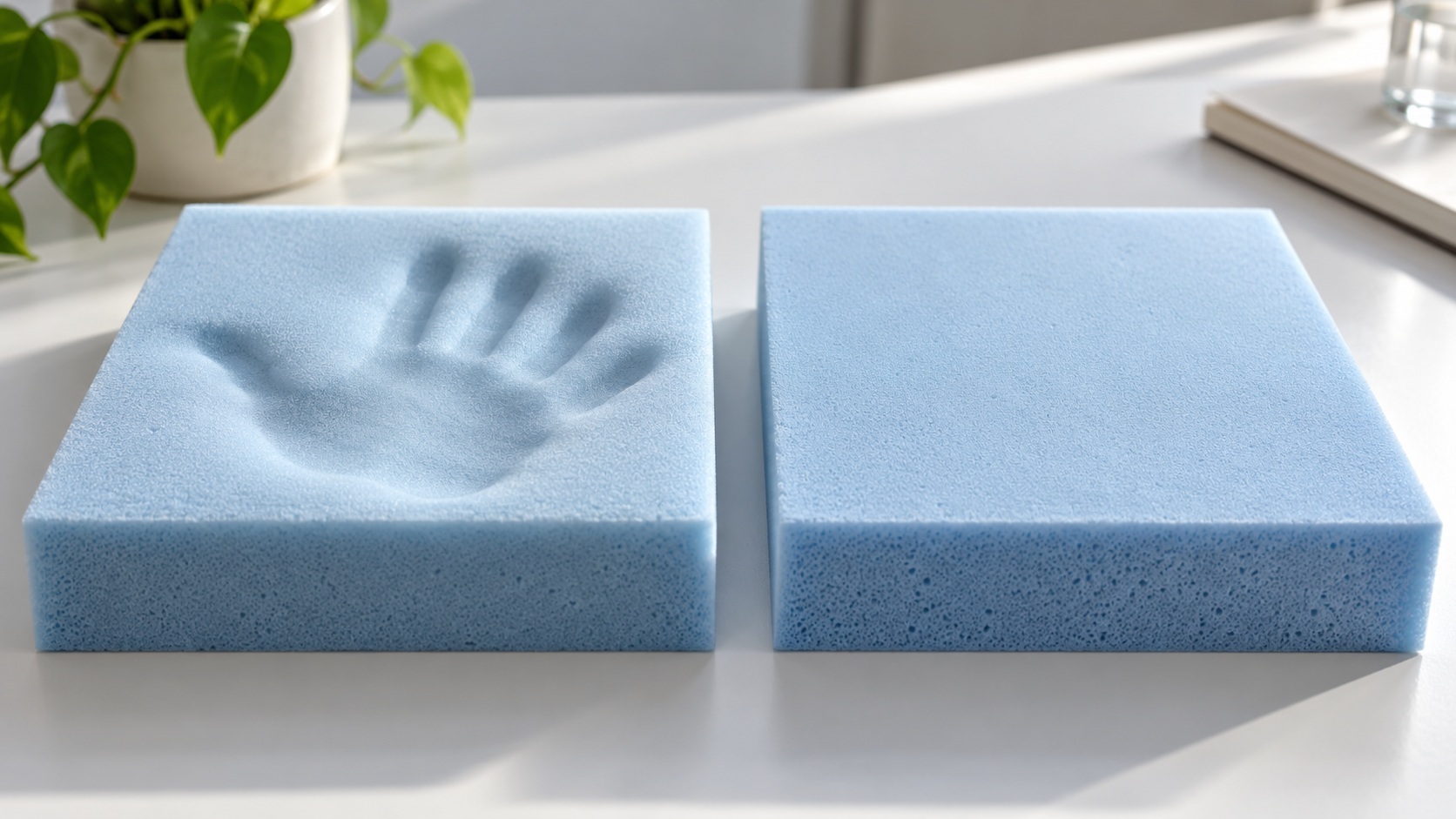
Contrast helps make that behavior legible. A rigid neighboring element can remain unchanged while a yielding area records temporary contact. A cover can make an indentation easier or harder to read, depending on tension, thickness, and its own return. A fixed photograph captures only one stage and may suggest a permanent relief where the encounter was actually changing. Documentation of such a work needs an account of duration and interaction, not just an attractive image of the most recognizable impression.
An Artist’s Statement Connects Temporary Marks to Experience
The Wattis archive provides a direct artistic example in Shirley Tse’s Capp Street Project, presented from November 2002 to January 2003. In her statement, Tse distinguishes lasting impressions on polystyrene platforms from temporary impressions in areas covered with memory foam. She connects visitors’ movement and bodily contact to the work’s exploration of packaging, experience, and memory. This is unusually useful evidence because it identifies both the material contrast and the artist’s conceptual terms rather than asking a later writer to invent the connection.
The archived exhibition page documents one installation, not the first artistic use of memory foam or an endorsement of walking on arbitrary cushioning stock. Its significance here is the deliberate contrast between kinds of marks. Memory foam was not simply a lightweight substitute for a heavier sculptural substance; its temporary response helped organize the visitor’s encounter. That is a concrete artistic afterlife for the material without claiming an uninterrupted line of influence from the aircraft laboratory to this particular project.
Recovery Has Conditions That a Sculpture Cannot Ignore
Viscoelastic foams are not all interchangeable performers. The Polyurethane Foam Association’s technical guidance notes that temperature and testing speed can affect measured behavior. Its discussion of viscoelastic foam also describes humidity effects. These variables matter when comparing samples, but they do not supply one universal recovery time for a gallery piece. The actual grade and assembly need their own evidence. A supplier’s test condition should accompany the resulting number instead of being stripped away to make an appealing promise about an entire category.
For artistic planning, separate a fleeting visible trace from the ability of a material to continue serving its intended role. A depression that disappears attractively after one contact says little about repeated concentrated use, edge damage, or long-term aging. A hypothetical participatory sculpture might need replaceable contact elements while retaining another component as the enduring work. That would be an artistic and technical design decision requiring documentation, not an automatic permission to replace any aging original with a visually similar cushion.
Spatial arrangement changes the encounter as well. A thin layer on a firm substrate can feel and read differently from a thick unsupported mass. A tightly fitted skin can restrict an observable indentation, while a loose cover can create folds that viewers mistake for behavior of the foam beneath. Those are reasons to assess the assembled sample rather than judge the core by a hand squeeze alone. The desired visible duration belongs to the full construction, including how it is supported, covered, and approached.
Temperature-dependent behavior also creates a curatorial question: which conditions belong to the intended presentation? An object conceived for a controlled interior should not be assumed to perform identically in an unconditioned space. Record the conditions in which an interaction was approved and document a meaningful change when it occurs. The goal is not to force every artwork into a laboratory protocol, but to preserve enough context that a later installer can understand why a familiar-looking replacement behaves differently from the recorded encounter.
NASA Lineage Is Neither Exhibition Approval nor a Safety Rating
An association with aerospace research does not qualify a finished art installation for body support, fall protection, public circulation, or fire performance. Each of those functions brings requirements beyond the material’s historical origin. A product may serve a specialist application under defined conditions without making an improvised sculpture suitable for the same duty. In particular, an exhibition involving visitors’ weight needs appropriate design review of the complete construction rather than a claim that the cushioning technology was once developed for impact-related research.
Processing also changes the question. Buying a cured component differs from mixing reactive foam ingredients, adding a coating, or applying heat. Use the actual product information and relevant process controls rather than extrapolating from the comfort of a finished cushion. The CPSC Art and Craft Safety Guide is a useful starting point for evaluating art-making hazards. An origin story is not a substitute for current information about the materials and operations planned in the studio.
Document the Encounter as Carefully as the Object
A useful record of a time-dependent foam artwork includes the material identity when known, the component’s dimensions, its support and cover, and the intended interaction. Moving-image documentation can show the surface before contact, during loading, and through recovery. The camera angle and lighting should make the change legible without implying that an edited interval is real time. A short contextual description can explain whether the contact was a demonstration, a permitted visitor action, or a reconstruction staged for documentation.
Historical reconstruction should remain distinct from present-day experimentation. A modern sample can demonstrate a possible slow-recovery effect, but it does not reproduce a named artist’s original component unless the materials, geometry, and conditions are supported by evidence. Keep that qualification attached to the demonstration wherever it appears. The difference matters especially online, where a compelling image can circulate without the surrounding explanation and gradually acquire an authority its makers never intended it to have.
The featured image here is an AI-generated editorial concept of a generic memory-foam sample displaying a temporary indentation beside an uncompressed sample. It is not an image of NASA’s original seat, a laboratory archive, or Tse’s installation. The actual historical connections come from the linked institutional and manufacturer records. A clearly labeled concept can help explain what a temporary trace looks like while leaving provenance claims to documents and authenticated photographs that can genuinely support them.
The Legacy Is a New Kind of Trace
NASA-related seating research helped establish a material whose delayed response could travel into art. Its sculptural importance lies in particular uses of contact, absence, and recovery, not in treating a technological pedigree as an artistic meaning or a performance guarantee.