A Scenic Textile Purchase Starts with the Swatch
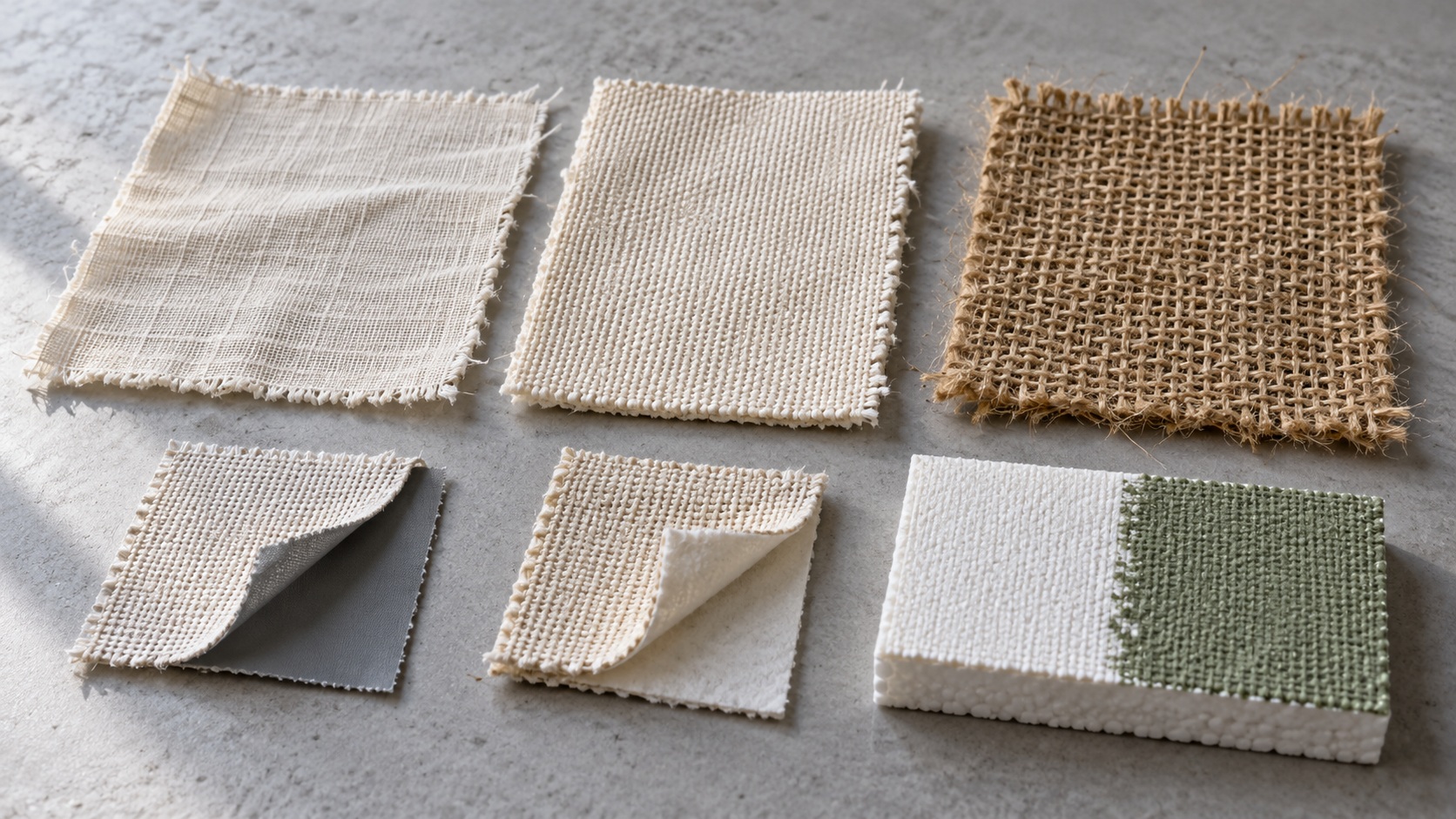
Three pale fabrics can look almost interchangeable in an online catalogue and produce very different scenic surfaces. One may leave its weave visible through paint; another may conceal the foam but require a heavier ground; a third may carry a backing whose composition is barely described. Selecting cloth for foam scenery is therefore a materials investigation, not a contest between natural and synthetic labels. The useful evidence combines a named construction, the physical sample, the intended paint system, and the proposed service. Cotton content, a bio-based ingredient, or an attractive unbleached color answers only part of that enquiry. Before purchasing yardage, establish which surface qualities matter and which layers the supplier is actually offering.
A: None is established as such. Choose against the observed requirements of a specific surface and service.
A: Not by itself. Observe the actual construction under the relevant lighting and finish.
A: No. Request the product's treatment and layer information.
A: It establishes the starting weave and appearance, but the intended ground and paint must be evaluated separately.
A: Water does not reproduce the formulation, bond formation, or cure behavior of the selected adhesive.
A: Use them to define questions and limits; do not recommend an incompatible conditioning method without resolving the proposed use.
A: The program describes a ratio involving new organic carbon and total organic carbon, not automatically the whole object's mass.
A: It can inform a defined sample repair, but document the failed layer and do not generalize beyond the tested construction.
A: They can value opposite appearance qualities, so one combined score may conceal the actual design requirements.
A: The exact variant, reverse-layer description, accepted finished sample, use restrictions, and identified repair boundary.
Put Three Identifiable Constructions on the Table
A manageable comparison begins with products that can be ordered again. Rose Brand’s MUSX0041 specification identifies an extra-wide natural heavyweight muslin as cotton, plain woven, approximately 6.5 ounces per square yard. The same sheet specifies dry cleaning only. Those are useful purchasing facts; they do not establish its opacity over your foam or its response to your scenic ground.
For a second candidate, Rose Brand lists a 7-ounce, 72-inch natural NFR cotton canvas within its unprimed canvas range. Gerriets lists Burlap H 425 as jute, approximately 12.53 ounces per square yard, and describes scenic texture applications. The NFR variants are non-flame-retardant samples, not evidence that an installed foam-and-textile assembly meets venue requirements. Resolve the finished assembly’s requirements with the responsible venue reviewer. These examples offer identifiable constructions and different starting weights, not a ranked recommendation for every prop. Confirm current variants and request physical samples before ordering.
Record the exact sample identifier beside each swatch. Neither muslin nor canvas names a universal thread count, treatment, or finish. The quoted products also do not supply a comparison of all natural fibers. A linen candidate could enter the investigation if a supplier provides its actual construction and documentation; there is no need to invent a linen performance advantage to complete a list. Exclude unavailable or inadequately identified samples rather than letting attractive photographs stand in for purchasable stock.
Read the Reverse as a Separate Material
Turn each swatch over before judging its face. For this comparison, distinguish cloth sold without a separately declared backing, cloth carrying an applied coating, and cloth laminated to another layer. An unbacked description does not prove an absence of sizing, dyes, or other treatments. A coating may be continuous or patterned, while a laminate has an identifiable additional layer and an interface between materials. Ask the supplier which description applies rather than deciding solely from touch.
Request the backing’s material identity, purpose, and relevant care and processing information. Is it intended to control fraying, add body, block light, or serve another function? Does the supplied weight include it? Can the face and backing be purchased separately? A soft reverse could be a textile layer, a polymer coating, or something else; resemblance is not composition. Keep unanswered points visible in the comparison because they can affect which side accepts the proposed adhesive and whether a later repair can reach the cloth itself.
Separate Weave Appearance from Opacity
View equal-sized samples over the same white foam panel with the same lighting and camera settings. Look first at the unpainted face. Record whether individual yarns, openings, slubs, or loose fibers contribute to the intended appearance. A visible weave can be the desired scenic texture rather than a defect.
Then compare concealment. Put a temporary contrasting reference behind an unbonded portion of each swatch and observe whether it remains visible. This is a studio observation of that sample, not a standardized opacity rating. Use the same reference and viewing distance so a change in the test setup does not masquerade as a textile difference.
Ask whether the installation will receive light only from the audience side or also from behind. A sample that conceals a dark line under front lighting may behave differently in another lighting arrangement. Obtain a representative lighting review instead of assuming that heavier cloth always solves the problem.
Paint can change both properties. A coating that conceals the foam may also fill the weave that made the material attractive. Keep a bare strip visible beside the painted area. Compare the result at the audience’s likely distance, not only in a close-up photograph that exaggerates every thread.
There is no need to declare a winner yet. A textured scenic sack and a smooth imitation architectural panel can favor different observed surfaces. Write separate acceptance descriptions for those two briefs. Otherwise, a single score for appearance may reward a compromise that serves neither object well.
Follow Liquid Through the Complete Sample
Wet-out describes what happens as the proposed liquid contacts and enters the textile construction. In a controlled sample using the intended product, observe whether it spreads, beads, darkens the cloth, emerges on the face, or remains largely on one side. Follow the product’s directions and handling requirements. Do not substitute water as proof of adhesive behavior: water can answer a limited wetting question, but it does not reproduce every ingredient or cure mechanism in an adhesive or scenic ground.
Inspect the reverse and the foam-facing interface as well as the visible surface. A backing can change where liquid goes, and a good-looking face can conceal an incompletely bonded region. Record the applied product and quantity, then inspect after the specified cure. Staining, strike-through, and inadequate attachment are different observations with different consequences. Avoid correcting every disappointing sample by adding more product; that would change the comparison before you understand whether the issue is absorption, a surface treatment, or an incompatible layer. Refer unresolved compatibility questions to the relevant suppliers.
Measure Change Rather Than Assuming Preshrinkage
A natural-fiber label does not supply a usable shrinkage allowance. Mark a measured gauge area on an offcut, identify its two directions, and photograph it flat before the proposed conditioning or finishing step. Measure it again after the sample has dried or cured under the agreed conditions. Preserve an untreated control from the same sample.
Only condition the textile by a method its instructions permit. The dry-clean-only statement on the cited muslin sheet is a reason to ask questions, not an invitation to wash it experimentally and then recommend washing to everyone else. If a production method introduces moisture despite restrictive care guidance, resolve that proposed use with the supplier before treating the sample as approved.
Check dimensional change from the scenic finish separately from any cleaning trial. Record the operation responsible for each measurement. A piece that changes after coating tells you something about that coating-and-textile process; it does not establish a fiber-wide shrinkage percentage. Backing curl, local puckering, and an altered face texture should be recorded even when the outer dimensions look similar.
Stiffness needs a similarly bounded observation. Compare equal unsupported lengths before and after the full finish, using consistent orientation and support. The result can reveal whether a selected swatch has lost the drape the design needs. It cannot establish strength, fire behavior, or a general durability rating. Keep the observation tied to the sample’s actual layer sequence and service brief.
Locate the Biological Claim Within the Layers
If a vendor describes a backing as bio-based, ask which component the claim covers and how the stated content was determined. The answer might concern an ingredient in a coating rather than the face fabric or the completed laminate. Request a diagram or written layer description that connects the claim to the supplied product. Do not expand that claim to include the foam panel, the adhesive added in the studio, or subsequent paint.
The USDA’s Certified Biobased Product explanation defines its content percentage in terms of new organic carbon relative to total organic carbon. That is not automatically a percentage of the entire object’s mass. Where this label is offered, verify the listed product and whether the statement concerns product or packaging. Do not invent an equivalent certification for an unlabeled sample, or borrow a certificate from another grade in the same supplier’s range.
A biological origin claim also does not answer whether the finished surface is compostable, acceptable to a recycler, or suitable for the intended exposure. The FTC’s Green Guides summary distinguishes specific substantiated attributes from broad environmental claims. For this purchase, keep the conclusion modest: the supplier has documented a particular attribute of a particular layer. Performance, complete-assembly suitability, and any receiving route remain separate enquiries, not benefits that follow automatically from the word bio.
Find the Boundary of a Repair
A material selection becomes more useful when it predicts what a future repair would replace. On a sacrificial finished sample, examine a representative damaged region using an approved repair method. Does the repair concern paint alone, exposed yarns, separation between cloth and backing, or separation at the foam-facing bond? Record the layer where failure occurred instead of calling every defect a fabric problem.
Evaluate the repaired appearance under the same lighting as the original sample. A matching new swatch may still differ from a painted surface that has aged, while a local coating repair may change sheen or obscure weave. Determine whether a visible patch is acceptable for the brief and whether replacement material can be obtained. Do not describe a laminated backing as removable merely because an exposed corner can be peeled by hand. The relevant question is whether the proposed service repair preserves the parts intended to remain.
Write Two Different Purchase Decisions
Consider two hypothetical commissions using the same sample set: a close-view painted architectural panel and a deliberately rough textile-faced scenic object. For the panel, the acceptance sheet might prioritize concealment of the substrate, an unobtrusive finished weave, limited dimensional change, and a repair that does not leave a conspicuous border. It should identify the observed results needed before accepting a candidate, not assume the canvas or muslin has already won.
For the textured object, the acceptance sheet might instead require legible yarn structure after coloring, the intended openness under installation lighting, and an acceptable response to occasional handling. Gerriets’ description gives H 425 a reason to enter that investigation, but its catalogue use does not prove the finished result. Reject it if the actual sample cannot meet the brief without unwanted filling or another incompatible treatment.
Compare the accepted constructions on a common area basis. Include cloth, declared backing, approved ground and paint consumption, and the labor required to reach the selected appearance. Convert linear-yard prices only after accounting for usable width; distinguish weight per square yard from weight per running yard. Keep these quantities separate from environmental impact claims. A lighter invoice or lower initial material weight is not a complete lifecycle assessment.
Put the exact textile variant, backing description, approved finish sample, restrictions, and repair boundary on the order record. A later change from unbacked cloth to a similarly named coated version should reopen the relevant checks. Before production, a separate fitting study still needs to establish that the chosen construction suits the shape; that prerequisite does not replace the material investigation. Retain the approved swatches so purchasing and the paint crew can compare what arrives with what was actually selected.
Buy the Construction You Can Explain
Select a documented textile and backing for an observed scenic result. The useful specification connects the layers to appearance, dimensional change, finish behavior, and repair limits without asking natural content to stand in for missing evidence.