Foam Near a Collection Object Has a Different Job
In a museum, foam may be a carved support, a thin contact cushion, a transport component, a case gasket, or part of a scenic display. Those roles have different requirements. A material useful for a short journey is not automatically suitable for years inside a closed case, and a foam that feels soft is not necessarily gentle on a fragile surface. Conservation-friendly selection considers chemical stability, physical behavior, contact, duration, and access to the object. Reversible mounting adds another question: can the object be removed without damage, alteration, or an improvised rescue? Work with the responsible conservator or trained mounting specialist from the beginning. The aim is not to find one universally archival foam, but to design an appropriate relationship between a particular object, its support, and its display environment.
A: No. Review the actual grade, product, physical role, and object-specific requirements.
A: No. Pressure distribution, texture, fit, and material behavior still matter.
A: Fabricate away from the object and use fitting methods approved by the responsible specialist.
A: Not necessarily; the object also needs a practical nondamaging removal route.
A: It may change contact but does not automatically eliminate emissions concerns.
A: No. Revise the mount or presentation under appropriate conservation guidance.
A: Refer the condition for conservation review rather than forcing removal.
A: Only after its suitability for the actual transport demands is evaluated.
A: They allow future staff to inspect, replace, and remove the support with less uncertainty.
A: The responsible conservator and a suitably trained mounting specialist working with the exhibit team.
Separate Scenic Foam From Object Support
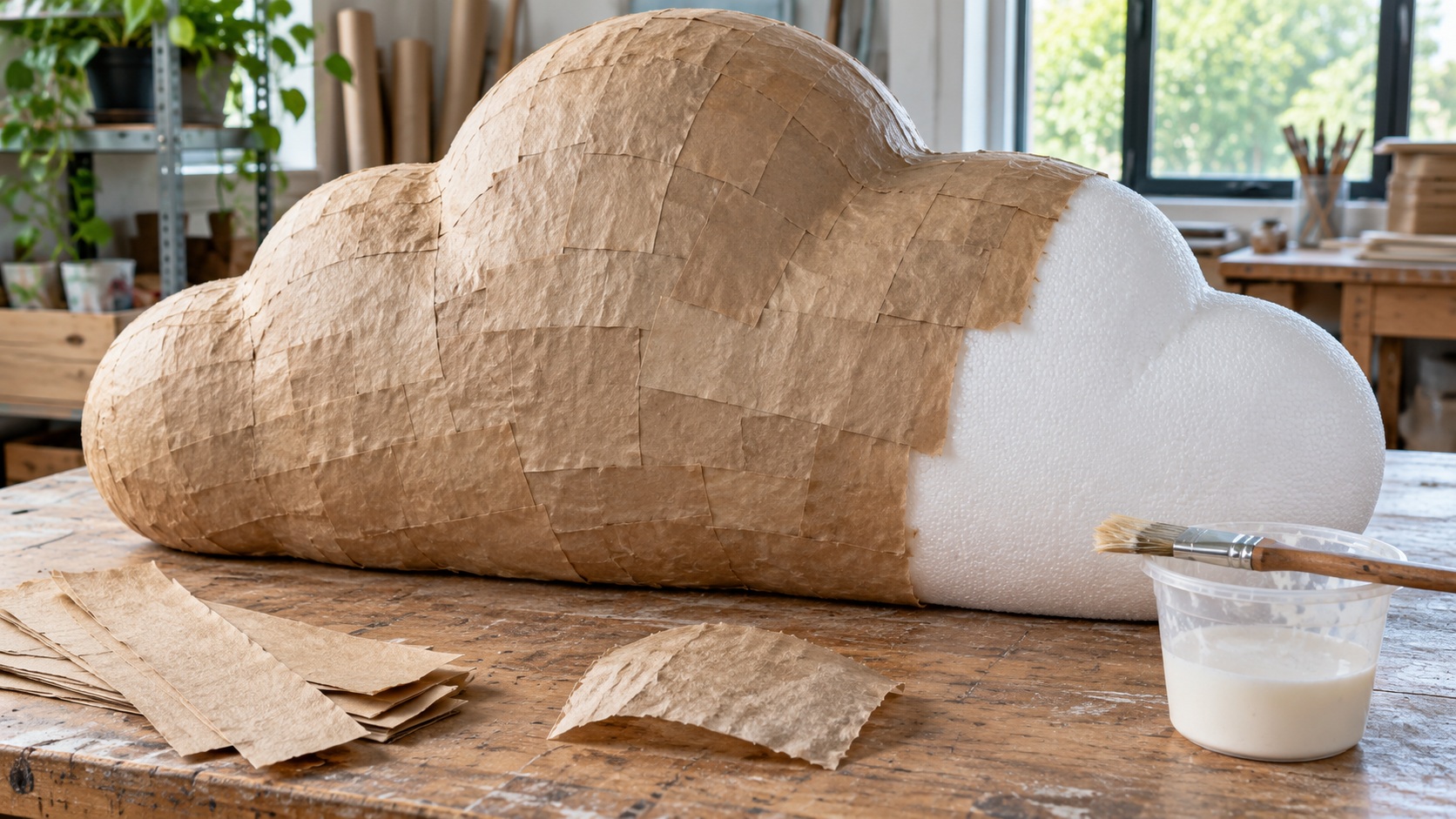
A foam rock in an exhibit and a foam cradle touching a collection object should not be specified as though they were the same item. Scenic foam may carry paint, fillers, adhesives, and protective layers chosen for appearance and wear. An object support needs a different evaluation of materials and contact. Keep those functions visible in the drawings and material schedule. A decorative surround can be visually convincing while remaining physically separate from the collection-bearing mount.
Map direct contact, nearby noncontact material, and the wider case environment. A thin interleaf may prevent one surface from rubbing another, but it does not necessarily stop emissions from nearby products. In a closed enclosure, the combination of materials and ventilation conditions can matter. Do not assume that hiding a scenic component beneath fabric makes its chemistry irrelevant. Have the whole assembly reviewed, including unseen backing, tapes, coatings, labels, and adhesives rather than only the most visible foam layer.
State the duration and purpose. A packing support used under supervision for a short move has a different duty from a permanent display cradle. If a temporary solution is approved, label its time and use limits so it does not quietly become a long-term arrangement. Record who made the decision and what review is required before extending the period. Museums often inherit temporary supports precisely because the original context was never preserved in the object file.
Specify the Actual Foam Product
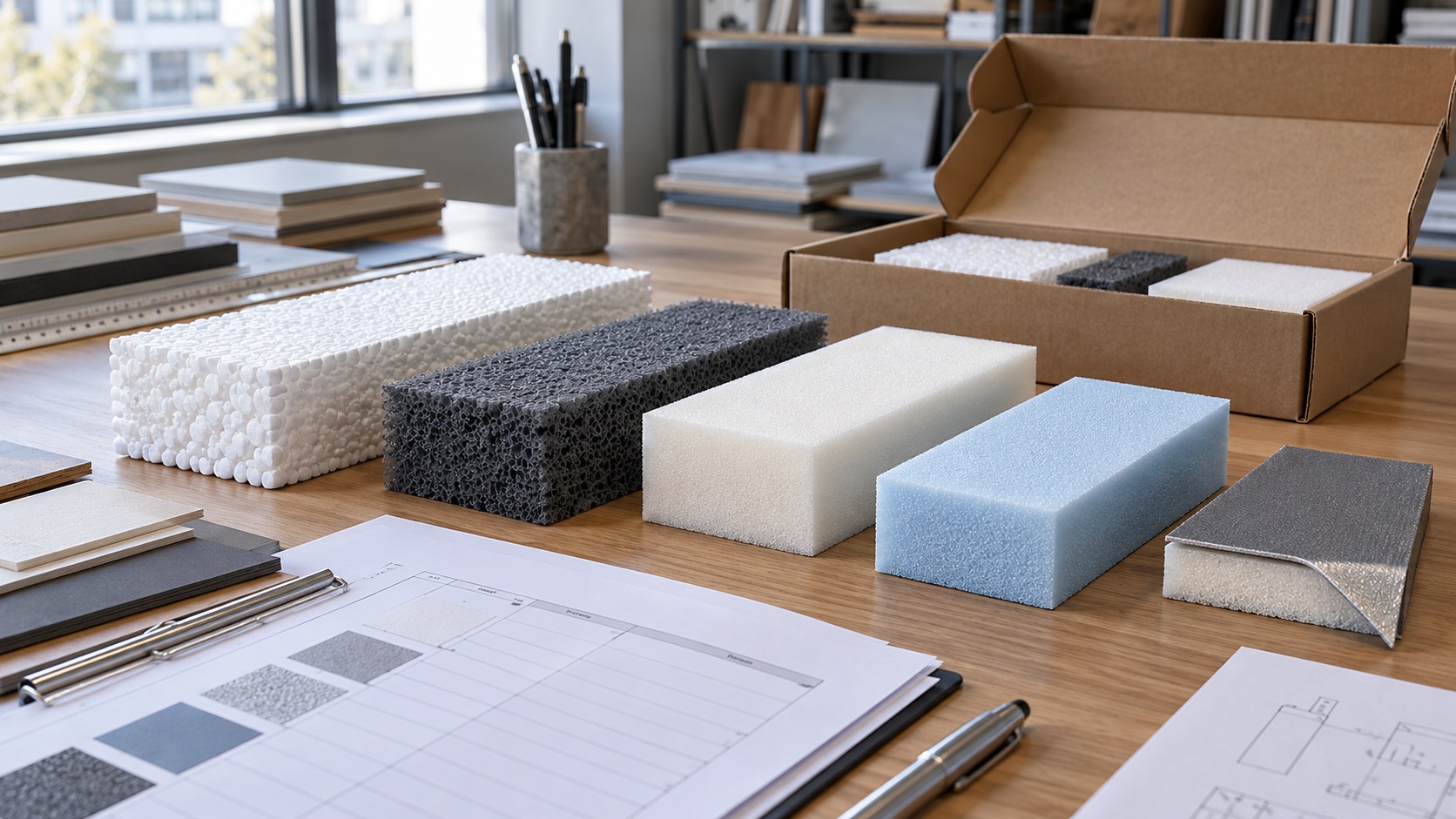
Use product identity and documented composition rather than color, softness, or a supplier’s broad archival label. Polyethylene and crosslinked polyethylene foams are commonly discussed in conservation guidance, but grades, densities, surface qualities, and additives still matter. The Canadian Conservation Institute’s preventive-conservation materials bulletin provides a useful framework for product selection. It should guide informed review, not be converted into an unrestricted approval for every foam bearing a familiar polymer name.
Consider both chemical suitability and mechanical function. A stable foam can still be too stiff, too soft, too thin, or too textured for a particular contact. The selected density and support area must suit the load and intended behavior. A cradle intended to locate an object is not necessarily a shock-isolation system for transport. Treat cushioning design as its own question rather than assuming that adding more foam automatically improves protection. Product information and the conservator’s requirements should inform the choice.
Be Cautious With Aging and Unknown Padding
Do not reuse old packing foam merely because it has been kept in a museum cupboard. Its identity and condition may be uncertain, and some foams deteriorate in ways that can affect objects. CCI’s artwork packaging guidance distinguishes material choices and warns about less stable polyurethane foams in long-term contact situations. Inspect inherited supports and refer uncertain or degraded materials for conservation review rather than relying on their past use as proof of suitability.
Look for changes such as crumbling, tackiness, discoloration, deformation, or adhesion to an interleaf, but do not interpret the absence of those signs as a complete chemical assessment. Record the observation without manipulating a fragile object to investigate. Removal of a stuck or deteriorated support may require a conservator’s intervention. A support that can no longer release the object easily has already lost an important part of its intended function, even if the display still looks orderly from outside the case.
Keep new supply records and a retained sample where appropriate. Note product name, supplier, batch or purchase information available, and the date installed. If a supplier changes a formulation or the museum changes its requirements, those records allow targeted review. Without them, staff may have to treat an entire group of similar-looking supports as unknown. A modest documentation effort can prevent a much larger identification problem during a future gallery renewal or collection move.
Avoid amateur identification by flame, heat, solvent, or odor tests. Such experiments can expose staff and damage materials without providing the evidence needed for conservation use. Where testing is required, use the museum’s established material-assessment route and qualified expertise. Not every product needs the same test, and one screening result should not be described as a permanent guarantee for all objects and environments. The question remains whether the actual product is appropriate for this defined application.
Design Contact Around the Object’s Vulnerabilities
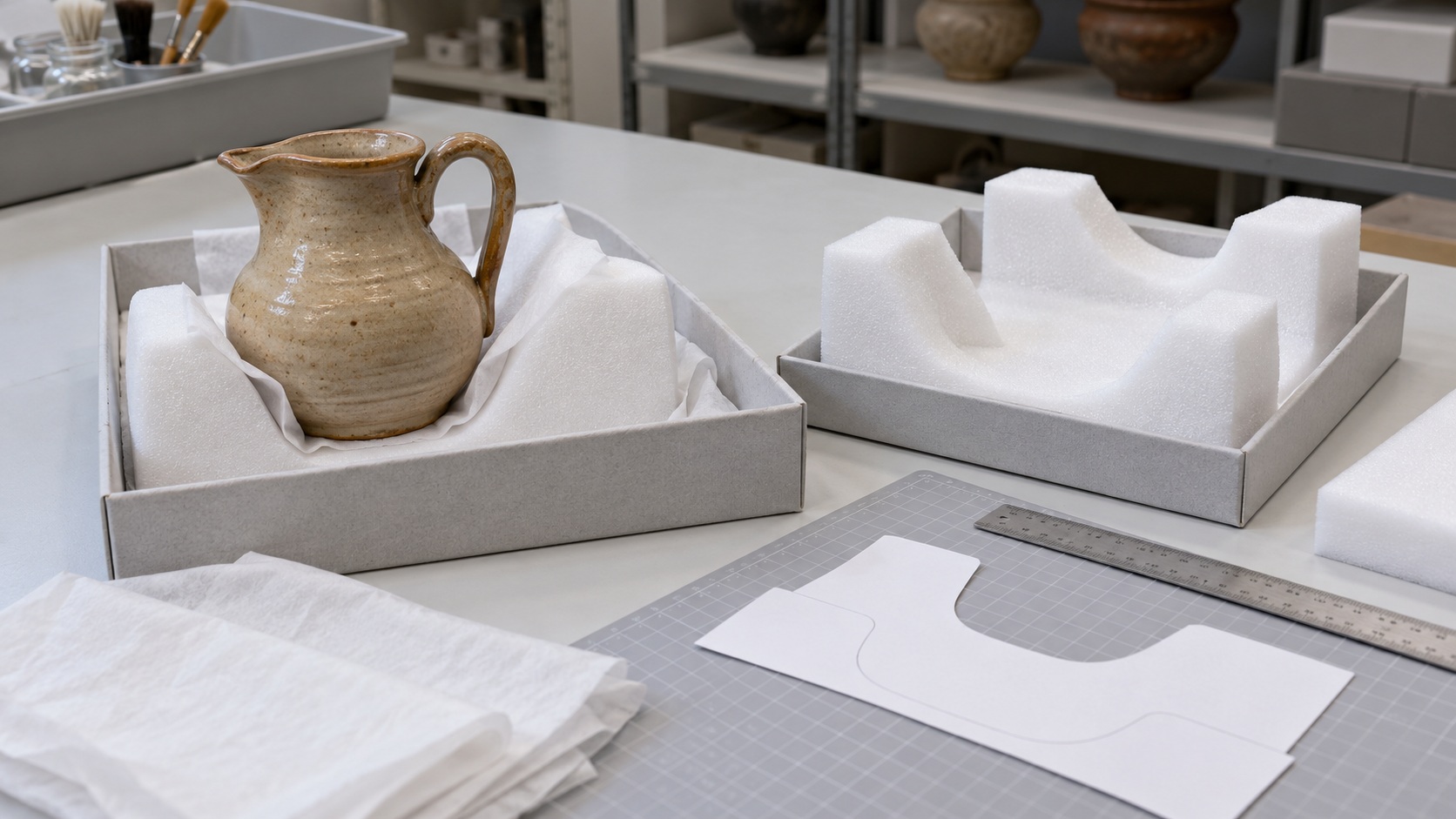
Review the object’s condition before choosing support locations. Handles, rims, projections, repaired joins, friable surfaces, and moving components may need to remain unloaded. Support broad suitable areas identified with the conservator, and allow attached elements their own appropriate support where necessary. A jug should not be made stable by wedging its handle tightly against a foam wall. The mount must accommodate the object as it exists rather than requiring the object to tolerate an attractive geometric arrangement.
Consider abrasion and snagging as well as pressure. A rough cut surface may catch fibers or delicate projections, while an overly tight recess can rub during insertion and removal. A suitable smooth interleaf may be appropriate, but its material and fit need review too. Avoid adding loose padding indiscriminately to solve every gap. Small pieces can migrate or create new pressure points. The contact design should remain understandable when another trained person examines the mount later.
The National Park Service exhibit guidance emphasizes object-specific support and trained mounting work, including avoiding alteration of objects to fit mounts. That principle is central: do not trim, drill, bend, or glue a collection object merely to simplify the display. If the preferred pose cannot be supported appropriately, revise the pose or mount design. Presentation ambitions should be negotiated around preservation needs rather than treated as an instruction for the object to comply.
Make Reversibility a Removal Sequence
A mount is not meaningfully reversible just because no adhesive was intentionally applied to the object. It must provide a practical way to release and remove the object without snagging, forcing, or loading fragile parts. Draw that sequence. Identify which support or restraint is released first and where trained handlers can place their hands. A deep foam recess can be difficult to escape even when its materials are otherwise suitable. Access should be part of the design rather than an assumption made after installation.
Use a suitable replica, dummy, or approved measurement method to develop the support whenever possible. Do cutting, sanding, adhesive work, and messy fabrication away from the collection object. A close-fitting mount should not be carved around an artifact as though the artifact were a workshop template. Protect the object from debris and accidental tool contact, and have the responsible specialist determine how actual fitting checks are performed. A carefully staged fit process reduces the need for risky improvisation.
Keep Mount Attachments Separate From Object Attachment
A foam support may need to be joined to a base or another mount component. Specify those connections independently from the collection object’s contact. Adhesives acceptable in a fabrication joint are not automatically acceptable on an artifact. Keep glue lines, fasteners, and potentially abrasive edges away from object surfaces as required by the design. Provide sufficient cure and any required conditioning before installation, following the approved material system rather than relying on the absence of odor.
If the mount uses mechanical restraints, they need a properly reviewed shape, finish, padding, and release method. Foam should not be assumed to provide a reliable anchor for a restraint under unknown loads. The underlying base and connections must perform their assigned function. Do not hide an unresolved attachment behind soft padding and call it protective. A trained mount maker can help translate preservation requirements into an arrangement that supports and locates the object while remaining serviceable.
Distinguish ordinary support from seismic, theft, or accidental-contact restraint where those concerns apply. A cradle designed to prevent rolling is not necessarily adequate for another demand. Have the relevant specialists establish the required performance and review the whole installation. Avoid universal tie-down or fastening recipes for objects of unknown condition and value. The mount’s documentation should state what it was designed to do so future staff do not infer capabilities from its reassuring appearance.
Maintain access to case hardware and environmental equipment without disturbing the object unnecessarily. A mount that blocks a sensor, case service panel, or required inspection point can create later handling risk. Coordinate the support layout with the exhibit team before final fabrication. A small adjustment to a base can prevent a future situation in which staff must remove a fragile object simply to perform routine work elsewhere inside the enclosure.
Inspect the Completed Relationship
At installation, document the object’s position, approved contact areas, clearances, and removal sequence. Check that the mount does not impose a new distortion or force an unsupported part into an awkward angle. Observe the assembly as a whole rather than judging only whether it looks centered. The responsible conservator or specialist should approve the relevant fit and condition checks. Photographs should include views useful for future comparison, not only the public-facing display angle.
Plan Replacement Without Losing Knowledge
Set review intervals appropriate to the materials, object, and environment. Look for compression changes, movement, contact marks, deteriorating foam, or changes in the interleaf. Record findings and refer concerns through the museum’s conservation process. Do not tighten or add padding casually when the object shifts; the cause may be deformation, an unsuitable support area, or a change elsewhere in the assembly. Corrective action should address the actual problem and preserve the object’s condition.
Keep drawings, material records, fit photographs, and removal instructions with the collection documentation in a retrievable form. A replacement support can then reproduce the useful geometry while incorporating current material advice. If the object travels, clarify whether the display mount can accompany it and whether it is appropriate for transport. Do not assume a static display support provides the cushioning or restraint needed for a journey simply because the object already fits it neatly.
Dispose of retired mount materials through appropriate local routes and keep uncertain or contaminated pieces from returning to general clean stock. When reusing a base or support component, reassess its condition and role rather than treating reuse as automatic conservation benefit. Long service is valuable only while the mount continues to protect the object. A well-documented replacement can be the more responsible choice when the original material or fit no longer serves the collection.
Preserve the Object and the Ability to Remove It
Conservation-friendly foam mounting combines identified materials, suitable contact, reviewed support, and a practical release sequence. Its success is measured by the object’s condition and future access, not by how invisible the mount appears.