A Different Future for the Sculpted Object
The next generation of foam sculpture will probably be recognized as much by its joints, ownership arrangements, and material records as by its surface. A new biological feedstock may change what a sculptor carves, but a recoverable finish or an accessible fastener can determine whether the finished object gets another life. Three developments deserve attention together: bio-composites with distinct manufacturing possibilities, circular systems that keep objects and materials moving, and digital design that anticipates revision. None guarantees a lower-impact result on its own. The interesting future is one in which the material, fabrication method, service life, and eventual receiving route are designed as a connected proposition rather than separate promises.
A: No. Feedstock origin does not determine breakdown behavior, and disposal requires product-specific guidance and an accepted route.
A: Not without confirming supply, properties, fabrication guidance, and suitability for the intended finished assembly.
A: It may approach the required geometry through a different manufacturing route, but molds, growth, drying, and rejected samples still need evaluation.
A: No. A scenic component can face different handling, finish, exposure, and venue requirements.
A: The finished layers influence repair access and receiving options, so the bare core cannot represent the complete object.
A: Not necessarily. Collection needs a confirmed subsequent use or processing outcome to establish what actually happened.
A: It addresses one fabrication variable; reinforcement, setups, finishing, transport, and service life may change the conclusion.
A: Preserve replacement geometry, interface dimensions, material and finish records, and understandable assembly information.
A: Use a limited noncritical component, disclose the experiment, document its results, and retain a workable fallback.
A: A documented use boundary can prevent repeated mistakes and identify a more appropriate component or service condition.
Biological Feedstocks Change the Questions
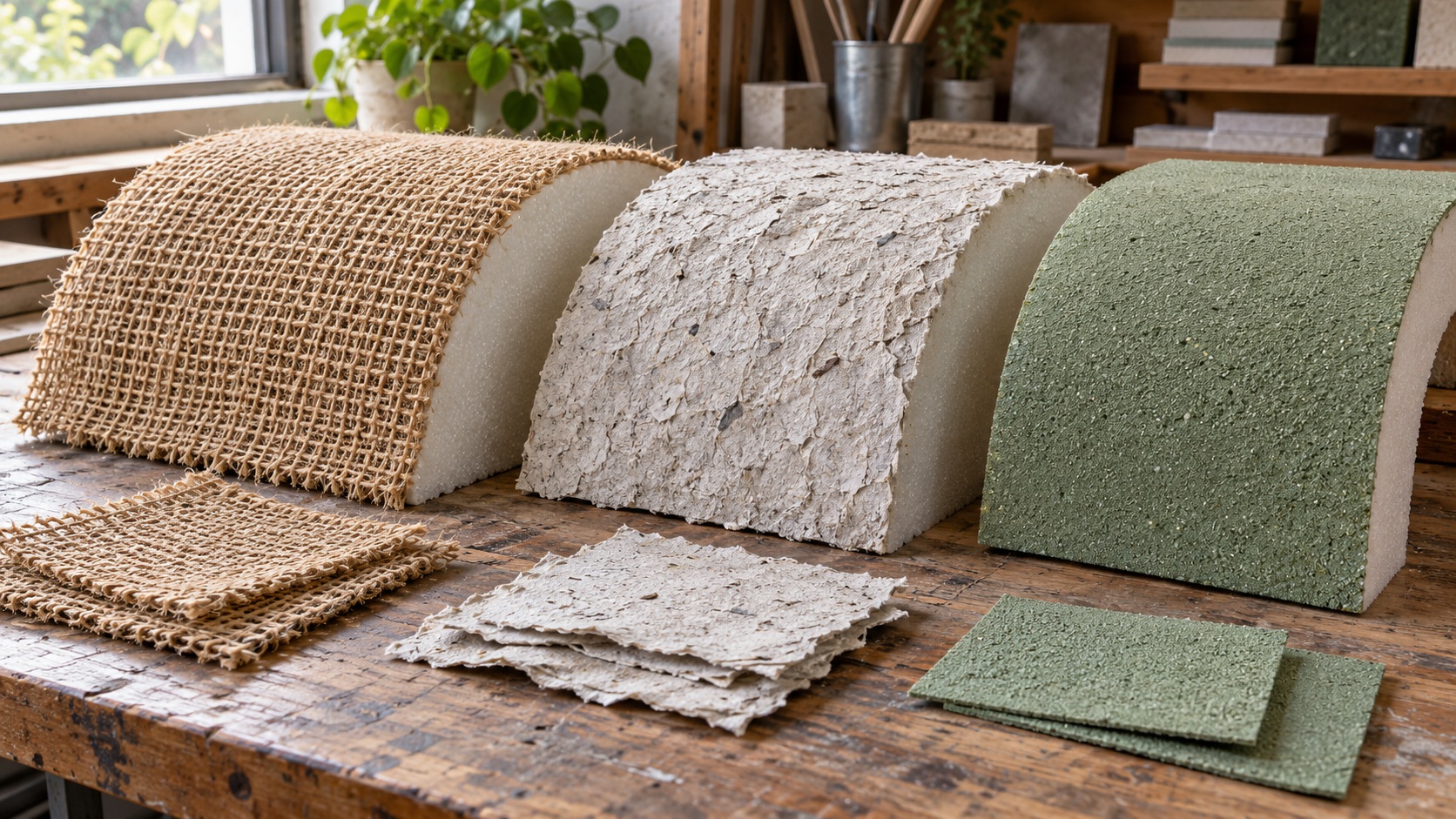
Bio-composite is a broad description, not a single carving material. A fibrous substrate bound by mycelium, a wood-derived foam, and a polymer partly made from biological feedstocks can differ in structure, processing, repair behavior, and end-of-life options. Their shared association with renewable resources does not make them interchangeable. A sculptor needs the actual product composition and manufacturing method before considering where it belongs in an object.
It is also important to separate feedstock origin from breakdown behavior. The US EPA’s plastic recycling and composting guidance explains that biobased plastics are not necessarily biodegradable. Compostability involves specified conditions and does not establish that a local collection program accepts an item. A plant-derived ingredient is not permission to put a finished painted sculpture into a garden or mixed recycling bin.
These distinctions suggest a more useful development brief. Instead of asking for a universally green foam, specify the job: a protected display insert, a repeatedly handled theatrical component, or a replaceable textured panel. Then consider whether the candidate can perform that job with an appropriate finish and an achievable destination afterward. A material that suits one component may be inappropriate for the sculpture’s vulnerable edges or outdoor base.
Wood Foams Offer a Different Structural Starting Point
Fraunhofer WKI’s wood-foam research is an example of changing the cellular material itself rather than merely changing a conventional polymer’s feedstock. The institute describes finely ground wood dispersed in water and processed into an open-pore material. Its wood-foam overview discusses potential applications including packaging, lightweight boards, and sandwich-panel cores.
The research describes strength arising from wood’s own binding characteristics without synthetic adhesive in that material. That is a specific finding about the described foam, not a claim that every wood-filled composite has the same composition. It points toward possible scenic components whose texture, density, and machining response differ from familiar expanded polymer blocks.
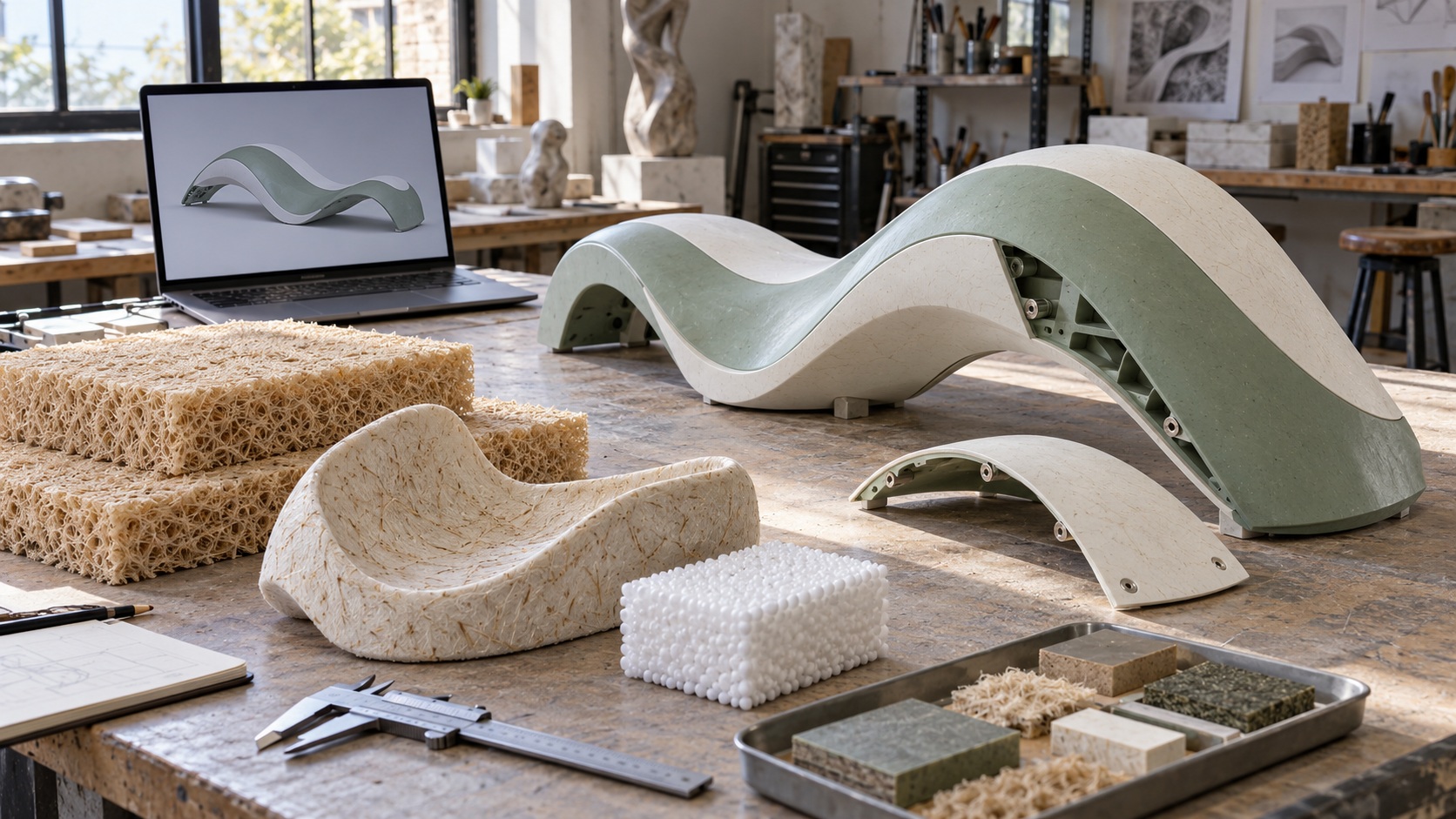
For sculpture, the most interesting opportunity may initially be a panel or core rather than an intricate carved figure. An interior sandwich construction could place a candidate material where its properties are useful while allowing another component to handle wear. That possibility is a design inference, not evidence that a particular research foam is approved for a venue or available in production quantities.
A published demonstrator leaves practical questions unanswered: minimum order, dimensional consistency, machining guidance, storage conditions, and the supplier’s support for your intended use. Verify those points directly before promising a client a substitution. Research descriptions of packaging recovery routes also cannot establish acceptance of a coated scenic composite in your local paper stream.
Mycelium Composites Invite Near-Net-Shape Thinking
Mycelium-based composites invite a different manufacturing imagination: forms may be grown in molds rather than carved from a larger purchased block. Ecovative’s material FAQ distinguishes its packaging applications and development work, and notes that the materials it discusses are not waterproof. Its historical and availability statements should be checked directly with a current supplier before procurement. A packaging application does not validate a large scenic sculpture, especially one exposed to wet conditions or repeated impact. Nevertheless, molding a repeatable insert or sacrificial surface could be an interesting controlled experiment. The experiment would need to consider mold production, growth and drying time, dimensional change, finish compatibility, and the finished component’s actual function. The appeal is not simply that something biological replaces something synthetic; it is that the production method might make a different geometry or supply arrangement practical. A studio should document both successful samples and rejected ones so an attractive prototype does not become an unsupported general claim.
The Surface Can Decide the Material’s Fate
A sculpture is rarely a bare foam sample. It may combine primer, hard coat, paint, adhesive, mesh, fasteners, and an internal armature. Those additions can alter repair access and the options available to a receiving facility. Evaluating a new core without the proposed finish risks optimizing the least visible part of the object while overlooking the assembly that will actually leave the workshop.
One promising direction is to give protective and decorative layers their own replacement logic. A vulnerable lower panel might detach without destroying the central form. A transport cover might provide protection without becoming permanently bonded to the sculpture. Such arrangements are not automatically preferable: additional parts, weight, and assembly labor also count.
Develop finish trials around the real service conditions. Compare adhesion and appearance after representative handling, cleaning, and storage, using supplier guidance and appropriate professional testing where needed. Do not infer fire performance, exposure suitability, or chemical safety from a natural-looking ingredient. Venue requirements and the properties of the complete assembly remain separate questions.
Record what is on the surface as carefully as what is underneath. A future repairer cannot confidently strip or replace an unidentified layer. A receiving partner needs an honest description of coatings and reinforcement before agreeing to take material. The material passport becomes useful when it identifies the assembled object, not just the original bag or block.
Circularity Requires Someone to Receive the Object
A circular system is a set of actual transactions. Someone retains ownership, someone inspects the returned piece, someone authorizes repair, and someone funds storage until the next installation. If those roles are absent, a theoretically reusable sculpture can still become unwanted inventory. Leasing and rental arrangements may help align responsibility, but they bring transport, maintenance, insurance, and scheduling obligations that need realistic provision.
Material recovery is a different loop from object reuse. A clean production offcut may qualify for a process that rejects a painted return. The system therefore needs separate routes for intact objects, repairable modules, clean remnants, and unrecoverable mixtures. A future collection network could make these distinctions easier to manage, but its success would depend on volumes, distances, contamination control, and receiving capacity. No clever label can substitute for confirmation that a specific partner will take the material in its actual condition. A well-designed trial should follow the object beyond the collection van and record the receiving outcome.
Digital Design Can Preserve Options
Digital tools can support material restraint before fabrication starts. A model can reveal which details are never visible, which solid regions could be hollow, and where a split would permit a smaller transport envelope. Nesting can compare part arrangements within available stock. These are opportunities to evaluate, not promises that a software package always reduces waste or environmental impact.
The comparison should include manufacturing consequences. A tightly nested layout may leave awkward fragments or require extra setups. A hollow component may need more reinforcement. A multipart object may save stock but add permanent adhesive joints. Inspect the proposed toolpaths, support requirements, and assembly sequence before treating the digital material estimate as the final result.
Versioned design files can also extend useful life. Preserve interface dimensions, replacement-part geometry, coating records, and assembly instructions with the project. A later fabricator may need an open exchange format rather than access to an abandoned software subscription. The valuable digital asset is not a photorealistic rendering alone; it is enough understandable information to manufacture a repair and fit it to the surviving object.
New Materials Need Comparable Service Evidence
A fair comparison starts with an equivalent function. Two materials may have very different weights yet provide the same display volume, or require different reinforcement to survive the same handling. Compare finished systems delivering the intended service, with stated assumptions about installation count, transport, maintenance, and disposal. A kilogram-for-kilogram comparison may miss the design change that determines the outcome.
Ask lifecycle evidence to reveal trade-offs rather than produce a single flattering label. Biological feedstocks involve cultivation or collection, processing, and competing uses; conventional materials also have upstream and downstream burdens. A study for one product and region cannot automatically characterize another supplier’s formulation or a different electricity and transport context.
Durability evidence should follow the proposed use. An indoor display trial does not settle outdoor behavior. An uncoated coupon does not represent a reinforced painted object. Document the specimen, conditions, observations, and limitations so another designer can judge relevance. Where a performance claim requires recognized testing or professional assessment, a workshop observation should remain clearly identified as an observation.
Do not conceal a disappointing result. A candidate that survives storage poorly may still suit a different, shorter-lived application, while a durable core may need a better surface design. The record helps future projects narrow the question instead of repeating the same experiment. Progress can mean identifying a useful boundary, not proving that a new material can replace everything already on the shelf.
Adoption May Begin with Small Replaceable Components
A cautious development path separates research from a paid commission’s critical requirements. Start with representative samples, move to a limited component, and assess a complete assembly before wider use. Keep a conventional replacement option when the pilot is not essential to the artistic concept. Agree with the client on what is experimental and what evidence will be collected. That transparency protects the production schedule and gives the experiment an honest purpose.
The future may be less visually dramatic than promotional renderings suggest. A familiar scenic object could contain a different insert, ship in a better-designed cradle, return under a service agreement, and carry files that make a later repair straightforward. Those changes can be assessed individually and combined when their benefits survive contact with actual use. Material innovation remains important, but the most capable studio will be able to distinguish an intriguing research direction from a repeatable service, and a repeatable service from a verified environmental improvement.
Procurement can make room for that distinction by separating the prototype budget from the production price. A sample-development fee can cover tooling changes, observation time, and a written account of the results, even when the candidate is not adopted. Otherwise, the pressure to justify an unpaid experiment may encourage a studio to describe an uncertain outcome too favorably. Agree on ownership of the trial records and whether useful findings may be shared without exposing the client’s design. Over several projects, a modest library of well-described samples could become more valuable than a shelf of impressive objects with forgotten formulations. Record the supplier and batch, intended use, finishing sequence, and the reason for acceptance or rejection. That accumulated knowledge supports more discriminating material choices without claiming to predict how every future formulation will perform.
Keep the Future Open to Repair
The most useful innovation leaves the next decision possible: another installation, a replaceable part, a better-documented trial, or a confirmed receiving route. Judge emerging materials by those opportunities and their evidence, not by the novelty of their names.