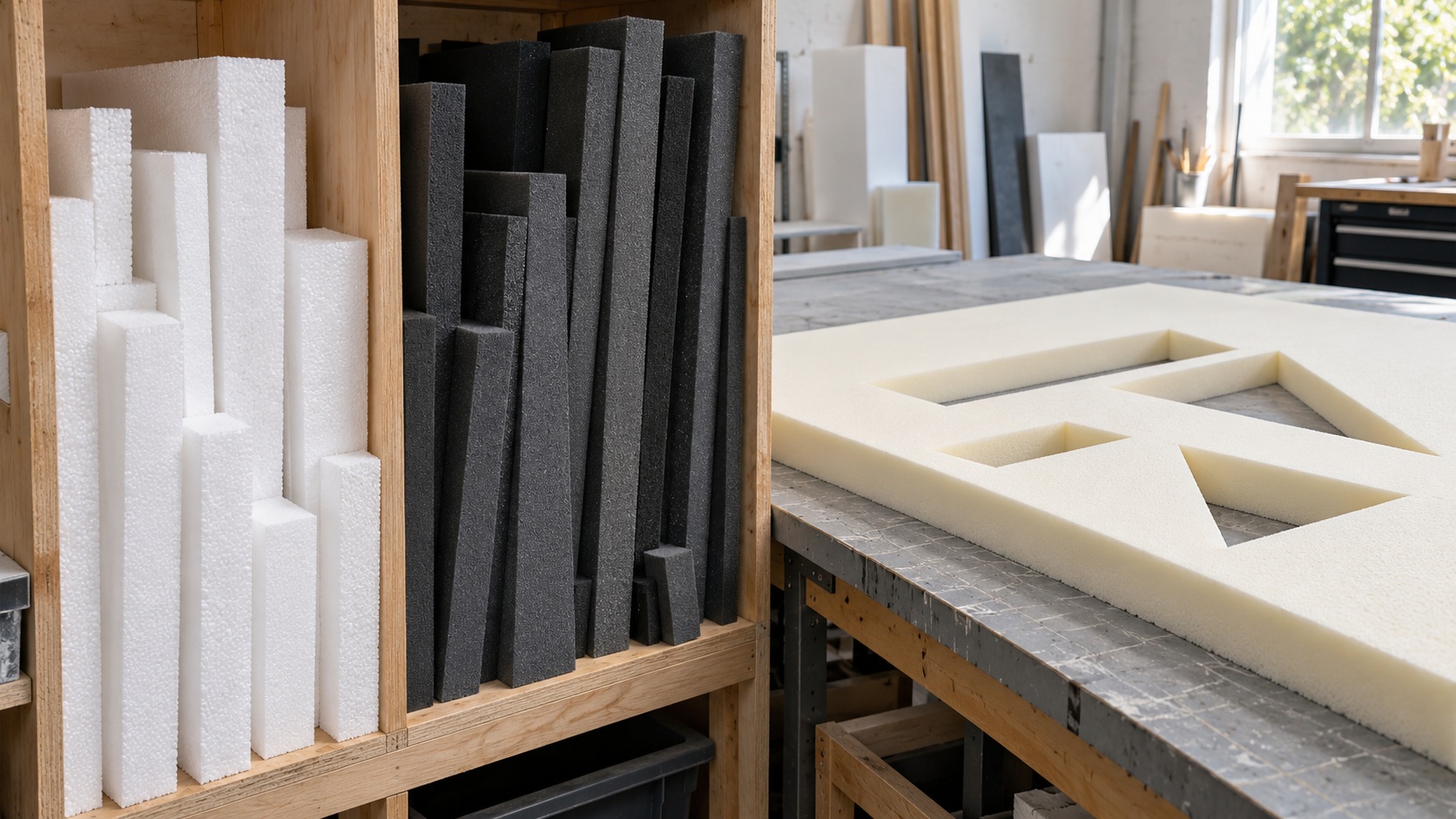
Sort Foam by Identity and Destination, Not Color Alone
A useful foam scrap system answers two questions: what is this material, and who can actually use or accept it next? Color can help staff recognize a familiar product, but it is not a dependable polymer code. White material may belong to several foam families, and a manufacturer’s color can change between product lines or formulations. The most reliable identity begins before cutting, with purchasing records, original labels, and marked offcuts. Then separate usable stock from smaller recovery candidates, coated composites, contaminated material, and unknowns. Keep the destination visible. A clean rigid scrap retained for carving has a different purpose from material prepared for a particular collection program. Sorting does not magically create a recycling outlet, but it preserves options that disappear when everything is swept into one mixed bag. Build the system around traceability, practical storage, and actual recipient requirements rather than an optimistic row of bins marked only with colors.
A: No. Use product provenance and documentation; colors may vary between suppliers and formulations.
A: Only if the actual receiver accepts their combination and conditions.
A: Keep it out of trusted streams while seeking appropriate identification or choosing an applicable route without guessing.
A: No. Avoid improvised heat or chemical tests that introduce hazards and still cannot establish the complete formulation.
A: No. The attached coating and other layers remain part of the material being offered.
A: Not necessarily. Define practical reuse sizes and review material that never returns to service.
A: No. Obtain current acceptance from a real receiving program.
A: It may contain fine particles, mixed products, and contamination different from clean identified stock.
A: Track useful internal reuse and actual recipient acceptance separately from material merely assigned to a bin.
A: Keep identity attached from purchasing through cutting so future sorting does not depend on uncertain visual guesses.
Keep Identity Attached to the First Offcut
Record the full product and grade when stock enters the shop. Keep the supplier’s identification and relevant product information linked to the material. When a sheet or block is divided, transfer a short identifier to the useful offcuts before they leave the work area. Waiting until the end of a large project makes it harder to distinguish similar pieces from several jobs.
Use hidden or expendable areas for marks so identification does not interfere with the next finish. A stock card, tied label, or designated container may be more appropriate than writing on every small piece. The important feature is a dependable link between the physical material and its record. A drawer full of anonymous white rectangles does not become an inventory merely because the pieces are neatly stacked.
Retain dimensions for larger reusable pieces. A searchable entry describing material, usable size, condition, and location is more helpful than a photograph alone. Include any known coating, adhesive, or heat exposure. The next maker needs to know whether a surface is clean stock or a previously altered assembly before planning tools and finishes around it.
Use Appearance Only as a Preliminary Clue
Visible bead structure can suggest expanded polystyrene, while some extruded boards have a more uniform fine-cell appearance. Flexible packaging foams and cushioning stocks can look different again. These observations help direct questions; they do not replace provenance when the exact identity matters. Surface skins, pigments, and prior treatments can hide the underlying structure.
Do not use a universal color chart to assign polymer identity. Supplier-specific colors may identify products within a known purchasing system, but that knowledge does not transfer automatically to an unrelated piece. DuPont’s Beyond Blue fact sheet illustrates that a named insulation family can include a changed color associated with a formulation change. Keep product evidence ahead of visual shorthand.
Separate Foam Families Before Asking About Recovery
Maintain known expanded polystyrene separately from known extruded polystyrene unless a receiver explicitly accepts their combination. Even when materials share a polymer family, a collection process may impose narrower conditions on form, product type, additives, or contamination. Ask about the exact stock rather than assuming chemical similarity guarantees shared acceptance.
Keep flexible polyethylene packaging, flexible polyurethane cushioning, rigid polyurethane model stock, and other identified families in their own appropriate streams. The list should reflect what the shop actually uses, not an enormous abstract taxonomy. Start with a few clearly documented categories and add one when a real material and destination justify it.
Use an unknown category without embarrassment. Uncertain material should not enter a clean stream because its color or feel seems close enough. Seek supplier records or appropriate specialist identification if the quantity and intended use justify it. Otherwise retain or dispose through the applicable route without inventing certainty.
Avoid improvised burning, hot-wire identification, or solvent-dissolution tests on unknown scraps. Those methods can introduce exposure, fire, and waste concerns while still failing to establish the complete formulation. HSE’s cellular plastics guidance discusses relevant processing and fire risks. Traceable stock management is a better routine identification strategy than creating a hazardous test at the sorting bench.
Distinguish Usable Stock From Recovery Material
Keep sufficiently large clean offcuts available for the next build before reducing them to a recovery stream. Define practical minimum sizes around the shop’s work: a small model shop may use pieces too small for a monumental scenic build. Review those limits periodically. Retaining every tiny fragment can consume storage without preventing future purchases.
Store pieces so their dimensions and condition remain useful. Prevent crushing, dirty floor contact, and accidental coating overspray. Keep accessible high-turnover stock separate from long-term unusual remnants. A reuse shelf works only when makers can find material quickly enough to prefer it over opening a new sheet.
Record actual withdrawals and repeated leftovers. If one shape of offcut accumulates without being used, revise nesting or stop saving it indefinitely. A reuse program should respond to demand rather than measure success by the growing volume of stored foam. Material that is never used again has not delivered the intended reuse benefit.
Keep Contamination Visible
Paint, adhesive, tape, paper, reinforcement, food residue, soil, and embedded fasteners can affect the next use or a receiver’s acceptance. Separate these conditions clearly. A small clean edge attached to a large coated panel does not make the whole piece clean. Do not describe a composite as uncoated foam simply because the core is visible through a broken face.
Remove readily separable labels or fasteners only through an appropriate practical process. Do not create uncontrolled dust or chemical stripping waste merely to chase an imagined recovery specification. Ask the recipient what preparation is required and evaluate whether it is achievable for the material on hand. Sometimes intact reuse is more practical than attempting to recover a bare core.
Keep wet or uncured material out of ordinary clean-stock containers. Follow the relevant product instructions and workplace procedures for handling those wastes. A bin intended for dry foam should not become a place for adhesive-contaminated rags, uncured resin pieces, or unknown liquids. Clear categories help prevent a materials-management task from becoming an uncontrolled chemical-storage problem.
Document mixed constructions where they are worth retaining. A reusable scenic panel can be identified as a foam-and-skin assembly with known limits instead of being rejected simply because it is not pure stock. Its value may lie in reuse as a panel, not in a claim that every layer can be separated later.
Ask the Receiver Before Filling the Bin
Obtain current acceptance requirements from the actual destination. Insulation Technology’s EPS collection information, for example, specifies clean material and excludes several other foam forms and contaminants. That is evidence of one program’s rules, not a promise that the same conditions apply in every city.
Confirm product forms, color restrictions if any, packaging, quantity, delivery arrangements, and contamination limits. Ask specifically about scenic stock, coated pieces, dust, chips, and insulating boards when those are relevant. A program accepting clean appliance packaging may not accept the shop’s entire polystyrene stream. Keep its answer with the container label or collection record.
Design Containers Around Real Shop Behavior
Use clear written material names and example images where helpful, with a short description of allowed condition and destination. Color coding can support the system, but should not carry the entire meaning. A new employee or visiting maker should be able to distinguish reusable stock, receiver-approved recovery, composites, and unknowns without memorizing a private color language.
Place containers near the point where scraps arise while preserving circulation, required access, and the shop’s fire-risk controls. Oversized open piles can defeat a good sorting plan by spreading lightweight debris. Use storage arrangements appropriate to the material and workplace assessment. Keep collection frequency realistic so overflow does not mix streams.
Assign a person or role to review containers and arrange removal. Check contamination before a shipment rather than discovering a rejected load at the receiver. When a recurring mistake appears, adjust the label, location, or workflow. Blaming staff for a confusing bin arrangement does not improve the material stream.
Keep dust and small debris collection compatible with the process controls used to produce it. Do not empty an extraction container into a clean offcut bin simply because both came from foam. Fine debris can carry mixed materials from earlier work and may require different handling. Ask about that specific waste rather than treating it as a smaller version of clean stock.
Track What Actually Leaves for Useful Use
Record material reused internally, accepted by a recipient, rejected, or disposed. Use a consistent measurement appropriate to the operation and state its limitations. Volume can be useful for storage planning but changes greatly with packing and compaction; mass answers a different question. Avoid comparing loosely filled bags with dense blocks as though their volumes represent equivalent material quantities.
Keep accepted collection records where available. A pile designated for recycling is not yet a completed recycling outcome. If the destination changes or stops accepting material, update the system promptly rather than letting a misleading label remain. The process should describe current reality even when that reality is less convenient than the original plan.
Use the record to prevent waste upstream. Repeated large offcuts may suggest a different stock size or nesting arrangement. Frequent coating contamination may suggest separating reusable pieces before finishing. Unknown scraps may reveal a purchasing handover problem. Sorting becomes more valuable when it changes how material enters and moves through the shop.
Keep the System Honest as Stock Changes
Review categories when a new product enters the workspace. Obtain its documentation, decide whether it belongs in an existing stream, and ask the receiver before assuming acceptance. A similar-looking replacement may differ in composition or condition. Update example pieces and labels so the physical sorting station continues to match the purchasing inventory.
Retire unusable stored material through the appropriate route instead of preserving every questionable scrap forever. Keep the useful identification lesson even when the material leaves. A manageable, trusted shelf of known stock is more effective than a crowded archive that forces makers to guess, sort again, or buy new material because nothing can be found.
Prepare a Shipment That Matches Its Description
Before dispatch, compare the contents with the receiving program’s current instructions. A clean container can still conceal the wrong foam family near the bottom. Inspect representative contents and remove identified mistakes without dispersing loose debris. Keep the shipment’s product and condition description accurate rather than using a generic label such as all foam.
Arrange a practical collection quantity and route. Bulky low-mass material can occupy considerable vehicle space, so coordinate transport with the recipient instead of repeatedly sending nearly empty vehicles on an assumed green mission. Do not improvise onsite densification or heat treatment to solve the volume problem; use an appropriate supported service where available.
If a load is rejected, record the reason and correct the sorting system before the next shipment. A rejected collection is useful evidence about acceptance, not an administrative inconvenience to hide. Keep its destination outcome separate from the quantity originally loaded.
Preserve Options Through Traceability
Mark stock early, keep foam families and contamination conditions distinct, and connect each stream to a real next use. Color can assist recognition, but provenance and recipient acceptance make the sorting system dependable. Measure completed outcomes rather than intentions written on bins.