Foam Fireproofing Means Tested Resistance
Foam fireproofing is the use of additives, coatings, barriers, and assembly design to reduce ignition, flame spread, smoke, melting, or heat damage. The term sounds absolute, but responsible foam work usually talks about tested resistance, documented conditions, and the difference between a treated sample and a safe finished assembly.
Why Fireproof Is the Wrong Shortcut
Foam fireproofing starts with language. A product may be flame retardant, fire resistant, self-extinguishing under a specific test, or protected by a rated barrier, but those phrases do not mean the same thing. Fireproof suggests certainty that foam rarely deserves.
The safer question is specific: what material was tested, at what thickness, with which coating or barrier, and for what condition? Once the claim becomes that concrete, a builder can decide whether it applies to a prop, display, wall element, or public installation.
What Additives Can and Cannot Do
Some foams include flame-retardant additives that change ignition or flame-spread behavior. Those additives can help, but they do not erase smoke concerns, melting, dripping, exposed seams, or poor storage practices. They also do not automatically make every adhesive or paint layered on top acceptable.
Chemistry is only one part of the story. A treated foam block can behave differently after cutting, sanding, gluing, painting, weathering, or repair. Any claim that ignores fabrication details should be treated as incomplete.
Coatings and Barriers as Systems
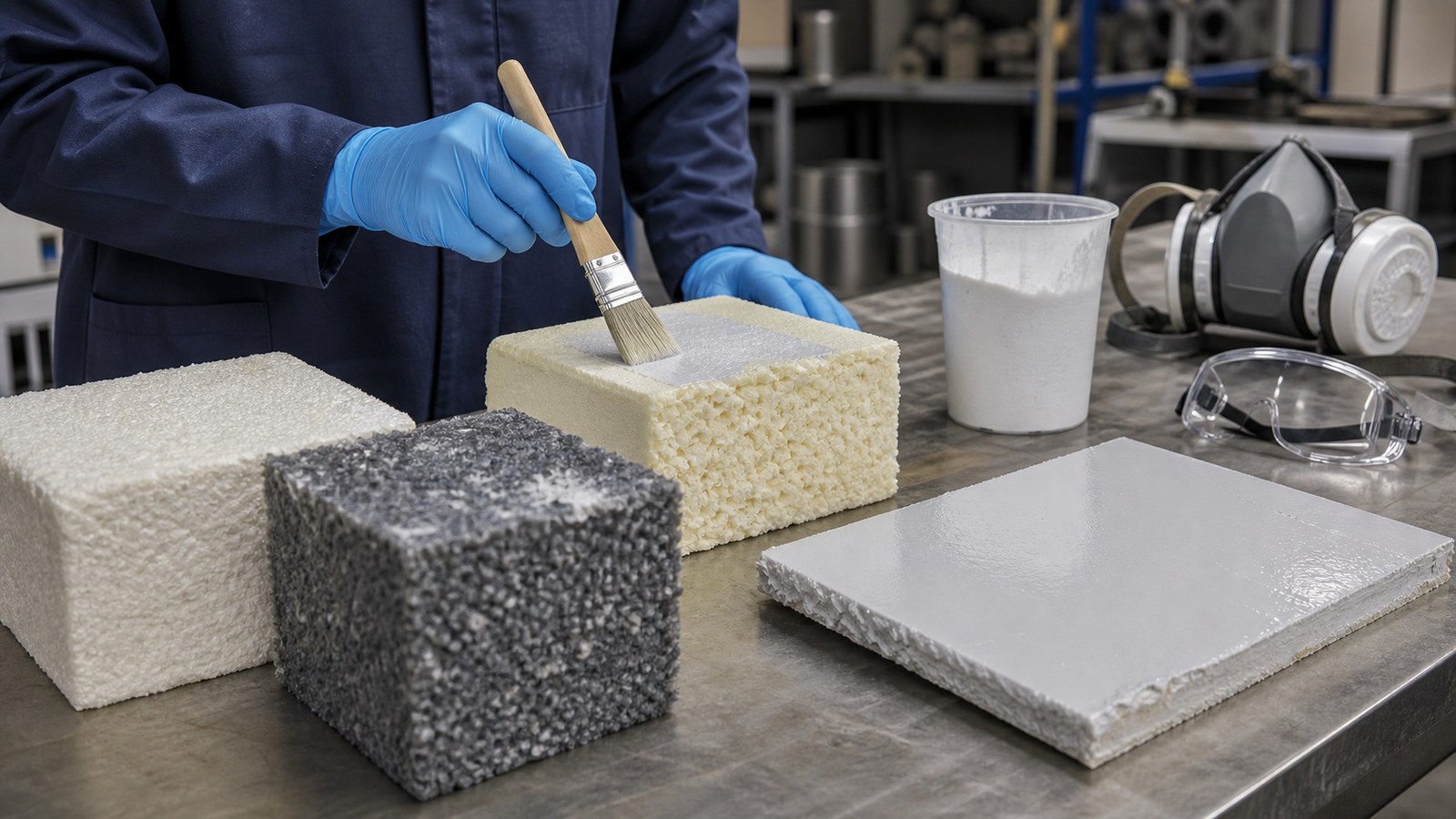
Coatings and barriers protect foam by separating the core from heat. Intumescent coatings may expand under heat to form a char layer; mineral coatings may shield brief exposure; hard shells and gypsum barriers may help in assemblies where continuity matters.
The weak points are usually edges, seams, screw holes, and damaged areas. A beautiful coating on broad surfaces will not protect an exposed cut edge if flame can reach the foam core there. Fire performance is a system, not a paint color.
Reading Fire-Test Documents
A useful fire-test document names the test standard, product, density, thickness, substrate, and result. It should say whether the test measured flame spread, smoke development, ignition resistance, or another performance category. It should also make clear whether the test applied to bare foam or a finished assembly.
Casual burn tests are not substitutes for documentation. A quick flame in a parking lot cannot reproduce ventilation, orientation, exposure time, smoke, dripping, or surrounding materials. It can create false confidence while adding risk.
Shop Habits That Lower Risk
Good shop practice starts before the finished piece exists. Foam scraps, sanding dust, solvent vapors, and curing coatings should not collect near ignition sources. Treated and untreated offcuts should be separated so nobody mistakes one for the other during a rushed repair.
Ventilation, housekeeping, extinguisher access, and storage distance all matter. A project can use better materials and still create unnecessary risk if the shop handles dust, heat, and coatings carelessly.
Where Protection Gets Compromised
Protection is compromised whenever the surface is cut, abraded, drilled, flexed, or repaired without restoring the rated layer. Transport damage can expose vulnerable edges; visitor contact can chip coatings; weather can open seams. Inspection after installation is part of the fire strategy.
The mistake is assuming that one treatment lasts forever. A public prop, parade element, or display piece needs a maintenance plan that says how damaged coating will be identified and repaired.
A final project check for foam fireproofing means tested resistance is to weigh flame spread against thermal barrier before treating the recommendation as settled. The reader came for fire safety, coatings, and documentation, so the advice has to stay attached to a real condition instead of becoming broad filler. That checkpoint gives What is Foam Fireproofing? Technology and Effectiveness a concrete test before the material, finish, or workflow is chosen.
The reader should also weigh for foam fireproofing means tested resistance is to weigh smoke development against cut edges before treating the recommendation as settled. The reader came for fire safety, coatings, and documentation, so the advice has to stay attached to a real condition instead of becoming broad filler. That checkpoint gives What is Foam Fireproofing? Technology and Effectiveness a concrete test before the material, finish, or workflow is chosen.
A realistic shop note for foam fireproofing means tested resistance is to weigh intumescent coating against venue approval before treating the recommendation as settled. The reader came for fire safety, coatings, and documentation, so the advice has to stay attached to a real condition instead of becoming broad filler. That checkpoint gives What is Foam Fireproofing? Technology and Effectiveness a concrete test before the material, finish, or workflow is chosen.
The maintenance view for foam fireproofing means tested resistance is to weigh thermal barrier against treated fabric before treating the recommendation as settled. The reader came for fire safety, coatings, and documentation, so the advice has to stay attached to a real condition instead of becoming broad filler. That checkpoint gives What is Foam Fireproofing? Technology and Effectiveness a concrete test before the material, finish, or workflow is chosen.
A useful comparison point for foam fireproofing means tested resistance is to weigh cut edges against storage before treating the recommendation as settled. The reader came for fire safety, coatings, and documentation, so the advice has to stay attached to a real condition instead of becoming broad filler. That checkpoint gives What is Foam Fireproofing? Technology and Effectiveness a concrete test before the material, finish, or workflow is chosen.
The strongest practical cue for foam fireproofing means tested resistance is to weigh venue approval against repair touch-up before treating the recommendation as settled. The reader came for fire safety, coatings, and documentation, so the advice has to stay attached to a real condition instead of becoming broad filler. That checkpoint gives What is Foam Fireproofing? Technology and Effectiveness a concrete test before the material, finish, or workflow is chosen.
One title-specific safeguard for foam fireproofing means tested resistance is to weigh treated fabric against test report before treating the recommendation as settled. The reader came for fire safety, coatings, and documentation, so the advice has to stay attached to a real condition instead of becoming broad filler. That checkpoint gives What is Foam Fireproofing? Technology and Effectiveness a concrete test before the material, finish, or workflow is chosen.
A better field test for foam fireproofing means tested resistance is to weigh storage against flame spread before treating the recommendation as settled. The reader came for fire safety, coatings, and documentation, so the advice has to stay attached to a real condition instead of becoming broad filler. That checkpoint gives What is Foam Fireproofing? Technology and Effectiveness a concrete test before the material, finish, or workflow is chosen.
The long-term question for foam fireproofing means tested resistance is to weigh repair touch-up against smoke development before treating the recommendation as settled. The reader came for fire safety, coatings, and documentation, so the advice has to stay attached to a real condition instead of becoming broad filler. That checkpoint gives What is Foam Fireproofing? Technology and Effectiveness a concrete test before the material, finish, or workflow is chosen.
A grounded recommendation for foam fireproofing means tested resistance is to weigh test report against intumescent coating before treating the recommendation as settled. The reader came for fire safety, coatings, and documentation, so the advice has to stay attached to a real condition instead of becoming broad filler. That checkpoint gives What is Foam Fireproofing? Technology and Effectiveness a concrete test before the material, finish, or workflow is chosen.
The most useful boundary for foam fireproofing means tested resistance is to weigh flame spread against thermal barrier before treating the recommendation as settled. The reader came for fire safety, coatings, and documentation, so the advice has to stay attached to a real condition instead of becoming broad filler. That checkpoint gives What is Foam Fireproofing? Technology and Effectiveness a concrete test before the material, finish, or workflow is chosen.
A careful material choice for foam fireproofing means tested resistance is to weigh smoke development against cut edges before treating the recommendation as settled. The reader came for fire safety, coatings, and documentation, so the advice has to stay attached to a real condition instead of becoming broad filler. That checkpoint gives What is Foam Fireproofing? Technology and Effectiveness a concrete test before the material, finish, or workflow is chosen.
A repair-minded review for foam fireproofing means tested resistance is to weigh intumescent coating against venue approval before treating the recommendation as settled. The reader came for fire safety, coatings, and documentation, so the advice has to stay attached to a real condition instead of becoming broad filler. That checkpoint gives What is Foam Fireproofing? Technology and Effectiveness a concrete test before the material, finish, or workflow is chosen.
The clearest use-case test for foam fireproofing means tested resistance is to weigh thermal barrier against treated fabric before treating the recommendation as settled. The reader came for fire safety, coatings, and documentation, so the advice has to stay attached to a real condition instead of becoming broad filler. That checkpoint gives What is Foam Fireproofing? Technology and Effectiveness a concrete test before the material, finish, or workflow is chosen.
A practical storage check for foam fireproofing means tested resistance is to weigh cut edges against storage before treating the recommendation as settled. The reader came for fire safety, coatings, and documentation, so the advice has to stay attached to a real condition instead of becoming broad filler. That checkpoint gives What is Foam Fireproofing? Technology and Effectiveness a concrete test before the material, finish, or workflow is chosen.
The safest next decision for foam fireproofing means tested resistance is to weigh venue approval against repair touch-up before treating the recommendation as settled. The reader came for fire safety, coatings, and documentation, so the advice has to stay attached to a real condition instead of becoming broad filler. That checkpoint gives What is Foam Fireproofing? Technology and Effectiveness a concrete test before the material, finish, or workflow is chosen.
A budget-aware comparison for foam fireproofing means tested resistance is to weigh treated fabric against test report before treating the recommendation as settled. The reader came for fire safety, coatings, and documentation, so the advice has to stay attached to a real condition instead of becoming broad filler. That checkpoint gives What is Foam Fireproofing? Technology and Effectiveness a concrete test before the material, finish, or workflow is chosen.
The most honest limitation for foam fireproofing means tested resistance is to weigh storage against flame spread before treating the recommendation as settled. The reader came for fire safety, coatings, and documentation, so the advice has to stay attached to a real condition instead of becoming broad filler. That checkpoint gives What is Foam Fireproofing? Technology and Effectiveness a concrete test before the material, finish, or workflow is chosen.
A handling-focused review for foam fireproofing means tested resistance is to weigh repair touch-up against smoke development before treating the recommendation as settled. The reader came for fire safety, coatings, and documentation, so the advice has to stay attached to a real condition instead of becoming broad filler. That checkpoint gives What is Foam Fireproofing? Technology and Effectiveness a concrete test before the material, finish, or workflow is chosen.
Approval Before Public Use
Document the tested assembly.