What Mattress Edge Support Actually Describes
Mattress edge support is the way the perimeter responds when weight moves near it. In a foam mattress, that response may come from the main support core, a reinforced foam border, or a combination of layers. In a hybrid, it may also involve the coil system. The purpose is not to make the side feel like a rigid bench. It is to keep the useful sleep surface and ordinary entry and exit behavior consistent with the mattress’s intended design. Sitting on the edge and lying close to it apply different loads, so one quick showroom squeeze cannot describe both. Understanding that distinction makes edge support easier to evaluate without confusing it with overall firmness, medical suitability, or a guarantee against every kind of sagging.
A: Not necessarily. Sitting and lying distribute load differently and should be evaluated separately.
A: No. Edge response can also come from the main support core and overall construction.
A: No. Overall firmness and perimeter behavior are different characteristics.
A: Yes. Some hybrids use reinforced perimeter coils rather than relying only on a foam border.
A: An unsuitable or damaged support can change how the mattress behaves.
A: It may change surface feel without restoring the underlying support.
A: No. Use the current instructions for the actual product.
A: Not without appropriate evidence and assessment for that specialized need.
A: State the position, location, observed change, timing, and support system.
A: How often and in what way you use the perimeter during ordinary bed use.
Compare a Seated Edge with a Sleeping Edge
When a person sits near the side, much of their load may be concentrated in a relatively small region. When lying down, the load is spread along more of the mattress. A perimeter that compresses noticeably while seated can still feel adequately supported during sleep. Conversely, a firm sitting edge does not prove that the adjacent comfort layers suit a sleeper. Evaluate both situations if both matter to you. Keep the distinction clear in reviews and comparisons: a report that an edge collapsed may describe a seated impression rather than the experience of sleeping near the side.
Use normal, appropriate movements instead of dramatic edge tests. Sit in the position you ordinarily use to put on slippers, then lie in your usual sleep position at a realistic distance from the side. Notice whether you feel a gradual change, an abrupt drop in support, or pressure from a firm border. Do not deliberately balance on the extreme edge to create a failure demonstration. If mobility or balance makes a trial difficult, arrange suitable assistance and seek relevant professional advice rather than using an ordinary mattress-shopping test as a clinical transfer assessment.
Understand the Main Perimeter Constructions
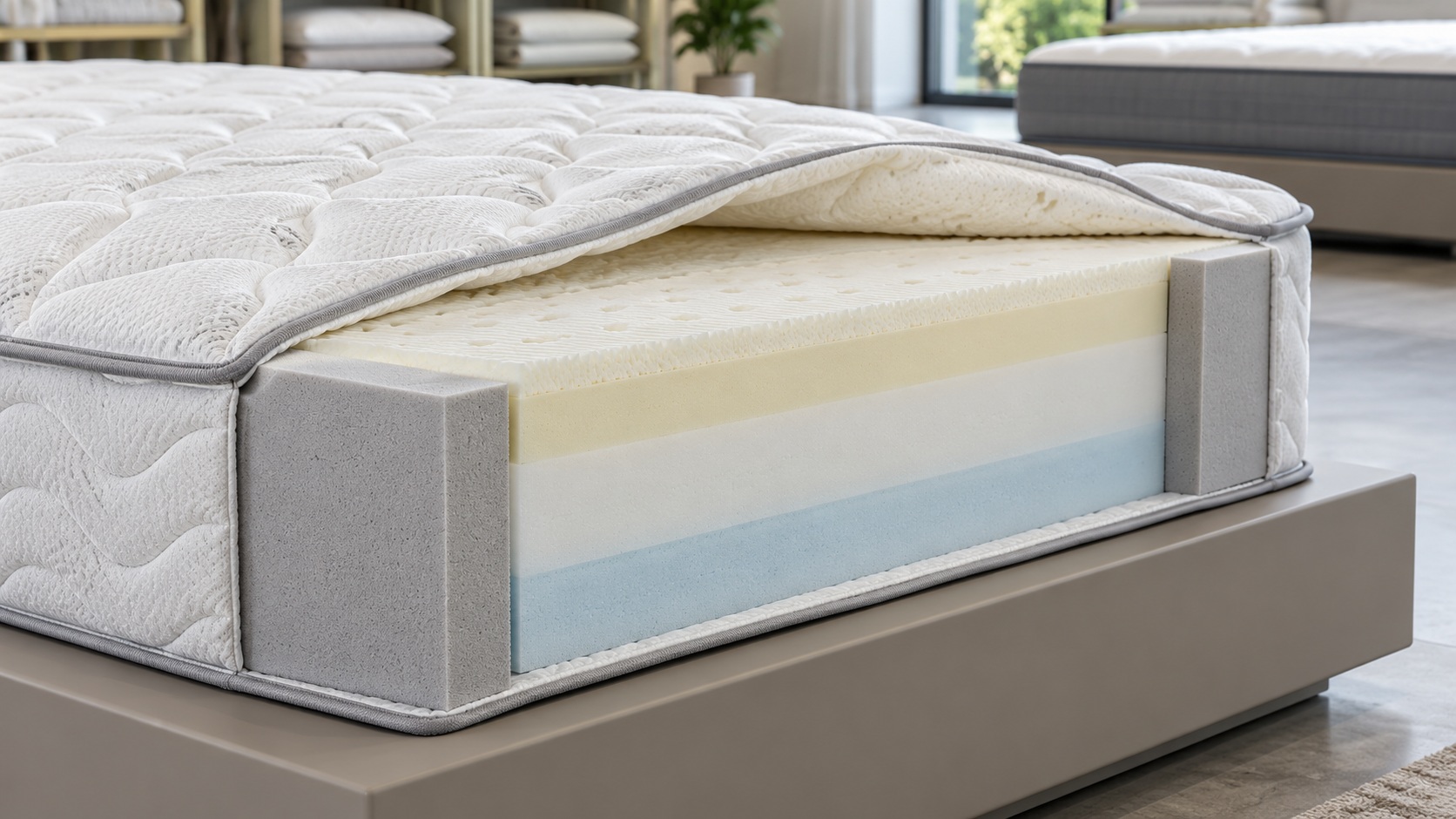
A foam-encased mattress uses a defined border around another support region. The border’s material, dimensions, connections, and relationship to the upper layers all influence how the edge feels. A simple diagram may show a neat rectangular rail, but the finished response depends on the whole construction. Ask whether the advertised border applies to the exact model and size being considered. Product families can contain several constructions, and a familiar edge-support name may not mean every mattress in the range has the same arrangement. The current specification matters more than a general brand description.
A hybrid can obtain perimeter support through coils rather than, or alongside, a foam rail. Sealy’s construction overview describes both reinforced foam-border and coil-edge approaches in its product discussion. Those are examples of different engineering routes, not a ranking that makes one category universally superior. Foam and coil designs can each vary substantially. Compare the actual model’s response, documentation, and intended use instead of assuming that every foam edge is weak or every reinforced coil edge must suit your preferences.
Some all-foam designs rely on the support core without a separately identified perimeter rail. That does not automatically establish inadequate edge behavior. Core properties, mattress geometry, and comfort-layer thickness still affect the result. Likewise, adding a rail is not proof that every part of the sleep surface becomes equally comfortable. A broad or firm border can create a perceptible transition for some users. The useful question is what the mattress feels like across the area you actually use, including the place where your shoulder or hip rests near the perimeter.
Reinforcement should be understood as part of a product, not as an accessory you can reliably add from outside. A loose wedge, board, or improvised foam strip beside a mattress does not reproduce an integrated engineered border. It can change fit and introduce other problems while leaving the original cause of softening unresolved. Do not open or modify a mattress to install a rail based on a diagram. Ask the manufacturer about an observed problem and follow its instructions. Preserving the intact construction also avoids disturbing components that may have functions beyond the visible comfort layers.
Firmness, Density, and Thickness Interact at the Edge
A mattress’s overall firmness label describes a broad sensation, not a precise edge specification. Two medium-feeling models can have different perimeter behavior, while a firm center does not guarantee a firm sitting edge. Foam density is also distinct from firmness. The Polyurethane Foam Association’s discussion of support and firmness explains why surface resistance and deeper compression response are separate considerations. Use product information and a representative trial together. Neither the softest surface layer nor the densest advertised component describes the complete edge response on its own.
Comfort layers can soften the first contact even over a more resistant perimeter below. That may feel pleasant while lying down but produce more visible compression when seated. Thickness changes the travel available before deeper support becomes noticeable. Do not compare the rail alone with the completed mattress as though they were the same product. Ask which layer the specification describes and whether the demonstration model has the same cover, quilting, and topper arrangement as the one you intend to use. A promotional cutaway is useful for understanding location, not for predicting the full sensation by sight.
Body size, position, and duration influence a trial. A brief seated impression from one person is not a universal score for every user. If two people share a bed, each should consider the relevant edge and sleep positions. A person who sleeps well inside the perimeter may place less importance on edge reinforcement than someone who regularly uses the full width. Keep preference separate from a defect claim. A mattress can be functioning as designed yet feel wrong for a particular routine, which is why return and trial terms matter alongside construction details.
The Foundation Can Change the Interpretation
Before concluding that a perimeter has failed, inspect the support beneath the mattress according to the manufacturer’s directions. The foundation, slats, center support, frame condition, and mattress fit can all matter to the system. A mattress overhanging an unsuitable base is not the same test as one properly supported. Do not use a universal slat-spacing rule copied from another brand. Tempur-Pedic’s foundation guidance illustrates how a manufacturer specifies compatible support and warranty conditions for its own products. Check the current requirements for your actual mattress, model, and market.
An adjustable base adds another compatibility question. The mattress and its edge construction need to suit the intended movement, while the base has its own operating instructions. Do not assume an improvised stiff perimeter modification will cooperate with articulation. If the edge feels different in a raised position, ask the responsible supplier to help distinguish expected behavior from a support or compatibility problem. Keep the mattress centered and installed as directed. Any concern involving damaged equipment or unstable support deserves assessment before continued use, not a cosmetic attempt to hide the visible symptom.
Make a Showroom or Home Trial More Informative
Compare mattresses under conditions close to your normal setup. Note the base, topper, protector, and bedding used during the trial. A thick add-on layer can change both the height and the perceived edge, even if it does not alter the underlying support construction. Try your ordinary sleeping position and the usual transition between sitting and lying. Ask the retailer to identify the exact display model rather than relying on a broad collection name. Differences between model years or versions can make an old review less useful than a current specification and direct trial.
Spend enough time to notice how the surface settles. Some foams change response with time under load and temperature, so the first few seconds may not represent the later impression. There is no universal waiting period that makes every trial conclusive. Follow any product acclimation guidance and compare the same routine across candidates. Write concise observations rather than only a number: the edge feels gradual while lying, the border is noticeable under a hip, or sitting raises concern about the intended routine. Specific notes make it easier to discuss the result with the supplier.
Read the trial, return, and warranty terms before purchase. These documents address different situations and may impose different conditions. A comfort return is not the same process as a warranty claim for a manufacturing defect. Ask how edge concerns are assessed and what documentation is required, without assuming that every visible compression qualifies. Keep the invoice, model identification, and foundation information. A well documented purchase does not guarantee the mattress will suit you, but it reduces confusion if the trial reveals a mismatch or a later concern requires the manufacturer’s review.
Recognize Change Without Diagnosing by Appearance Alone
Visible compression under load differs from an unloaded depression. A mattress may be designed to yield and recover, while a persistent change can require a different enquiry. Follow the manufacturer’s inspection and measurement instructions rather than inventing a defect threshold. Photograph the condition consistently and note the support system and history. Do not stand or kneel on the mattress to exaggerate the symptom. If the perimeter has changed enough to make ordinary use concerning, contact the supplier promptly and describe what changed, when it appeared, and whether it occurs on one side or several locations.
Care instructions should remain product-specific. Some mattresses may be rotated under the manufacturer’s guidance; others have different requirements, and a one-sided mattress should not be flipped by habit. Avoid assuming that rotation repairs a failed component or that a topper restores a damaged edge. A topper can change surface comfort without solving the deeper issue. Keep cleaning and moisture care within the approved methods as well. An attempt to repair or reshape the core with heat, solvents, or unapproved cutting introduces new risks and can obscure the evidence needed for a proper assessment.
Choose the Importance of Edge Support for Your Routine
Edge behavior matters most when the edge is part of daily use. Shared beds can make the usable width important, and some people habitually sit near the side while dressing. Others seldom approach the perimeter except when getting in and out. Describe your own routine before ranking candidates. Stronger seated resistance may be a priority for one buyer but less important than pressure comfort or ease of repositioning for another. No single feature makes a mattress universally best. Evaluate the tradeoff within the complete product and the practical options available during its trial period.
Do not turn reinforced edges into a fall-prevention or mobility-treatment claim. A mattress is not automatically a clinical transfer system, and a product that feels stable in a showroom may still be unsuitable for someone with specific needs. Seek appropriate professional guidance where those needs exist. Ordinary shopping observations remain useful for comfort and preference, but they should not be used to certify safety for a different task. Avoid assuming that a firmer border removes the need to assess bed height, surrounding space, assistance, or other relevant equipment.
The most useful answer from a retailer combines explanation and evidence: the model’s construction, the compatible foundation, the intended care, and the terms under which you can evaluate it. Treat proprietary names as prompts for those questions rather than conclusions. Foam edge support can improve perimeter consistency when it is well matched to the mattress, but the result is still something experienced through the whole system. Compare it in the positions that matter, record the tradeoffs, and keep claims proportionate to what the manufacturer documents and your own trial actually demonstrates.
Evaluate the Perimeter as Part of the Bed
Foam edge support is about usable response, not a rigid-border promise. Compare sitting and lying separately, verify the foundation, and choose the complete mattress around the routine it needs to serve.