Design the Second Installation While Drawing the First
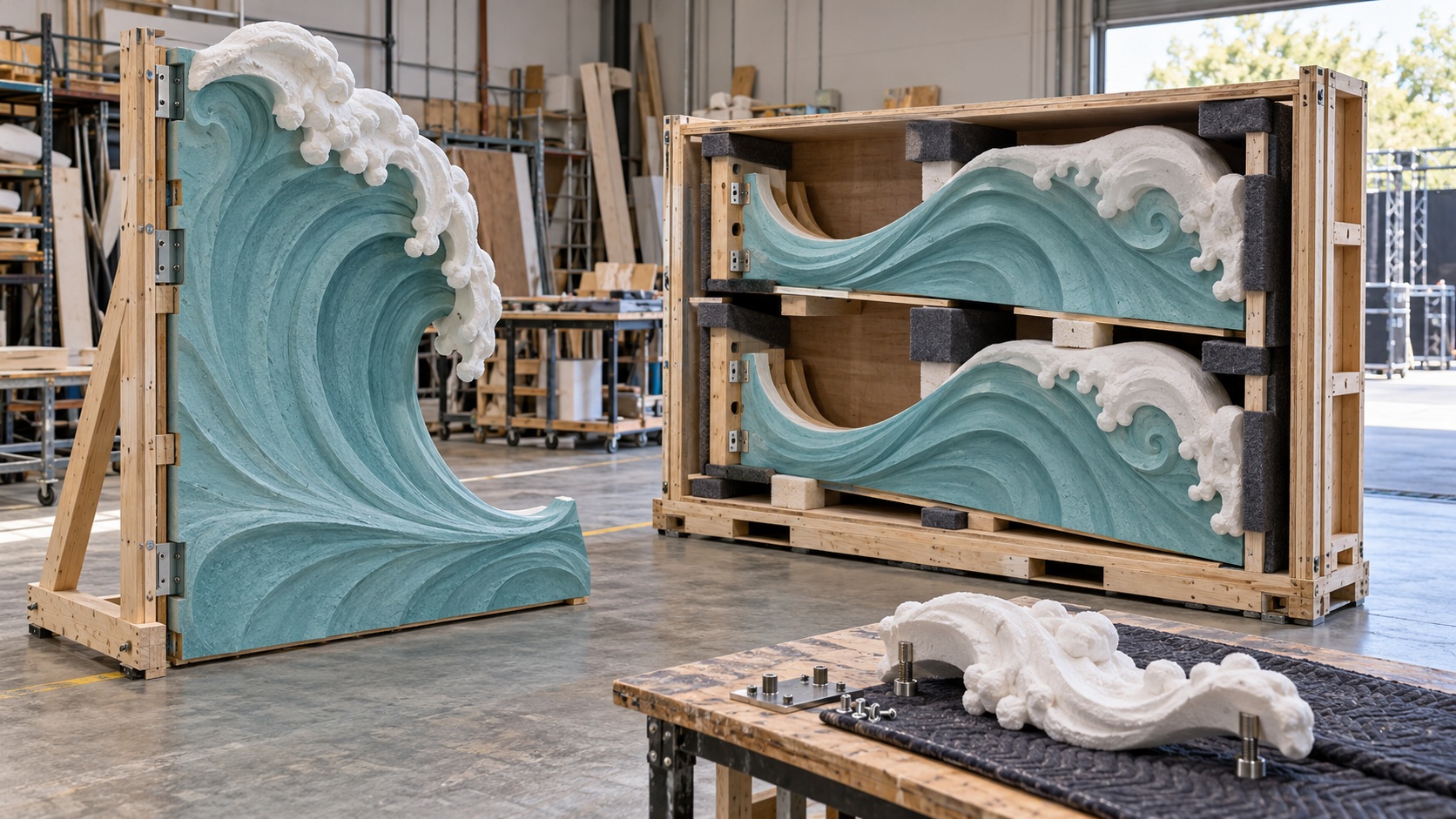
A circular festival build is not simply a sculpture kept after the event. It is a set of useful components that can be located, packed, inspected, rebuilt, adapted, and eventually directed to an appropriate next route. Foam’s low mass can help handling, but its bulky geometry and vulnerable surfaces can make repeated transport difficult. The design must preserve more than raw material: it must preserve recognizable shapes, workable interfaces, and the information needed to assemble them correctly. Imagine a wave-shaped decorative wall whose supporting modules remain useful while crest details and color treatments change. That is an illustrative opportunity, not a promise that every foam object can become a universal kit. Choose a realistic family of future uses, then design the connections and records that make those uses achievable.
A: Retention is only one step; useful repeat deployment and a managed next route need evidence.
A: Balance the visual form with handling, route, packing, storage, and connection needs.
A: Only within assessed configurations; new layouts can change structural and operational demands.
A: It reveals volume, pressure points, and access needs that the installed drawing cannot show.
A: It helps show whether the written sequence works without relying on the original maker's improvisation.
A: Not if it prevents the intended disassembly; use an approved visible or removable treatment.
A: Identity, layers, connections, versions, repairs, handling limits, and review information tied to the actual kit.
A: No. Each new setting needs the relevant review for its conditions and use.
A: Not alone; a broader quantified claim needs a suitable assessment and data.
A: Through documented component-specific repair, reuse, or confirmed recovery and disposal routes.
Define What Will Circulate
Decide whether the reusable unit is the whole sculpture, a supported scenic module, a backing frame, or a smaller decorative component. These choices lead to different connections and packing. Keeping a complete foam face intact may preserve artistic labor, while separating its support may improve transport. Do not call the whole object reusable if only a small frame is likely to return. State the intended unit clearly so design, inventory, and outcome records refer to the same thing.
Describe the likely next settings. A wall reused indoors at a similar scale is a narrower and more credible target than any future festival anywhere. Different heights, outdoor exposure, public access, and support conditions can require new review. Reuse-friendly construction should make that review easier by preserving information, not bypass it. Keep the object’s original limitations visible so the next production team does not infer unlimited capability from a modular appearance.
Choose which visual elements can change without undermining the system. On the wave example, the backing geometry and main module boundaries might remain fixed while removable crests or applied graphic panels vary. A different story may call for a completely different silhouette, making the kit less useful. Accept that limit. Circular design works through suitable repeat use, not through forcing every new creative brief into the shape of the previous production.
Separate Durable Interfaces From Consumable Finish
Identify the connections likely to experience repeated assembly, handling, or repair. Give those interfaces suitable structure and access rather than relying on screws driven repeatedly into fragile foam. The decorative skin and the supporting assembly have different roles. Have structural and installation requirements resolved by competent people for the actual use. A durable-looking connector does not establish the capacity of the material behind it, and a reused support still needs evaluation when the site or configuration changes. Make removable cosmetic covers easy to identify and release. A joint hidden under permanent filler can defeat disassembly even when the underlying connection is mechanical. Decide where a visible reveal is acceptable and where a separate seam cover belongs. Test the complete finished interface through assembly and removal. Paint thickness, repair buildup, and slightly distorted packing can change fit over time. A connection that works only before finishing has not yet demonstrated reusable service.
Divide the Form Into Useful Modules
Use module size to balance transport, handling, storage, and the visual composition. Tiny pieces increase assembly and inventory work; oversized pieces may fit the show but not the truck or storage rack. Measure the real route, including turns and loading access. The Theatre Green Book modular-design toolkit distinguishes geometric and functional approaches. For foam scenery, that distinction is useful: a removable carved face and a reconfigurable support can circulate differently rather than forcing every layer to share one division.
Keep a common dimensional reference across the kit. Record the module envelope, connection locations, clearances, and orientation. If two parts are not interchangeable, make that explicit. Similar-looking wave panels may have different curvature or support details. Label them discreetly in durable accessible locations and connect the labels to drawings. An installer should not have to infer correct placement from a publicity photograph or discover incompatibility only after lifting a module into position.
Preserve critical contours across joins. A flowing crest can tolerate a planned break, but an accidental step may interrupt the whole silhouette. Dry-fit the modules under side light and inspect from the audience approach. Use removable overlaps or separate details where they genuinely improve both appearance and serviceability. Avoid a delicate foam projection that bridges several independently moving panels unless its support, installation, and removal have been resolved specifically.
Reserve flexibility for future layouts without claiming more than the system allows. A flat wall kit might support several widths through approved combinations, while a curved sculptural kit may have only one reliable arrangement. Record the permitted configurations and the reviews needed for anything else. Modular does not mean structurally arbitrary. A new geometry can change loads and clearances even if every individual component has been used before.
Design the Packed Shape as Another Configuration
Draw the packed arrangement alongside the installed elevation. Include supports, separation, handling access, and the volume of the actual rack or crate. Low mass does not eliminate shipping volume, and a nest that looks efficient on paper may place pressure on vulnerable crests. Support suitable broad or structural regions and keep painted faces from rubbing. The transport package is part of the reusable system, not a wrapping task left until the finished pieces are occupying the loading area.
Give removable packing blocks their own home in the rack after unloading. Otherwise they may be mistaken for disposable scraps and vanish before strike. A reusable transport design should explain both its loaded state and what happens to its protection pieces while the scenery is on display.
Prototype Repeated Assembly, Not Just First Fit
Rehearse the intended sequence with the actual fasteners, covers, tools, and access positions. Document where each inspection occurs before the next piece hides it. A first assembly can succeed through improvised adjustments that nobody remembers later. Remove the modules and repeat the sequence using the written record. This is a practical way to learn whether the design has become a repeatable system or still depends on the original fabricator standing beside every connection.
Observe where wear begins. Edge chips, enlarged locating holes, scuffed paint, and trapped cover fasteners indicate different problems. Do not solve every issue by adding more permanent adhesive; that may sacrifice future disassembly. Revise the interface or packing where appropriate, and keep repairs compatible with the material system. A small replaceable detail can be valuable when it is the part most likely to suffer contact, but it needs its own stock and identification plan.
Measure the actual labor and tools needed. A kit that saves raw material but doubles site labor may still be worthwhile, yet that tradeoff belongs in planning and pricing. Record the crew size, access equipment, and approximate operation time under the rehearsed conditions. Do not present the best workshop trial as a guaranteed installation duration at every festival. Venue conditions and weather can change the operation even when the components remain identical.
Keep a Material Passport With the Components
Create a concise record for each module or kit: foam and backing identity, coating system, relevant supplier information, connection drawings, completed repairs, handling limits, and intended exposure. Call it a passport only if it actually travels with the object in a retrievable form. A decorative QR code is not useful when its link points to an abandoned account. Keep an accessible copy in the shop’s normal records and define who updates it after changes.
Separate visual version from structural version. A repaint may change color and sheen without altering support, while a modified base can change the installation arrangement even when the front looks the same. Record both. If a replacement crest uses a different material, update the material list and review any resulting acceptance requirements. Version control prevents a future team from applying instructions for an earlier configuration to an assembly that has quietly evolved.
Provide a component inventory that can be checked during packing and receiving. Include specific fasteners, covers, spares, and handling accessories rather than listing only the large scenic pieces. Missing small parts can disable an otherwise intact kit or encourage improvised substitutions. Use containers and layouts that make completeness visible. A photograph of the correctly packed rack can be more useful at a late-night strike than a long descriptive paragraph buried in a design report.
Keep review responsibilities explicit. Each new venue needs the appropriate assessment of support, electrical arrangements, access, material acceptance, and public interaction. The passport supplies evidence; it is not a universal permit. EPA’s design-for-adaptability guidance supports retaining information for future disassembly and reuse. Apply that principle while respecting the project-specific decisions that cannot be settled by a generic modular label.
Receive the Return Before It Disappears Into Storage
Inspect returned modules while the event history is still available. Note contact damage, moisture, missing parts, changed hardware, and unauthorized repairs. Compare with the dispatch record. A surface that looks acceptable from a distance may conceal a damaged interface or a wet cavity. Direct concerns to the responsible specialist before approving the next use. Storage should preserve an understood condition, not hide an unresolved problem until the next delivery date. Assign locations and repair status. Keep damaged or awaiting-review items distinguishable from ready-to-deploy stock. Provide suitable racks and environmental conditions for the actual materials. Do not stack broad foam modules in a way that slowly deforms their faces or loads their fragile details. Schedule repairs outside the next installation rush and retain the updated condition record. The circular service is only useful if the shop can find a complete, serviceable kit when it is needed.
Measure Circulation Through Real Use
Track actual installations, modules retained, replaced details, repair work, packaging changes, and residual waste. A kit stored for several years without a second use has not demonstrated repeated circulation merely because it was designed for it. Record planned and completed uses separately. Likewise, replacing one small crest is different from rebuilding most of the scenic face around an old frame. Clear boundaries make the outcome meaningful and help identify whether the system is delivering its intended value.
Avoid universal environmental claims from reuse count alone. Transport, repair materials, storage, and the alternative being compared can affect the broader assessment. Report what is known, such as the same backing modules serving three documented installations, without inventing an emissions equivalent. If a client requires quantified life-cycle results, use an appropriate method and data. Operational evidence is valuable even when the shop cannot credibly summarize the whole system in one sustainability percentage.
Plan retirement component by component. Some supports may be reused again, some details may be repaired, and some bonded surfaces may need a confirmed waste route. Ask receivers about the actual post-use material rather than assuming clean packaging-foam acceptance applies to painted scenery. A circular ambition should not end in an unsupported promise of universal recycling. Document the limitations and use them to improve the next version of the kit.
Make the Loop a Working System
Useful circular scenery combines serviceable modules, protected packing, accessible information, and real repeat use. Design those relationships early, then let inspection and return experience improve the system rather than treating storage as proof of success.