Texture Can Reuse Material Without Making the Whole Sculpture Green
Burlap, paper pulp, and plant-derived fillers can give foam a surface character that would take much longer to carve: a coarse weave, an irregular fibrous skin, or a granular relief. Recovered material can also displace some newly purchased decorative material. Neither benefit makes every resulting sculpture automatically eco-friendly. The binder, coating, foam core, service life, and eventual disposal still matter. A natural fiber permanently bonded to plastic becomes part of a composite, not a guarantee of compostability. The useful approach is to choose the texture for a specific visual job, use documented compatible materials, test the complete finish, and describe any environmental improvement precisely. A well planned experiment can create a convincing surface while avoiding both unnecessary layers and exaggerated claims.
A: No. The whole bonded assembly and its disposal route must be considered.
A: Its regular geometry can continue to cast recognizable shadows.
A: Not reliably without identifying and controlling the ingredients and process.
A: A broad area, a recess, a corner, and the intended finish sequence.
A: No. Follow the actual material information and appropriate process controls.
A: No. A consequential joint needs its own suitable connection and assessment.
A: Test the maintenance method or select a surface better suited to that duty.
A: Not by assumption. Obtain relevant support for the complete exterior system.
A: A specific documented recovered input or retained component used for an actual purpose.
A: When it cannot deliver the intended appearance and practical service without disproportionate rework or unsupported claims.
Let the Intended Surface Lead the Material Choice
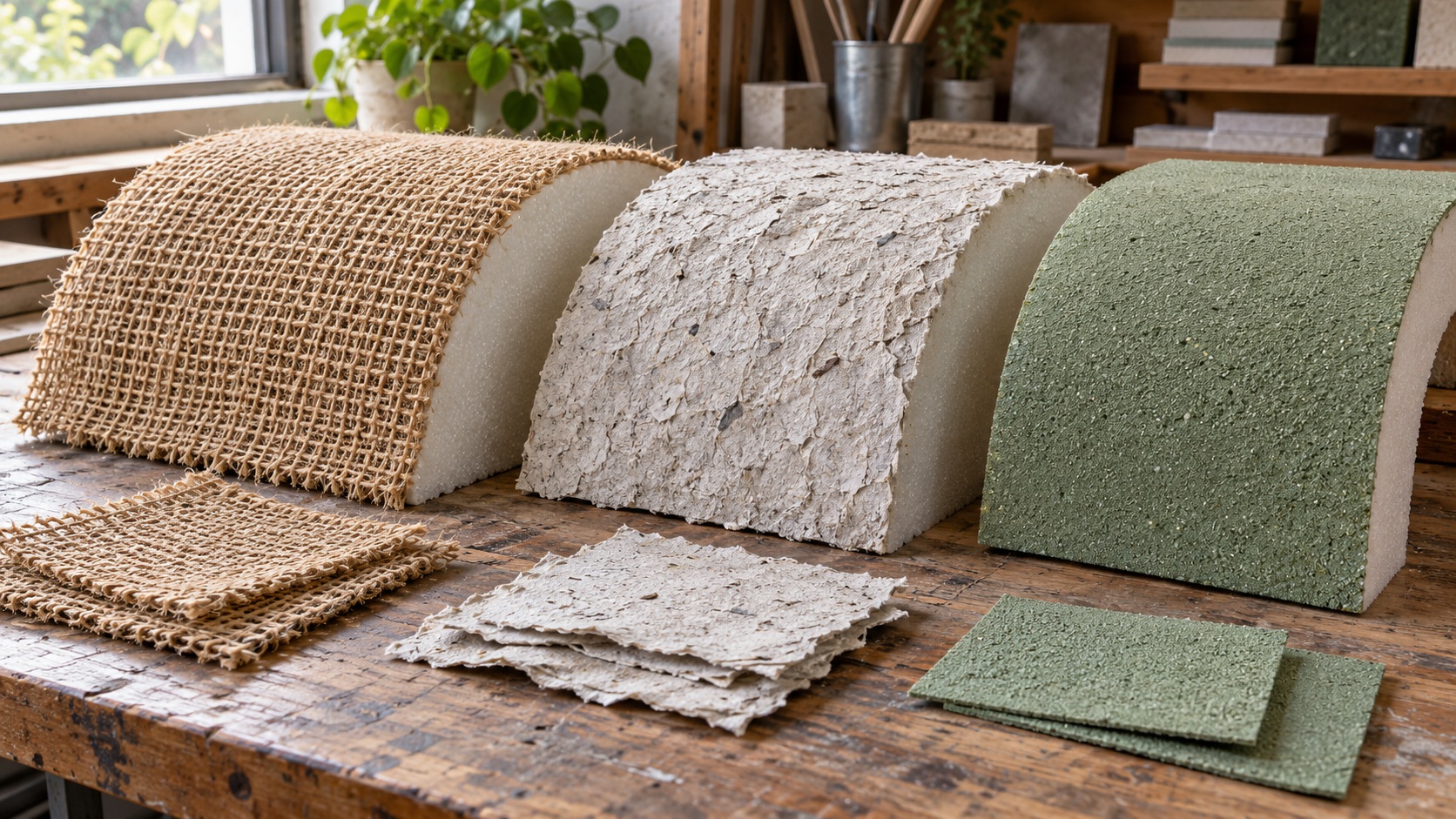
Start with the scale and character of the texture you need. Burlap brings an organized weave with visible directional threads. Paper pulp can produce a more irregular continuous surface. A granular filler introduces a different distribution of small highlights and shadows. Those effects are not interchangeable substitutes for the same finish. View samples at the intended audience distance and under relevant light. A texture that seems crude at the bench may read convincingly across a room, while a subtle fibrous surface may disappear at event scale. Choose the material because its structure contributes to the image, not simply because it is available in a scrap bin.
Decide whether the material should remain identifiable. Visible burlap can communicate cloth or a deliberate constructed surface; buried weave can become a suggestion of rough masonry or skin. Pulp can remain visibly papery or be shaped into a more ambiguous relief. The amount and type of coating affect that reading. A thick uniform layer can erase the texture that justified using the material, while too little coverage may leave a loose or visually distracting surface. Make this an artistic decision before treating adhesion and paint as separate later problems.
Burlap Adds Direction as Well as Roughness
The weave has a direction, and that direction can become part of the composition. Align it deliberately across a broad plane or change it at a meaningful boundary. Randomly rotated pieces may create a patchwork that remains visible through the finish. That can be useful for a repaired or assembled aesthetic, but distracting where the goal is a continuous natural surface. Lay dry pieces over the foam to explore the pattern before bonding. Photograph the arrangement and note where joins occur. The trial shows whether the fabric’s repeat supports the shape or fights its curvature.
A woven fabric does not conform to every compound curve without adjustment. Plan joins, overlaps, or smaller sections rather than forcing material into a shape it resists. A raised overlap can become an unwanted ridge after coating. Place it where the form can accommodate it, or treat it as a deliberate seam. Check the contact at concave areas as well as the easy convex faces. A piece that looks fitted while pressed by hand may lift when that pressure is removed. The bonding system and temporary support must suit the material and the chosen geometry.
Recovered sacks or fabric need assessment before use. Dirt, residues, unknown treatments, damaged fibers, and inconsistent weave can affect both appearance and processing. Do not assume a food-related origin establishes suitability for every studio application. Choose clean identified material and follow appropriate handling and preparation requirements. If the fabric cannot be made suitable without excessive work or uncertain chemical treatment, another source may be more sensible. Reuse is useful when it supplies a workable material, not when the project becomes an improvised attempt to rehabilitate an unknown contaminated object.
Paper Pulp Creates a Different Kind of Skin
Pulp texture depends on the fibers, particle distribution, binder, application, and drying process. It can soften the visual regularity of a carved foam form and provide irregular shallow relief. Treat it as a surface system rather than a universal paste recipe. Select a documented product or a well characterized formulation appropriate to the intended work, and test it on the actual foam. Different recovered papers can behave differently; a glossy printed sheet, a plain tissue, and a heavier uncoated paper are not identical ingredients. Record the material source so a promising result can be repeated rather than guessed at.
Wet material introduces drying and dimensional questions. A thick application may dry differently through its depth, and an uneven skin can change as moisture leaves. Make a representative sample with a corner, recess, and broad area, then observe its condition after the required drying period. Do not pack or paint over a surface merely because the outer face feels ready. Follow the binder or product instructions for application and finishing. If the schedule cannot accommodate the process, use a thinner suitable system or a different texture method rather than trying to force a wet construction into an immediate deadline.
Use the pulp to add texture, not to repair an unresolved structural problem. A moving foam joint can remain a moving joint beneath a paper-based skin. If reinforcement or another support is required, design it appropriately rather than expecting added fibers to make the assembly load-bearing. Keep intended disassembly lines open or detail them separately. A continuous pulp layer can conceal where modules divide, making later removal destructive. The surface experiment should preserve the sculpture’s handling and assembly requirements instead of converting every accessible connection into a permanent seam.
For long-lived or significant works, paper choice and binder history deserve more care than they do in a short scenic trial. The Canadian Conservation Institute’s paper guidance illustrates that paper composition and storage conditions influence preservation. It is not a recipe for pulp over foam, but it cautions against treating all recovered paper as equivalent. Consult a conservator where original material or long-term collection value is involved. An appealing recycled texture can still introduce a component whose future behavior is poorly documented.
Define What a Bio-Filler Is Doing
Bio-filler is a broad description of material derived from biological sources, not a standardized sculptural product. In a texture system it might contribute particles, fibers, bulk, or a visual effect. Those functions need separate evaluation. Ask what the selected filler is, whether it is intended for the proposed binder, and what preparation and controls apply. Do not mix arbitrary plant waste into a coating simply because its origin sounds sustainable. Particle size, moisture, surface condition, and variability can change the result. A formulated product with relevant guidance can be easier to assess than an improvised blend of unknown scraps.
Test the filler at the intended scale of relief. Large particles can create sharp or vulnerable peaks, while fine material may alter application and handling requirements. Evaluate the dried or cured surface rather than only the wet appearance. Check whether particles remain attached, whether the binder surrounds them adequately, and whether the next coating changes the texture. Keep preparation within appropriate controls for the actual materials. A plant-derived powder is not automatically suitable to breathe, and a reassuring natural label does not replace product instructions or a workplace assessment of dust-producing processes.
Make a Comparison That Answers the Design Question
Prepare separate samples of the candidate textures on comparable foam pieces. Use the actual binder and finish sequence rather than comparing one unpainted weave with one fully painted pulp surface. Include an untreated reference and record the products, amounts in a consistent useful measure, application conditions, and observations. The purpose is not to create a numerical environmental ranking from a few samples. It is to discover which construction delivers the required texture with manageable material use and a credible service plan. Keep a successful sample as the standard for the larger work.
Evaluate seams and edges as carefully as broad faces. A texture that looks convincing in the middle of a coupon may unravel, lift, or form a conspicuous buildup at a boundary. Include a representative join and an accessible edge in the trial. Ask how the surface will meet a base, an accessory, or another module. If a later coating must bridge those transitions, test that sequence too. The finished sculpture will be judged as an assembly, so a convenient uninterrupted sample should not be allowed to stand in for every difficult detail.
Inspect the finish under both broad and raking light. Texture depends on shadow, and a painted surface can read differently from a raw material under studio lighting. Match color, sheen, and visual scale to the intended subject. Burlap might read as fabric even under a stone color if its grid remains too regular. Pulp might look like a repair patch if its boundary is too abrupt. Those are useful observations, not failures of the material category. Change the composition or application deliberately, then compare again without adding layers whose purpose is unclear.
Keep Exposure and Process Limits Honest
Indoor texture success does not establish exterior durability. Water exposure, sunlight, cleaning, handling, and storage can affect the composite in different ways. Obtain relevant guidance for every consequential use and keep the environment within the system’s supported limits.
A sealing coat is not a universal conversion from an indoor paper or textile construction to a permanent outdoor sculpture. Consider a protected short-term use, a replaceable textured module, or another material when the exposure is demanding. The surface should suit the setting rather than rely on an unverified promise of complete weatherproofing.
Fire performance also concerns the whole construction. Burlap, paper, fillers, binder, coatings, and foam each become part of the assembly. Do not describe the natural layer as fireproof or assume it preserves an earlier treatment’s acceptance. Provide the actual material information and obtain the review required for the venue and use. Follow the selected products’ safety data during application and finishing. Avoid introducing solvent mixtures, reactive materials, or heated processing without the appropriate instructions and controls. The visual simplicity of a fibrous skin does not mean its fabrication and use need no assessment.
Plan drying, cleaning, and storage as part of the technique. A heavily textured surface can trap dirt or be difficult to wipe without disturbing raised material. Test a suitable cleaning approach on the sample and provide a contact-free cover where appropriate. Keep fragile edges supported during packing. If the next use requires a very smooth cleanable surface, a rough natural texture may be the wrong choice regardless of its appearance. Practical compatibility with the job is part of avoiding waste: a surface that must be removed immediately because it cannot be maintained has not delivered a useful material saving.
Describe the Environmental Benefit Precisely
The FTC’s Green Guides summary cautions against broad unqualified environmental-benefit claims. For a studio, the useful habit is to state the actual improvement and its limits. For example, identify clean recovered fabric used in a named texture layer, or record that an existing scenic body was retained while its surface was renewed. Do not imply that the foam composite is compostable, recyclable, or harmless because one ingredient comes from a plant. The binder and remaining layers still determine important parts of the finished object’s material story.
Keep quantities and destinations credible. Record what was newly purchased, what was recovered, what remained unused, and what waste was generated. Check actual acceptance before claiming recycling at the end of service. A separable fabric cover can have a different future from fibers permanently embedded in a plastic coating. Neither arrangement is automatically best, but the distinction should influence design. Useful environmental reporting does not need an invented percentage: it can name the retained material, the actual use, and the unresolved remainder. That level of specificity is more informative than applying a green label to the whole sculpture.
Use Texture to Do More with a Clearer Material Story
Burlap, pulp, and plant-derived fillers can add rich surfaces when their behavior fits the design. Test complete samples, respect the composite’s limits, and describe recovered inputs as specific benefits rather than blanket environmental guarantees.