Prepare for the First Minute, Not the Ideal Rescue
Emergency planning in a foam studio is a practical question of what people can do when normal work suddenly stops. A burning offcut, a chemical splash, an injured hand, or an unexpected release may leave little time for discussion. The plan should make a few essential decisions obvious: how to raise the alarm, which route to use, who calls for help, where everyone gathers, and what information responders need. It should also make the limits of assistance clear. An artist with good intentions can become a second casualty by entering smoke, approaching energized equipment, or attempting a chemical cleanup beyond their training. Preparation is most useful when it removes those decisions from the pressure of the moment.
A: No. Leave promptly and do not reenter for property.
A: Only within the workplace's assigned, trained response and its withdrawal limits; evacuation and calling for help take priority.
A: No. Compatibility, training, response limits, and waste arrangements are also needed.
A: The affected area may become inaccessible during the incident.
A: Yes. Accountability needs to cover everyone present, not only regular staff.
A: Do not enter a hazardous atmosphere or attempt an untrained technical rescue. Inform emergency responders.
A: Review it when processes, chemicals, staffing, building access, or significant layouts change.
A: Use the established alternative and report to the agreed assembly arrangement.
A: No. Clearance needs a competent assessment of the actual release.
A: It exposes practical confusion and produces completed corrective actions, not just an attendance record.
Start With Credible Studio Scenarios
Walk through the workspace and identify events connected to actual operations. Thermal tools, powered cutting equipment, reactive mixtures, solvent-containing products, and bulky scenery create different emergency situations. Do not write a plan around a dramatic event that could never occur while ignoring the adhesive mixing station used every afternoon. Include storage and cleanup, because incidents do not wait for the main fabrication step. Ask the people doing the work what has nearly gone wrong.
For each credible scenario, distinguish immediate protective actions from technical response. Raising an alarm and leaving a hazardous area are broadly different from extinguishing a fire or controlling a spill. Decide which tasks are assigned only to specifically trained people and which require outside responders. A small studio may reasonably choose evacuation as its response to fire rather than expecting every artist to fight it. Put that choice into the plan and the training.
Make an Emergency Call Easy to Place
Post the exact site address, unit number, entrance description, and local emergency number where they can be found quickly. A worker may know the business name but not the street number, especially in a shared industrial building. Identify which entrance an ambulance or fire crew should use and who can meet them without approaching the hazard. Keep access codes and gate arrangements available through an appropriate secure process, not solely in one absent person’s memory.
Check whether phones work in the fabrication area and whether machinery makes an alarm difficult to hear. Include hearing protection and closed room doors in that communication check, using the building’s established test arrangements. A lone worker with a discharged phone is a foreseeable weakness, not an obscure exception. Establish a communication arrangement appropriate to the tasks and working hours. If a process is too hazardous to perform alone, a check-in message is not a substitute for changing that work arrangement.
A caller should be able to describe the event briefly: fire, injury, chemical exposure, or another immediate concern; the location; the number of affected people; and known hazards. Do not delay calling while trying to identify every ingredient. Someone outside the danger area can gather documents while the emergency call proceeds. Follow the dispatcher’s instructions and avoid tying up the only available communication device with internal status calls.
Protect Escape Routes as the Sculpture Grows
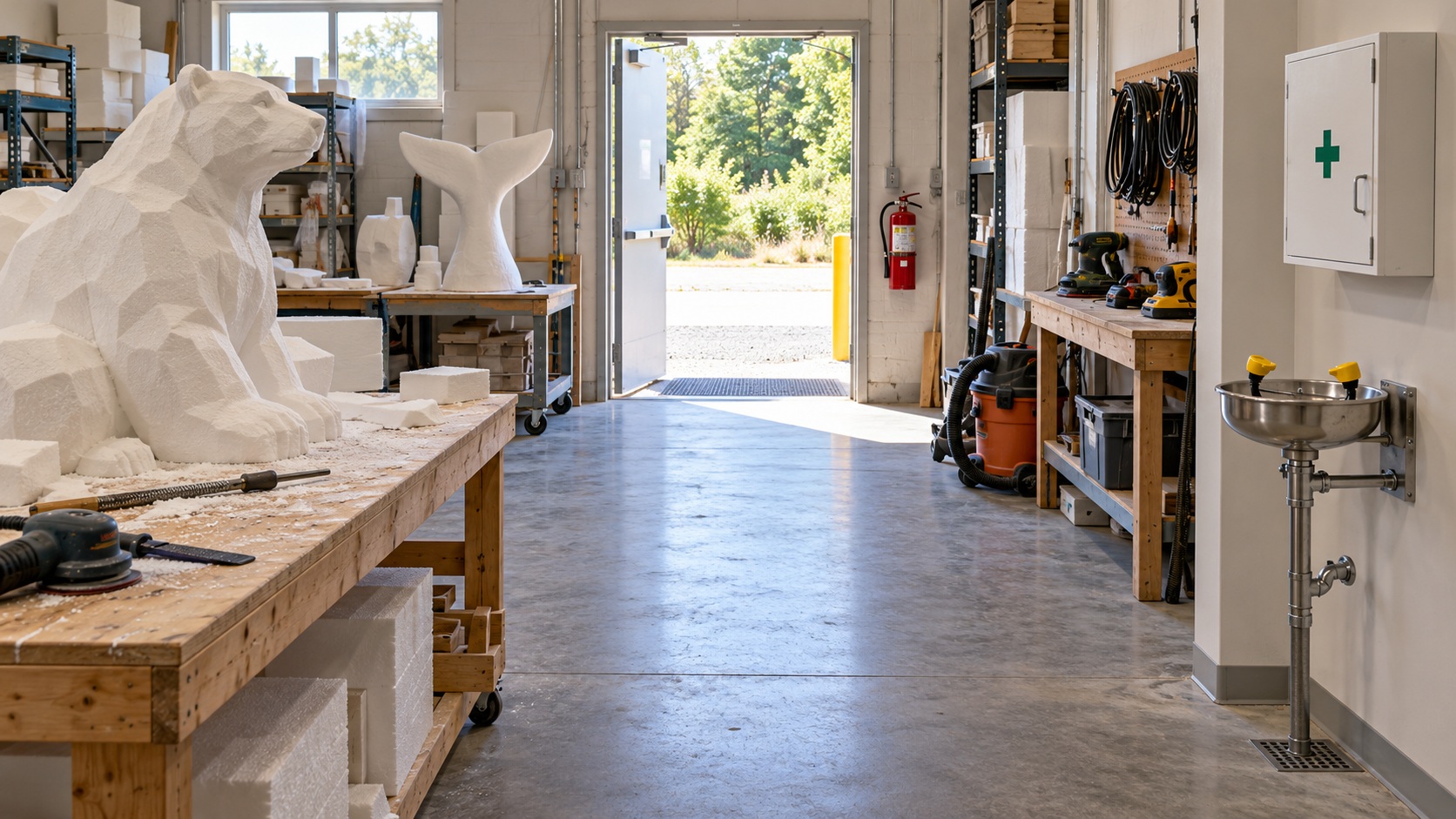
Large foam pieces can gradually change a room’s usable geometry. A route that was clear when the blank arrived may disappear after assembly, scaffolding, rolling carts, and packaging accumulate around it. Check escape access during the build, not just at opening time. Keep doors operable and prevent props from concealing essential emergency equipment. A sculpture on casters is still an obstruction if someone must move it before they can leave.
Plan for visitors, contractors, and people who need assistance. A new collaborator should not have to follow a stranger through an unfamiliar maze of worktables. Provide an orientation that identifies available routes and the gathering location. Do not assign assistance duties casually; discuss what is practical with the people involved and obtain qualified help where necessary. Emergency movement must reflect the building and its occupants rather than an imaginary standard worker.
Choose an assembly point that does not obstruct arriving vehicles or place evacuees in likely smoke or release pathways. Establish an alternative if the primary location is unsuitable. People should report there rather than going to their cars or leaving the site without notification. A roll call has little value if nobody knows whether a missing person is inside or simply waiting around the corner.
The OSHA emergency action plan standard identifies reporting, evacuation, accounting, and assigned duties among required plan elements where that standard applies. Use the framework to clarify responsibilities, while checking the obligations relevant to your workplace. A plan copied from another business still needs adaptation to your building, staffing, processes, and local arrangements.
Prepare Chemical First Aid Before Opening Containers
Review the first-aid section of each chemical’s safety data sheet during process planning. A splash response must not depend on searching an unfamiliar website with contaminated hands. Make the documents available to workers and responders without requiring access to the affected room. Keep an offline or otherwise resilient copy of essential information, because a network failure can coincide with the emergency.
Provide suitable emergency facilities for the identified hazards and maintain unobstructed access. OSHA explains that immediate drenching or flushing facilities are required in work areas where employees may be exposed to injurious corrosive materials. Have the equipment and its location assessed for the specific operation. A decorative first-aid cabinet or a bottle chosen for convenience does not establish that the necessary flushing capability exists.
Workers should know how to activate the equipment and summon help while following product-specific first-aid directions. Do not improvise chemical neutralization on skin or in eyes, and do not use workshop solvents to remove contamination from the body. Obtain emergency medical guidance when needed. Training should cover the actual products and the limits of the worker’s role, rather than treating all foam-related liquids as interchangeable.
Set Clear Fire Response Limits
Foam stock, coatings, waste, and adjacent building contents can complicate a fire. Do not assume an initially small flame will remain manageable while someone searches for equipment. Alert others and activate the planned emergency response. Never enter smoke to retrieve a sculpture, turn off a tool, or locate a colleague. Tell responders about the missing person and their last known location instead of attempting an untrained rescue.
If the workplace assigns extinguisher use, provide suitable equipment, training, and explicit conditions for withdrawing. The U.S. Fire Administration’s extinguisher guidance emphasizes factors such as a small contained fire and an available escape route. Firefighting should never delay alarm, evacuation, or the emergency call. Building-specific arrangements should be reviewed with the appropriate fire professionals.
Distinguish a Spill Kit From a Spill Response Capability
A stocked kit does not authorize anyone to handle an unknown release. Define in advance which incidental spills trained staff may address, using compatible supplies and the product instructions. Set a withdrawal threshold for larger quantities, uncertain chemistry, symptoms, spreading vapor, or any condition outside that plan. Someone should be empowered to stop the activity without having to defend the value of the materials at risk.
Keep people from tracking a spill into clean areas. Use communication and distance to restrict access without sending an unprotected person into the contaminated zone. Do not touch electrical switches, equipment, or containers simply to make the scene look orderly. Follow the emergency procedure for the situation and provide responders with the product information. Their assessment may require controls that an art studio does not possess.
Think through waste and decontamination before a small incident occurs. Used absorbent, contaminated gloves, and damaged containers may need different handling from ordinary shop debris. The product instructions and local disposal requirements should guide the arrangements. Do not pour leftovers together or seal reacting material into an improvised container. Cleanup is not complete until contaminated equipment and residues have an appropriate destination.
After a release, reopening the room requires a decision by someone competent to assess the remaining conditions. The absence of a noticeable smell or visible puddle is not a universal clearance test. Record what was released, where it traveled, what response occurred, and who authorized return. If the cause is unresolved, restarting the same process can recreate the incident even after the floor looks clean.
Plan for Machinery Injuries Without Creating Another One
Powered tools can continue moving after the trigger is released, and a workpiece may remain unstable after a jam. Training should distinguish stopping equipment from making it safe to approach or service. Do not reach into a cutting area, move a guard, or free trapped material while energy hazards remain. Emergency isolation and servicing procedures need to fit the actual equipment and be understood before an incident. Make first-aid supplies accessible and ensure appropriate trained assistance is available for the workplace. Keep emergency directions near the work area, but do not let a poster substitute for practical training. For a serious injury, summon emergency help promptly and follow the guidance of trained responders or dispatch. Avoid moving an injured person unnecessarily unless immediate danger makes withdrawal essential, and do not let bystanders crowd the response area.
Give the arriving crew a clear route to the patient. Large scenery can obstruct a stretcher even when a walking route remains open. Discuss access constraints during the planning walk-through, particularly for mezzanines, narrow doors, and outdoor fabrication areas. A person assigned to meet responders should know the location of the incident and any ongoing hazards, not merely wave from the street and leave them to navigate alone. Keep the approach available during ordinary production as well as during drills; temporary piles of offcuts and delivery cartons can quickly defeat an access arrangement that looked adequate on a floor plan.
Rehearse the Plan Under Ordinary Conditions
Use drills and short tabletop exercises to test decisions without introducing real hazards. Describe a scenario, ask someone to place a simulated call, and walk the evacuation route. Check whether workers can locate the assembly point and whether visitors appear in the accountability process. A drill should reveal confusing instructions, not reward people for pretending everything went perfectly. Debrief promptly while the details are still clear.
Include absences in the exercise. Can the team act if the usual studio manager is away, the main computer is unavailable, or the preferred exit cannot be used? Test the alternate arrangements without blocking real exits or disabling safety systems. Coordinate any alarm testing with the building’s established procedures. Emergency preparation should not create an actual emergency or trigger an avoidable response from public services.
Assign each improvement to a person and a completion date. Replace expired supplies, repair defective equipment, revise incorrect contact information, and change layouts that obstruct movement. Review the plan when new chemicals arrive, work shifts change, or an oversized commission alters the room. Keep a concise revision record so the people using the plan can tell whether the instructions reflect the current studio.
Leave Everyone With a Clear Next Action
A workable emergency plan gives people permission to stop, leave, call, and account for one another. Practice those actions, maintain the supporting equipment, and leave hazardous rescue or cleanup to appropriately equipped responders.