Less Dust Starts With Less Sanding
There is no sanding technique that can promise foam artists freedom from every lung risk. The practical goal is to reduce dust generation, capture what is produced, and verify that the remaining exposure is controlled. This begins at the drawing board: an accurately cut profile may need only a few finishing passes, while an oversized blank can demand hours of abrasion. A useful sanding plan therefore connects the intended surface, the foam’s identity, the shaping tools, the extraction arrangement, and the final cleanup. Treat the title’s promise as an ambition to reduce exposure, not a guarantee that a particular mask, abrasive, or material makes dusty work harmless. In a shared fabrication shop, the plan also needs to cover the people who never touch the abrasive: someone assembling a neighboring prop, a cleaner arriving later, or a colleague emptying the collector. Following the dust through that whole sequence reveals problems that a narrow focus on the sanding stroke can easily miss.
A: No. Slower abrasion can still release particles requiring control.
A: Visibility does not establish the concentration or composition in the breathing zone.
A: Wind and open space do not guarantee controlled exposure or prevent contamination of others.
A: Only refine as far as the intended coating and viewing conditions require.
A: Do not assume suitability; collection equipment must match the material and hazards.
A: The combined sample reveals the actual finishing behavior and materials being removed.
A: Avoid compressed-air cleaning that sends particles back into the room.
A: Access, capture distance, workholding, and total sanding time may all change.
A: Start with a closer-shaped blank and remove bulk material by an appropriate controlled method.
A: No. Exposure assessment may require measurements even when housekeeping looks good.
Find Out What the Abrasive Will Remove
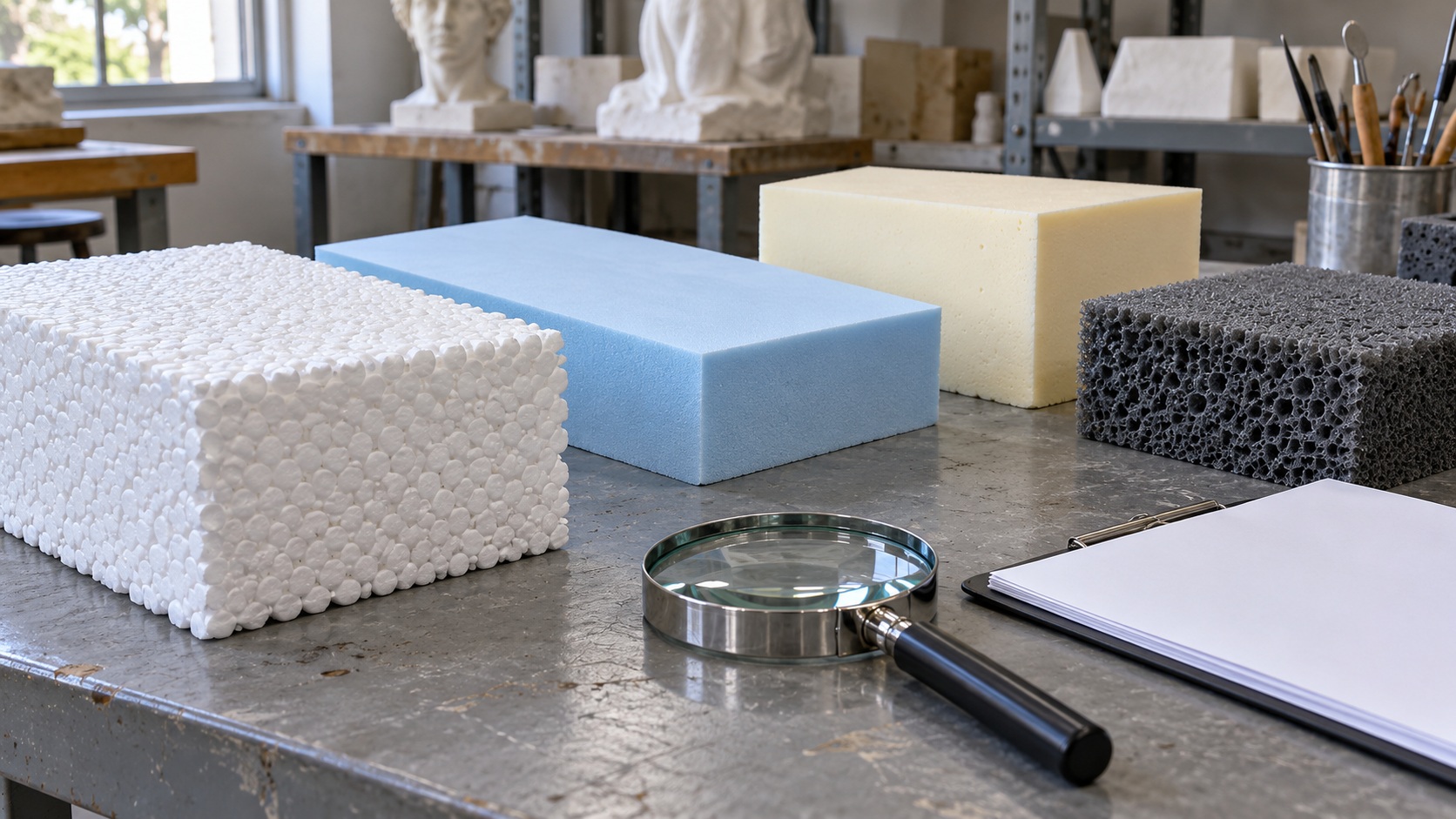
List every layer that the sanding operation will touch. Bare expanded polystyrene, a rigid polyurethane model board, and a resin-coated prop do not produce interchangeable debris. A finished sculpture may carry filler, primer, pigment, embedded reinforcement, or an unidentified repair. The dust assessment must follow those materials as well as the core. If the stock came from a previous installation, obtain its construction record before treating the exterior as ordinary foam.
Product safety information can identify machining precautions and constituents needing particular attention. Ask the manufacturer whether the product is intended for sanding and whether its guidance covers hand shaping, powered abrasion, or both. Do not infer suitability from softness. A material that yields easily to a fingernail can still produce particles you do not want in the breathing zone, and a coating that feels dry can conceal an unresolved cure problem.
Reject unknown salvaged foam for a dusty process until its identity and condition are resolved. Keep an identifiable offcut with the job paperwork so the workpiece does not become anonymous after packaging is discarded. If a later layer changes the dust composition, update the plan before returning the piece to the sanding station. This is especially important when a painter and a carver share responsibility for the same object.
Build the Shape Before Refining the Surface
Draw the intended silhouette on more than one face and use reference sections to guide the bulk removal. The closer the blank is to the final geometry, the less material must become sanding debris. Sawing, slicing, or another manufacturer-approved cold shaping method may remove larger pieces more efficiently than grinding the entire volume away. These alternatives have their own sharp-tool and workholding hazards; select them deliberately rather than replacing one uncontrolled task with another.
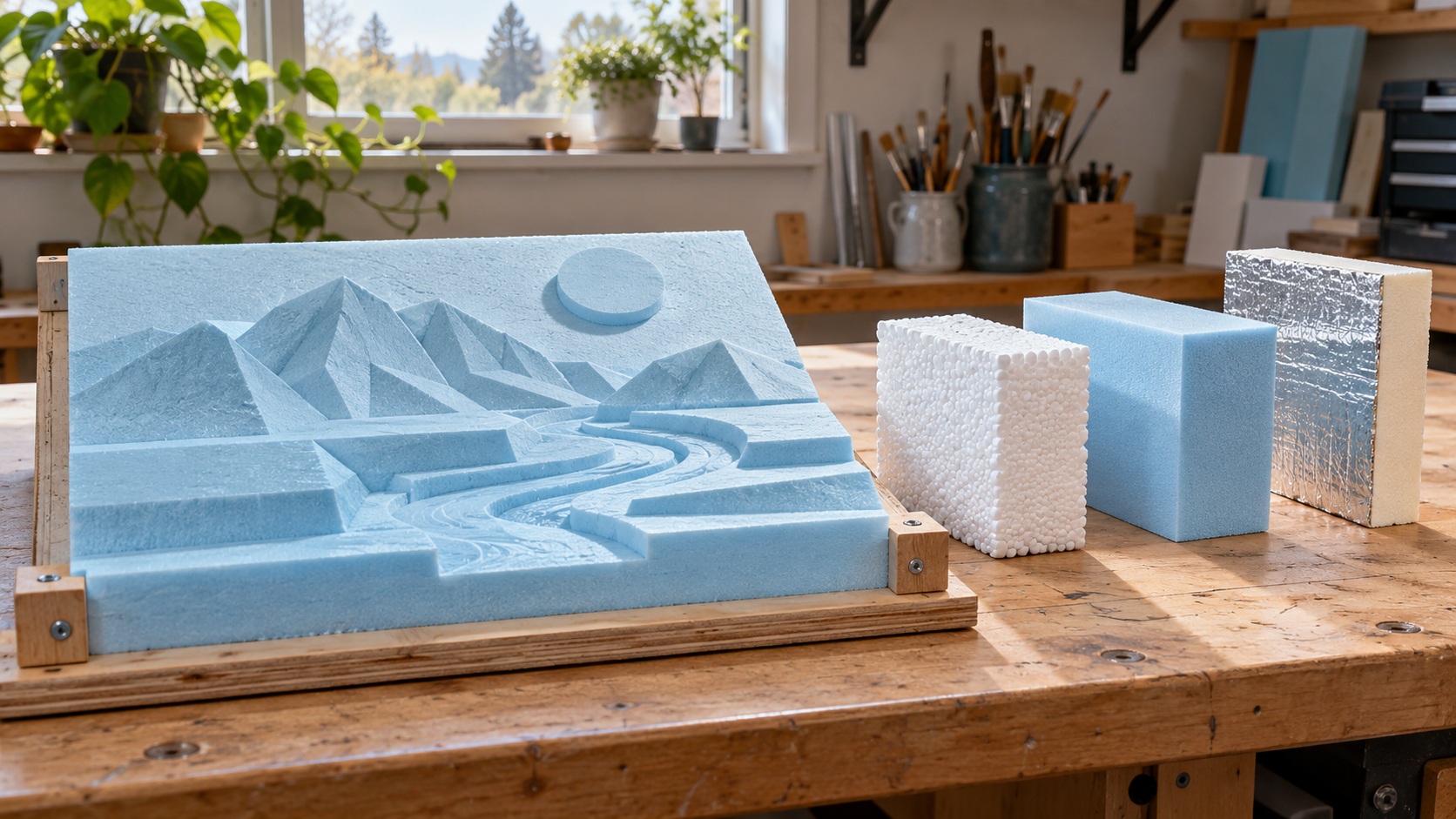
Leave a measured finishing allowance that matches the foam and desired texture. A theatrical boulder does not need the same polish as a model intended for a reflective coating. Check the piece under the lighting in which it will be viewed before chasing every small pore. Excessive polishing can consume time and generate dust without improving the visible result. Templates and profile gauges often reveal a geometric error sooner than another round of abrasion.
Design Capture Around the Actual Contact Point
Dust control works best when it intercepts material near where the abrasive meets the sculpture. An extraction connection on a powered sander can help, but only if the shroud, abrasive holes, hose, and collector function together. A hose lying somewhere on the bench is not equivalent to an engineered capture point. Consult the tool and collection-system instructions for approved combinations rather than assuming any adapter that fits creates adequate performance.
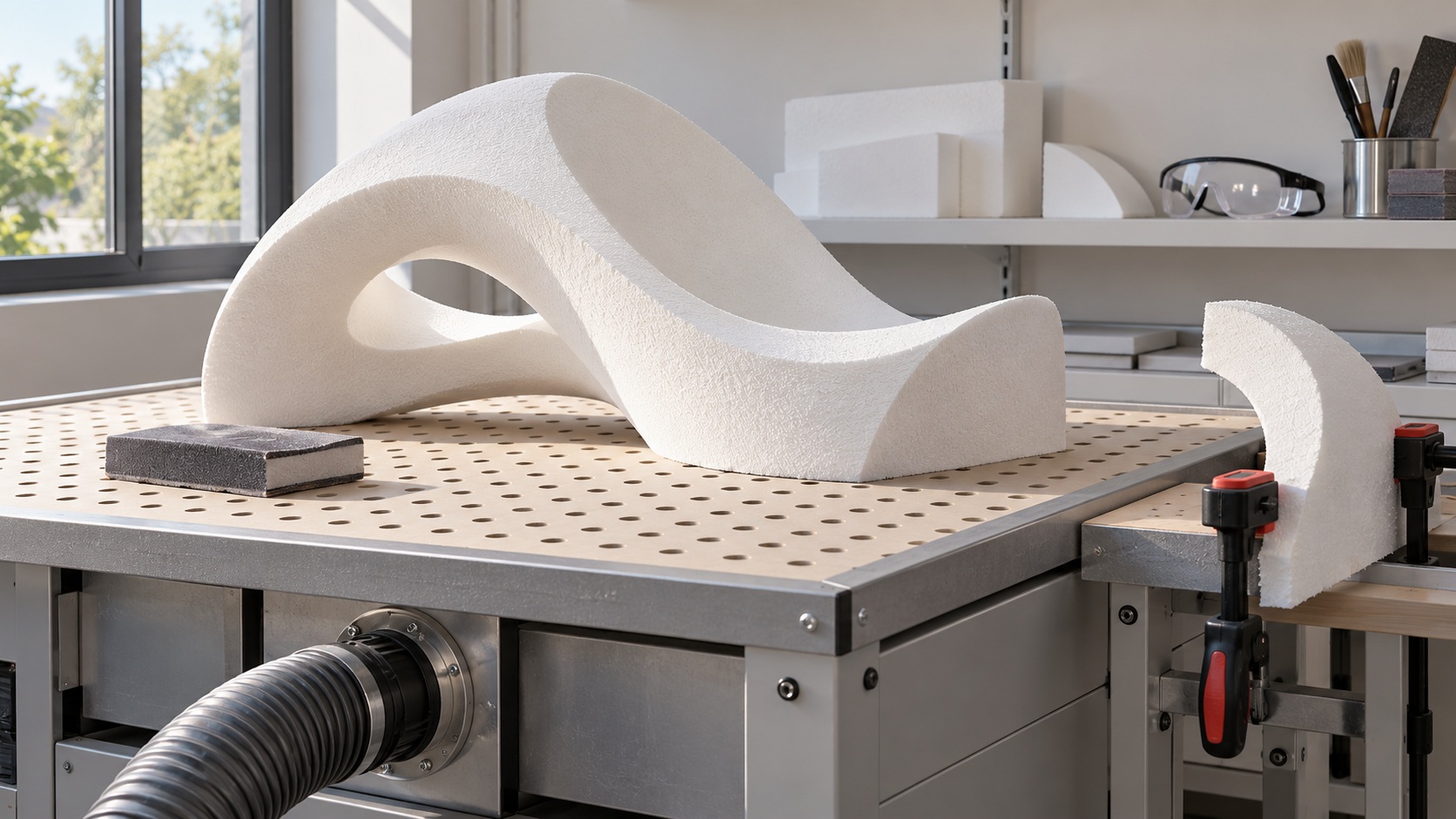
Large curved objects complicate capture because the tool frequently tilts away from a flat surface. A shroud that seals on a panel may leave gaps on a narrow ridge. Observe where debris escapes during a controlled trial and reposition the work or use a more suitable method. Do not compensate for visibly poor capture simply by increasing the sanding speed. Higher removal rates can overwhelm an arrangement that was already marginal.
A downdraft table is useful only when the object and operator do not defeat its airflow. A broad sculpture can cover much of a perforated surface, while a deep recess can place the sanding point outside the effective capture zone. Have a competent person assess the arrangement for the intended sizes and tasks. The NIOSH hierarchy of controls places engineering measures ahead of relying on personal protective equipment alone.
Check collection equipment suitability for the debris, including any combustible-dust considerations identified by the supplier or a qualified assessor. A fine-filter specification does not establish that a vacuum is suitable for every dust or ignition hazard. Avoid inventing a collection system from household equipment. The filter, seals, disposal method, and overall equipment design all influence whether collected material stays contained.
Choose Abrasives for Predictable Removal
Start with an abrasive that cuts the chosen material cleanly without requiring excessive force. Pressing harder is not a reliable solution to a clogged or ineffective sheet. It can deform the foam, spoil a contour, and move the workpiece unexpectedly. Inspect the abrasive frequently and replace it according to the work conditions and tool instructions. Store fresh sheets near the station so a worn abrasive is not retained merely to avoid interrupting the session. Keep the surface contact broad enough to prevent an unintended groove, especially on fragile edges.
Progress through grits because the surface requires it, not because a generic finishing recipe lists many stages. Test the complete sequence on an offcut that includes any coating to be sanded. Examine whether the final finish will hide, emphasize, or react poorly to the texture. A well-chosen stopping point prevents repeated fine sanding that contributes exposure while offering no meaningful benefit to the sculpture.
Keep Your Face Out of the Dust Path
Set the work at a height that lets you see the contour without bending directly over the abrasive. Rotate or support the sculpture so the cutting area stays within the capture arrangement. On a large piece, moving a platform or adjusting a support may be more effective than stretching across the surface. Plan access to the underside before it becomes tempting to sand overhead with debris falling toward the face.
Secure the foam without crushing it. Broad supports, appropriate fixtures, and sacrificial contact surfaces can reduce vibration and unexpected movement. Follow tool instructions for safe workholding, and keep hands away from powered abrasive contact. Do not use the extraction hose as a restraint or allow it to pull a lightweight object off the bench. A stable setup helps the operator maintain both control of the tool and a useful extraction position.
Keep other people out of the active dust zone. A visitor may see only a quiet hand-sanding task and step close to inspect the work. Separate the station from desks, food areas, and clean assembly. Avoid aiming fans across the workpiece, where they can interfere with capture and carry dust elsewhere. Moving the operation outdoors does not eliminate the need to assess exposure, neighbors, wind direction, or cleanup.
Use Respiratory Protection as a Planned Layer
Respirator selection depends on the contaminants and exposure assessment. The word foam is not enough information to prescribe a filter, and visible dust is not a complete measure of airborne exposure. An occupational hygienist or qualified safety professional can help identify what needs measurement and which controls are appropriate. The required protection may change when sanding a coating rather than bare stock, even if the tool and workbench remain the same.
Where employees must wear respirators, OSHA’s respiratory protection standard requires a program with elements including appropriate selection, medical evaluation, training, and fit testing for tight-fitting respirators. A packet of disposable masks on the bench does not provide that program. Fit, condition, storage, and correct use matter alongside the filter specification.
Do not assume a particle respirator covers vapors from a chemical step happening nearby. Keep coating and curing operations separate from sanding unless a competent assessment has addressed the combined exposures. Facial hair or other interference with a tight-fitting seal must be resolved through the respiratory program, not ignored because the job is brief. Follow the device’s instructions for checks and replacement rather than judging performance by how dirty the exterior looks.
Breathing discomfort, repeated coughing, or irritation is a reason to stop work and investigate, not to tighten straps and push through. Obtain medical advice when symptoms occur; urgent breathing difficulty needs emergency assistance. Record what was sanded, how long the task lasted, and which controls were running. Those details help a clinician or exposure professional understand the event more effectively than a broad description of an art project.
Finish the Cleanup Without Relaunching the Dust
Dust control is incomplete if the collected material returns to the room at the end of the session. Avoid using compressed air to clean the sculpture, clothing, or bench. It can redistribute particles that the extraction system successfully removed from the working area. Use cleanup equipment and methods selected for the material, and keep collection containers closed according to their instructions. Do not shake a dusty filter indoors to restore suction.
Maintain the equipment on a schedule that reflects actual use. A restricted hose, full container, damaged seal, or poorly fitted filter can reduce performance without causing the motor to stop. Follow the manufacturer’s isolation procedure before servicing, and arrange the task so the person changing a bag is protected from the accumulated dust. Keep replacement filters and compatible collection bags available so maintenance is not postponed simply because supplies ran out.
Review the Job Before Repeating It
Document the setup that worked: material identity, shaping sequence, abrasive type, extraction configuration, workpiece size, and cleaning method. Record limitations as well as successes. A successful trial on a palm-sized sample does not establish performance on a full scenic wall. If the next commission is larger, thicker, differently coated, or more repetitive, revisit the exposure assessment instead of copying the previous arrangement without question.
Measure improvement in more than surface finish. Did the revised blank reduce sanding time? Did the operator stay upright? Was the capture point maintained through the entire contour? Did cleanup remain contained? Worker observations can reveal practical weaknesses, while exposure measurements may be needed to evaluate airborne conditions. Neither a clean-looking room nor the absence of complaints proves that the breathing zone is adequately controlled.
There are times when the best sanding decision is to avoid it. Buy a closer-shaped blank, leave a deliberate texture, use a different fabrication method, or send the abrasive stage to a facility equipped for it. Budget these decisions alongside materials and paint. Dust reduction becomes much easier when it is treated as part of making the sculpture well, rather than as a housekeeping problem assigned after the shape is finished.
Make Dust Reduction Part of the Craft
Accurate shaping, effective capture, suitable respiratory protection, and contained cleanup work together. No single accessory guarantees risk-free sanding; a deliberate process makes exposure easier to prevent, assess, and improve.