Identify the Stock Before You Judge the Hazard
A sculptor cannot reliably sort foam into harmless and hazardous piles by color, firmness, or appearance. The same broad polymer family may be sold in different grades, with different additives, facings, coatings, and intended uses. A recognizable bead structure can suggest how a material was made, but it does not reveal the full formulation or approve a proposed carving method. Identification is therefore a traceability task: connect the piece in your hand to a named product, its supplier documents, its history, and the work you intend to perform. This approach replaces misleading visual shortcuts with evidence that can support a practical decision about accepting, quarantining, or declining the material.
A: Do not use improvised burn testing; it creates hazards without establishing the full formulation.
A: No. Color is insufficient evidence of grade, supplier, or composition.
A: No. Check processing instructions and the specific operation as well.
A: The coating may introduce different ingredients and control needs from the core.
A: Only after an assessment appropriate to that use; acceptance should state its limits.
A: Keep the material out of unresolved processes and compare investigation with documented replacement stock.
A: No. Ask for the exact test evidence and conditions rather than using an absolute claim.
A: Cutting can remove factory markings and break the link to product records.
A: Do not create uncontrolled thermal exposure to resolve an identity question.
A: The supplier, a competent materials specialist, or an appropriate testing service, depending on the decision needed.
Begin With Provenance, Not a Flame Test
Ask where the foam came from and what information traveled with it. Newly purchased stock should be connected to an order, product code, supplier, and relevant handling information. Salvaged material needs a more demanding history: what building or product contained it, whether it was coated or bonded, what contaminants it encountered, and how it was stored. A donor’s assurance that it is just packing foam is a useful lead, not a verified identification.
Do not burn a scrap, heat it until it smells, or dissolve it in an improvised solvent test to determine its identity. Such experiments create exposure and ignition questions while still failing to establish the formulation. If a material cannot be documented sufficiently for the intended use, put it aside. The ability to obtain a large free block does not obligate the studio to make that block part of a dusty or heated fabrication process.
Separate Recognition From Confirmation
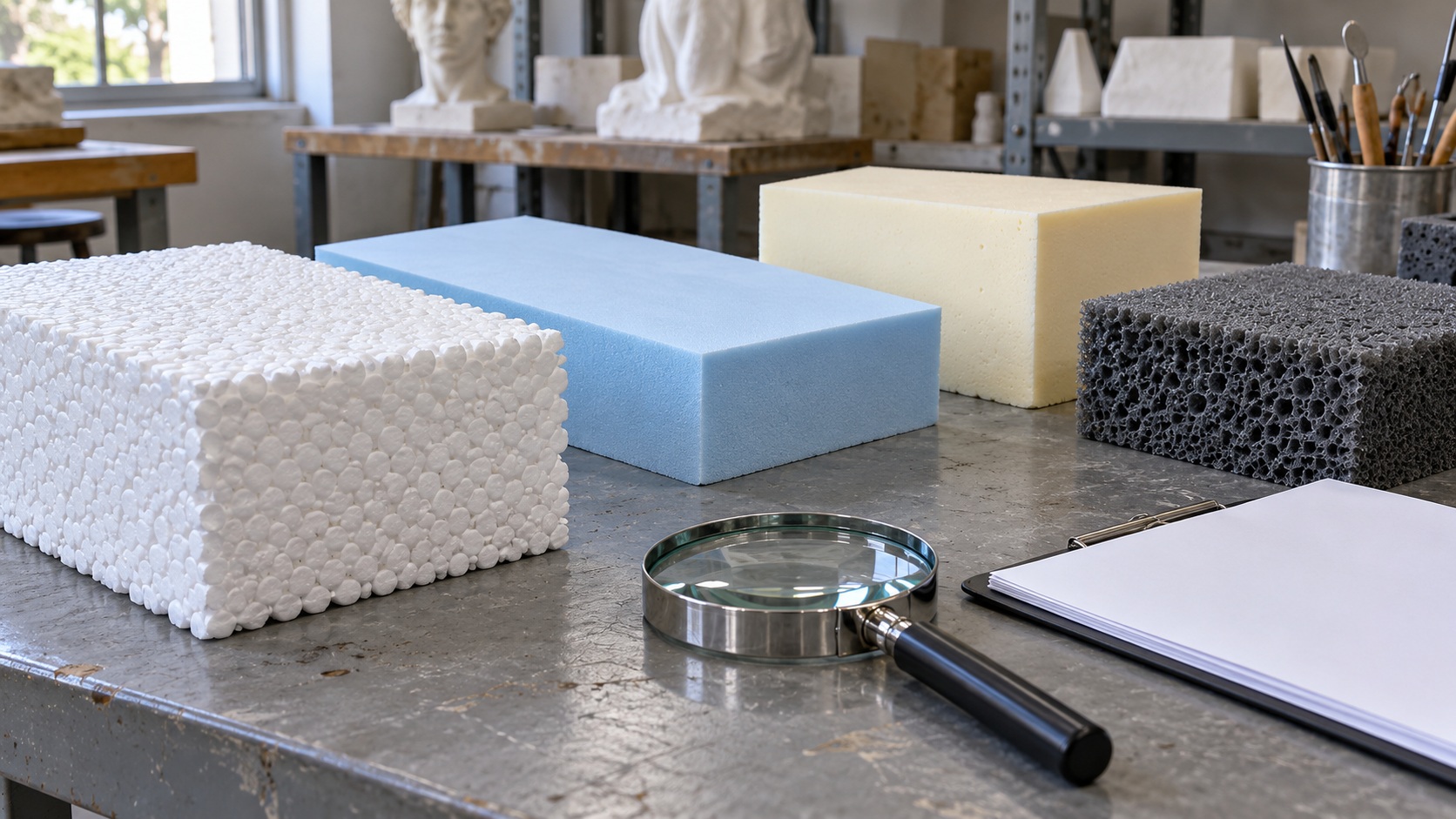
Visible beads, a smooth extruded face, an open-cell sponge structure, or a dense tooling-board texture can help organize questions. They do not confirm all ingredients or performance claims. Record observations without turning them into a chemical diagnosis. For example, describe a white bead-textured panel with an attached facing rather than entering a guessed polymer and an assumed fire rating in the inventory.
Color is particularly weak evidence. Manufacturers use pigments for commercial identification, and different products can share a color. A pink or blue board should not be accepted solely because it resembles a familiar product. Likewise, density and flexibility can vary within a family. Use markings and supplier records to resolve the commercial identity, and retain the distinction between an observed feature and a confirmed fact.
Where identification requires analysis beyond ordinary procurement records, consult an appropriate materials specialist or testing service. Explain the actual decision you need to make: whether the material can be machined, whether a coating contains an ingredient of concern, or whether a documented assembly meets a venue requirement. A generic polymer identification may not answer those more specific questions. Sometimes purchasing known stock is more sensible than paying to characterize uncertain salvage.
Match the Safety Sheet to the Product
Use the identifier on the package or supplier paperwork to obtain the correct current safety data sheet. OSHA explains the relationship between the identifier on labels and SDSs in its product identifier guidance. Save the document with the material record and check whether it covers the supplied article, a liquid component, or a related but different grade. Similar branding can conceal important distinctions.
A safety sheet is a hazard communication document, not a universal approval for sculpture fabrication. Read it alongside technical processing instructions. Ask whether your intended operation is covered, particularly if it involves abrasion, heat, spraying, or unusual chemical contact. A document describing normal handling of a finished product may not provide enough information for converting it into dust or deliberately heating it.
Check revision dates and use restrictions, then ask the supplier about anything unclear. A blank entry or an absence of a particular pictogram should not be converted into a broad claim that the material has no hazards. The relevant question remains whether the information is sufficient for the proposed process. Keep unanswered issues visible rather than resolving them through optimistic wording in a studio checklist.
For reactive systems, obtain information for every component and for the intended cured product. A finished foam’s description cannot replace the precautions for handling the unmixed liquids. Record the mixing and cure instructions as well as the ingredients’ hazard information. This prevents a common identification error: treating the name of the final polymer as if it described every intermediate state encountered during fabrication.
Inspect the Whole Layer Stack
Foam often arrives as part of a composite. A facing, fabric backing, adhesive film, hardcoat, paint layer, or attached board may dominate the hazard of the next operation. Look at edges and documented construction details, and ask the supplier to identify all layers. Do not pull apart unknown material casually if doing so could release dust or damaged fibers. Arrange a suitable assessment when a legacy or industrial component raises additional concerns.
A reused scenic object may contain repairs made at different times by different people. Its original material list can become incomplete after years of repainting and reinforcement. Ask for the maintenance history, not only the first fabrication invoice. If the next job requires sanding through an unknown surface, the uncertainty belongs to that entire assembly. A known foam core does not make the coating composition known.
Treat Condition as Separate Evidence
Even a correctly identified product may arrive in an unsuitable condition. Look for damaged packaging, water exposure, crumbling surfaces, unusual deposits, persistent tackiness, and evidence of chemical contact. These observations do not diagnose a specific contaminant, but they justify holding the stock out of production while the issue is investigated. Keep delivery details available when reporting the concern. Photograph the condition before moving or cleaning it so useful information is not lost.
Unknown stains and odors should prompt questions rather than close-range sniffing or bare-hand inspection. A block stored in an industrial area may have encountered substances unrelated to its original formulation. Ask the previous owner about that environment and disclose the history to anyone assessing the material. Keep uncertain deliveries separated from documented supplies while questions are resolved, including during a busy receiving day when ordinary storage space is scarce. Avoid presenting uncertain material to students or volunteers as a low-risk practice blank merely because it is inexpensive.
With site-expanded polyurethane, condition also includes cure history. EPA’s spray polyurethane exposure guidance notes concerns with cutting material before full cure. Obtain the product-specific instructions and investigate abnormal cure rather than relying on a hard exterior. A sculpture made from a reactive system needs records of its preparation, not just a label saying polyurethane.
Ask What the Proposed Tool Changes
A hazard judgment is incomplete until it includes the operation. Cold slicing, sanding, drilling, coating, and thermal shaping can create different releases and physical hazards from the same piece. Mark the intended processes in the material record. A stock item accepted for a static mockup should not automatically become approved for hot-wire cutting when a later project needs a curve.
Read restrictions on heat and decomposition before considering a thermal tool. Unknown identity is a reason to exclude that process, not an invitation to conduct a small demonstration. Ask about dust controls before machining, and confirm chemical compatibility before applying adhesive or paint. These are separate questions: a coating can adhere well while still requiring application controls that the studio cannot provide.
Consider embedded objects too. Fasteners, wire, timber, and hard repair compounds can affect cutting behavior and projectile hazards. A visual inspection of the exterior may miss them. Trace the construction through documentation or suitable assessment, including consultation with the original fabricator when that person can explain undocumented modifications, and revise the fabrication plan if the hidden structure is unresolved. Identification should help the tool operator understand what lies along the cutter path, not merely name the visible foam.
When the proposed operation falls outside available information, seek manufacturer advice or choose a documented alternative. Do not stretch a successful low-demand trial into proof for a larger, hotter, or more aggressive process.
A small sample may not contain the same layers, damage, or hidden components as the full stock. Preserve the limits of the evidence when deciding how far to proceed.
Do Not Confuse Fire Claims With General Safety
Terms such as flame-retardant, self-extinguishing, or a named test classification require context. Ask what was tested, which formulation was involved, and whether thickness, orientation, coating, substrate, or mounting conditions matter. A statement on one board does not establish the performance of an assembled sculpture covered in different products. Never describe foam as fireproof merely because a supplier reports a particular fire-test result.
For a venue installation, send the actual material and assembly information to the responsible venue or fire-code reviewer before fabrication. They may need documentation beyond a raw-stock data sheet. Keep the acceptance record with the project, including limitations and any change-control requirement. If a different coating or core is substituted later, revisit the decision rather than assuming the earlier review transfers unchanged.
Use a Quarantine Decision That People Understand
Create a clearly separated holding area for unresolved materials and mark why each item is there. The note should identify the question and the responsible person: missing supplier information, unknown surface coating, damage history, or unsuitable proposed processing. A generic caution sticker can become background decoration. Specific reasons make it less likely that another worker will assume the block was merely waiting for shelf space.
Set a practical route out of quarantine. Obtain the missing documentation, arrange assessment, accept the material with stated restrictions, return it, or manage disposal appropriately. Do not let uncertainty turn into permanent anonymous inventory. A useful decision includes the evidence reviewed and the operations allowed, so the next worker does not have to repeat the investigation or invent their own interpretation.
Keep identification attached to useful offcuts. Once a sheet is divided, the factory marking may remain on only one small piece. Assign a simple internal reference linked to the original record and use suitable labels or storage grouping. Distinguish grades that look similar, and do not mix unidentified leftovers into a communal carving bin. Traceability should survive ordinary cutting, sharing, and cleanup.
Make Acceptance a Project Decision
Material selection balances creative usefulness with the information and controls available. An inexpensive unknown block can become costly when it delays coating, requires specialist investigation, or cannot meet installation requirements. Compare that uncertainty with the price of documented stock early in budgeting. Include handling, extraction, protective equipment, waste management, and any testing in the comparison rather than counting only the purchase price.
Communicate the final decision to everyone who may use or alter the material. A purchasing record is not enough if the carver never sees its restrictions. Provide concise working instructions that preserve the link to detailed documents. When new evidence appears, update the status openly. Identification is not a one-time label exercise; it is the basis for deciding which operations are justified throughout the sculpture’s life.
Keep Uncertainty Visible
Recognize visual clues, but confirm products through records and assess the actual operation. When identity, condition, or construction remains unresolved, pause that use rather than inventing a reassuring category for unknown foam.