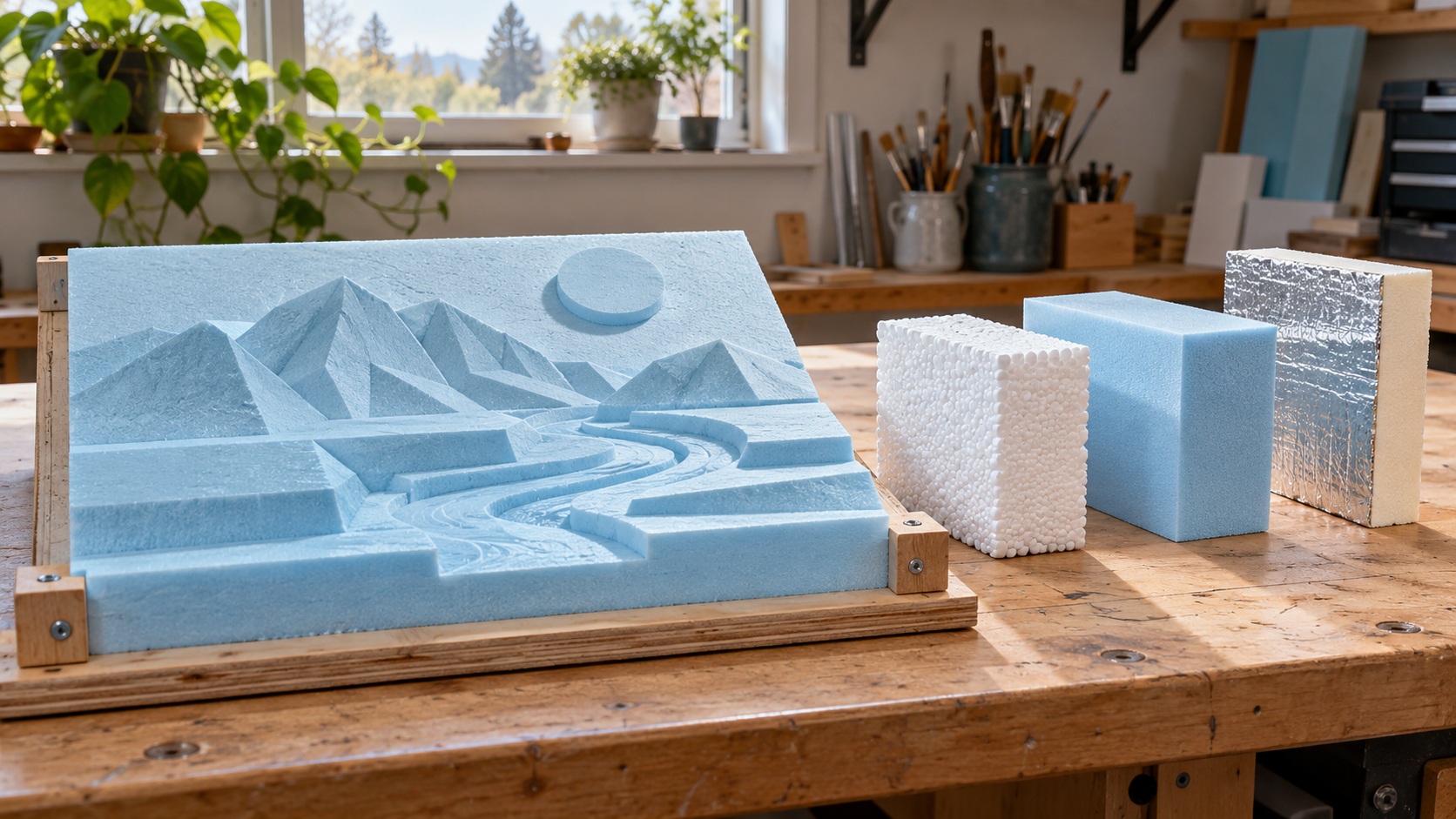
Building Insulation Is a Starting Material, Not a Sculpture Specification
Insulation board offers artists large, lightweight surfaces and readily available thicknesses, but its building label does not approve every studio process. A board intended to sit within a specified wall assembly may be carved, laminated, painted, or displayed very differently in an artwork. Facings, additives, surface condition, and the exact foam type all matter. Handling it responsibly means identifying the actual product, selecting appropriate cutting and bonding methods, controlling the resulting dust or other emissions, and assessing the finished installation separately. Neither a familiar color nor a successful previous project establishes that the next sheet is identical. Treat the transition from building stock to sculpture as a new use that needs informed choices, not as a permission already granted by the word insulation.
A: No. The actual processing and finished assembly need their own evaluation.
A: It can contain the manufacturer's relevant handling information even when the document is not titled SDS.
A: No. Similar colors do not establish identical chemistry or grade.
A: No. Its contamination, layers, and history may be uncertain.
A: First identify their role and assess the proposed alteration.
A: No. Geometry and the structural load path still matter.
A: Not automatically; the tested configuration and the sculpture may differ materially.
A: No. Confirm product support, facings, emissions, and required controls first.
A: It can test detail quality and workholding within an already assessed process.
A: Exact material references, layer maps, support information, and relevant restrictions.
Trace the Board Back to Its Product
Keep the label, invoice reference, and relevant technical information before cutting away the identifying edges. Expanded polystyrene, extruded polystyrene, and polyisocyanurate boards are different materials, and broad labels can conceal further differences between grades. Some boards include facings or films; others are supplied with exposed cellular surfaces. Photograph the original stock and note which face belongs to which product. These details become harder to recover once several materials are stacked together in a studio.
Obtain the current safety or safe-use information from the manufacturer. Owens Corning’s product safety-information search includes safe-use instruction sheets for relevant products, illustrating why the document may not always be titled exactly as expected. The absence of a familiar SDS heading is not proof that no handling information exists. Ask the supplier for the document that applies to the exact board and market.
For workplace decisions, read the information as part of the task assessment rather than as an independent guarantee. OSHA’s safety data sheet guide explains the roles of hazard, handling, exposure-control, and stability sections. A sculpture team should connect that information to what it will actually do: saw long edges, abrade a relief, bond layers, or work inside a confined recess.
Be Selective About Reclaimed Stock
Unused offcuts from an identified current project can be useful. Demolition salvage is a different proposition because its exposure and construction history may be unknown. Residues, previous coatings, attachment materials, and damage can complicate both fabrication and waste management. Do not accept a large unidentified load merely because it is free. Ask where it came from and what was attached to it, and decline material that cannot be evaluated adequately for the intended use.
Do not scrape questionable deposits or remove old building layers simply to find out what they are. That creates a separate assessment problem before sculpting even begins. Where suspect contamination or hazardous building materials may be involved, keep the material out of ordinary studio processing and obtain appropriate professional advice. Foam’s light weight does not tell you anything reliable about an unknown residue on its surface.
Choose the Least Complicated Suitable Cut
A straight sizing cut and detailed sculptural shaping may benefit from different tools. Start with the cut geometry and the identified material, then choose equipment supported for the task. A controlled knife operation, suitable hand saw, or appropriately equipped machine may avoid unnecessary material removal. Follow the equipment instructions and secure the work so the tool does not force the operator to hold an unstable sheet close to the cutting path.
Plan the order of cuts. Removing too much support early can leave a thin section vibrating or require a helper to hold a piece in an awkward position. Keep the offcut supported as well as the retained part. A falling offcut may be light but can pull against the blade, damage a delicate edge, or cause someone to reach into the work area unexpectedly. Good sequencing reduces both surface damage and reactive movements.
Heat cutting is not a universal shortcut. Confirm that the exact product and its facings are appropriate for the proposed thermal method, and assess emissions and controls separately. Do not infer permission from the fact that the core looks like a board used in another maker’s hot-wire demonstration. Cold methods may be more practical when material identity, thermal guidance, or suitable extraction is missing.
Use a small representative trial to establish edge quality and workholding before committing the full board. A test should include the feature that matters: a narrow fin, an inside corner, or a deep relief. If the material tears or compresses, reconsider the tool and design rather than compensating with force. An expendable trial can reveal that another grade or construction method will produce the required detail with less difficult processing.
Keep Dust Control Attached to the Task
Cutting, rasping, and sanding create different amounts and forms of debris. Assess the operation and use appropriate collection or extraction rather than waiting until the floor is covered. Keep the collection point close to where material is generated, with equipment suitable for the actual task and waste. Do not assume that any available vacuum is appropriate for every dust or process. Obtain competent advice when the equipment or exposure question is unclear.
DuPont’s UtilityFit XPS product information includes handling directions and notes the importance of surface dust to subsequent adhesive and finish performance. That is a reminder that housekeeping affects the artwork as well as the operator. Follow the applicable product directions while choosing controls for the process; do not borrow one board’s instructions to characterize every insulation foam.
Keep neighboring work in mind. Dust from a large relief can settle on fresh paint, another person’s tools, or stock intended for bonding. Isolate messy stages where appropriate and tell nearby users what is happening. Select personal protection through the assessment and product information, not through a general claim that foam dust is harmless. Respiratory protection, where needed, requires proper selection and use.
Facings Are Part of the Product
A film or foil facing can change cutting, bonding, surface texture, and how the board behaves as an assembly. Do not peel it away automatically because it interferes with carving. Determine what the product is, how the facing is attached, and whether the proposed modification is supported. Removing or damaging it may mean that published assembly-related properties no longer describe the material as used.
For a sculpture, the important question is not whether an altered board could still perform as insulation in a building. It is whether the modified stock can be processed and assembled appropriately for the artwork. Record which layers remain and which were removed. A future repairer looking at a painted surface should not have to guess whether a hidden film is carrying a bond or separating two materials.
Bonding Introduces Another Set of Instructions
Select adhesive for the actual substrates, including any facing, rather than choosing solely by its claimed bond strength. A product suitable for wood may be unsuitable for exposed foam. Check application conditions, ventilation, cure, and compatibility with the later finish. Keep each adhesive’s information with the project. The safest-looking board can become part of a more demanding chemical operation when another product is added.
Make a representative joint and allow the specified cure before evaluating it. Include the intended bond area and a similar surface preparation. A quick touch test can show that something feels attached without establishing how it will behave during carving, handling, or display. Observe whether the joint damages the foam, creates a hard ridge, or remains inconsistent across the specimen.
Layered blocks should be organized around the sculpture’s load path and access needs. A strong adhesive cannot compensate for a narrow connection that asks a weak region to carry an oversized projection. Separate decorative volume from structural responsibilities and obtain qualified design for suspended, public, or consequential loads. Product compressive figures from insulation data are not universal design allowances for sculptural beams or attachments.
Document the assembly before closing it. Photograph internal supports, layer orientation, seams, and inserted hardware. Record the approved lifting or carrying arrangement. These images help later teams avoid drilling into a hidden connection or assuming that a painted edge is a suitable handhold. Traceability should survive the transformation from recognizable board to finished object.
Do Not Inherit a Building Assembly’s Fire Claim
Insulation products are commonly used within specified construction assemblies. A test or classification for that arrangement does not automatically describe a carved freestanding object with different coatings and exposed edges. DuPont’s UtilityFit information identifies the product as combustible and includes heat-related precautions. Follow the actual product’s warnings and have the final installation reviewed through the venue’s appropriate process.
The UK Health and Safety Executive’s guidance on cellular-plastics fire risk addresses storage and processing concerns, including ignition sources and waste. Use such guidance to inform a task and premises assessment, not to declare an arbitrary artwork approved. Do not describe a paint or treatment as making the sculpture fireproof. Provide the reviewer with the complete construction rather than only the most favorable label from one ingredient.
Keep hot work, heaters, and other ignition considerations in the fabrication plan. An exposed core awaiting coating may spend days in the workshop, so the unfinished stage matters too. Manage quantities and accumulated scraps, preserve exits, and coordinate with the building’s responsible personnel. The final exhibition date should not be the first time someone asks where large amounts of stock are being kept.
Leave a Workable Cleanup and Handover
Separate clean identified offcuts from coated pieces, adhesive residue, and other wastes. Ask the receiving program about the actual material rather than assuming all insulation board enters a packaging-foam route. Keep fragments contained during transport. Do not melt or dissolve leftovers to make the volume smaller; such improvisation adds processing and waste problems rather than resolving identification.
For the owner or next fabricator, provide the product map, adhesive and finish references, support details, and processing restrictions. Explain where the original stock information is stored. A future alteration may involve a different task from the original build and needs its own assessment. Good handover information gives that person a basis for deciding rather than inheriting the vague assurance that the piece is only foam.
Label retained samples with their relationship to the finished construction. A bare board coupon and a coated joint specimen answer different questions, and neither should be mistaken for a loose piece of the artwork. Keep photographs showing how the sample was made. If a coating or adhesive is discontinued, these references can help a qualified fabricator compare a proposed replacement without experimenting directly on a significant surface. Store the samples separately enough that their identity is not lost in the ordinary offcut rack.
Before accepting the work, rehearse a routine maintenance task using the handover information. Ask someone who was not involved in fabrication to identify the carrying points, find the product reference, and explain which operations require review. If the answers depend on guessing or calling the original artist, improve the documentation. This is especially valuable for insulation-derived forms because a finished coating can conceal both a thin unsupported edge and the seams where different products meet. Useful information should remain available after the workshop has moved on.
Keep the Product History With the Artwork
Identify the board, assess each operation, and document the altered assembly. Insulation can be a useful sculptural resource when its building origins inform the work without being mistaken for blanket approval.