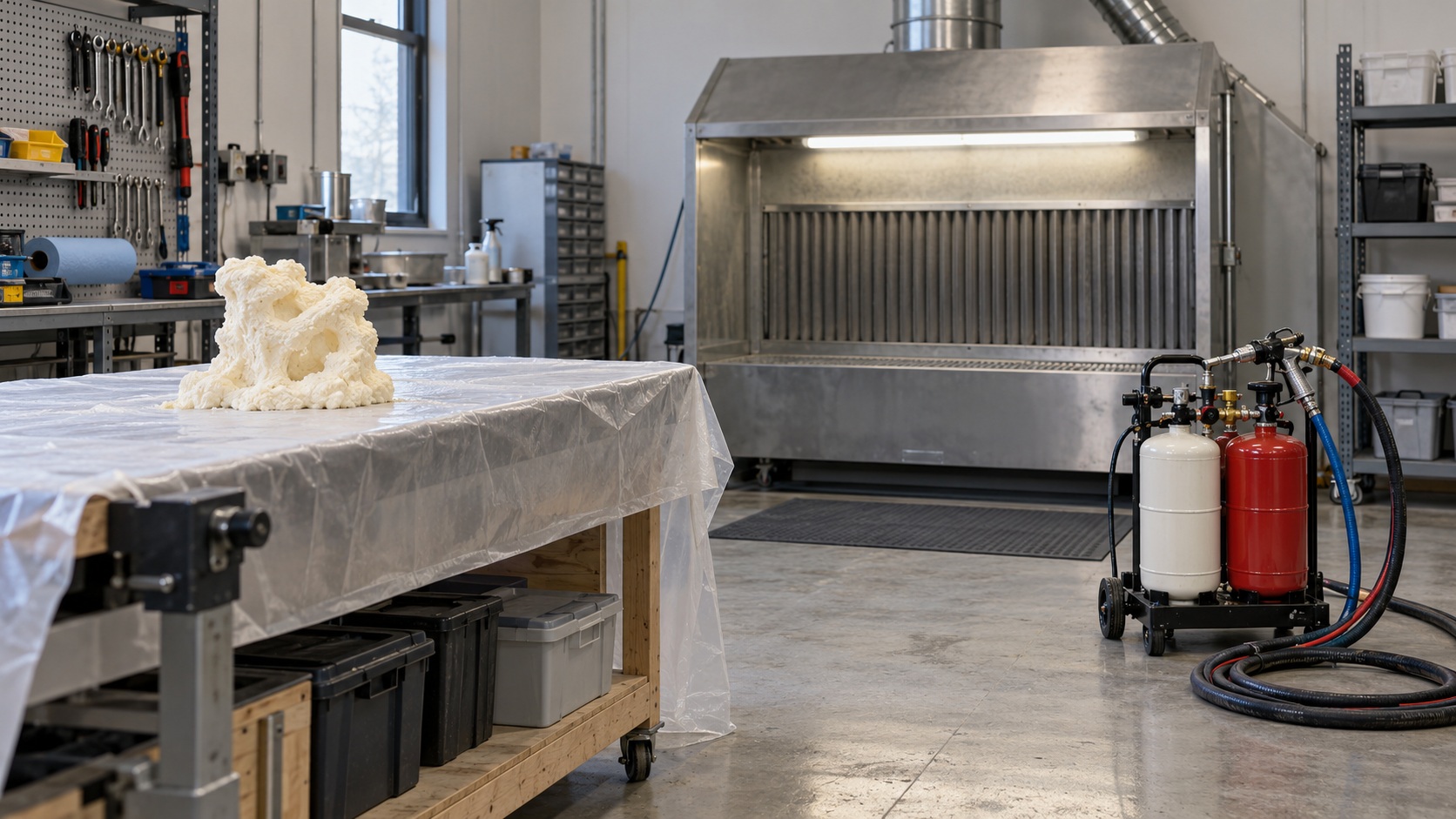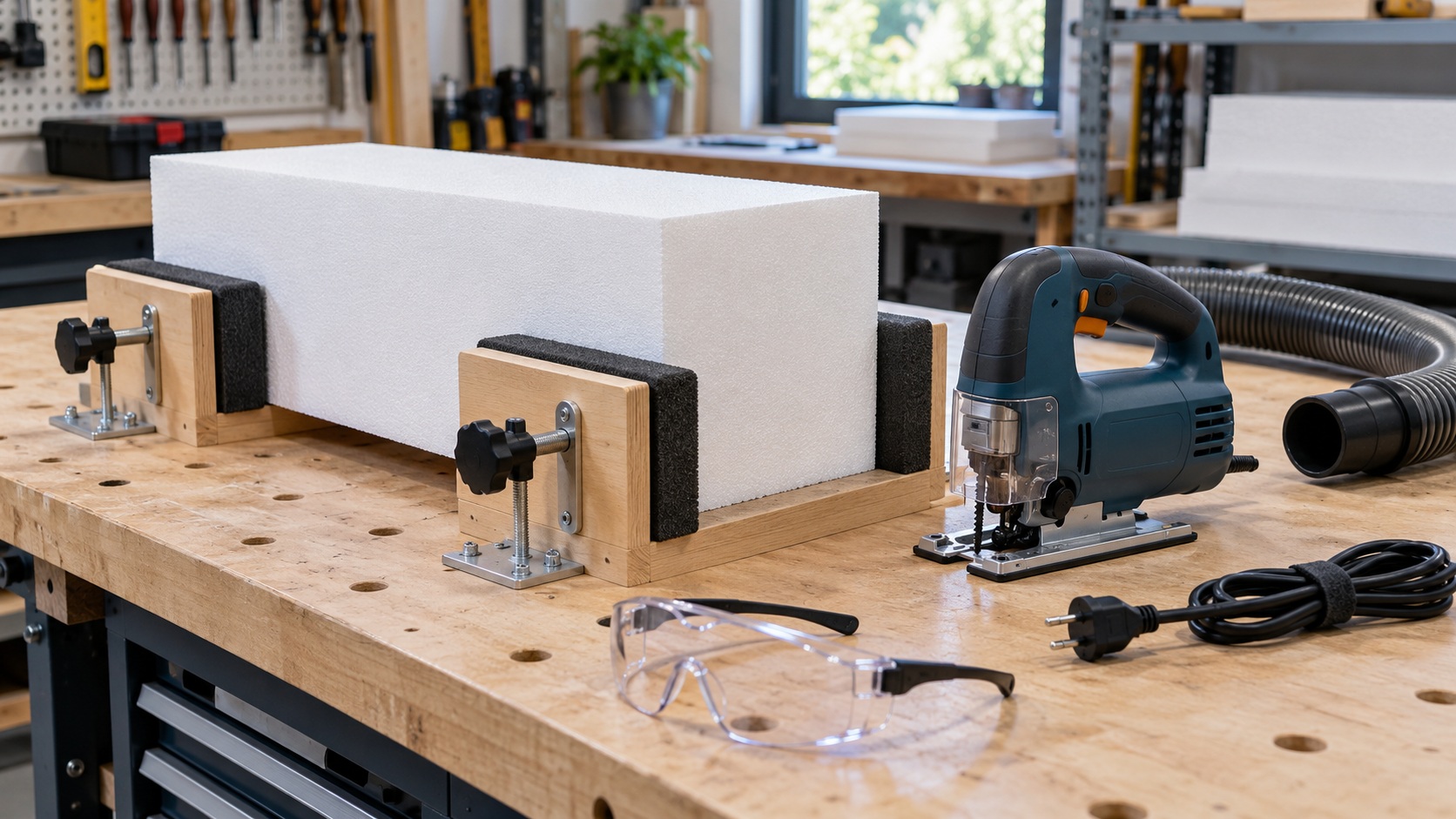
Soft Foam Does Not Make a Powered Cutter Gentle
A motorized tool does not distinguish a soft sculpture blank from the hand holding it. Foam can be easy to cut yet difficult to restrain, and that combination often encourages casual handling: one hand pinches a small piece while the other steers a fast-moving blade. The useful safety question is not whether the material offers much resistance. It is whether the tool, accessory, support, guard, operator position, and intended movement form a controlled operation. Power tools can be valuable in foam fabrication, but their use should begin with a planned setup and the manufacturer’s instructions. The lightness of the workpiece is a reason to improve restraint, not a reason to dismiss mechanical hazards.
A: No. Tool behavior, support, geometry, and hidden components still require assessment.
A: Use a suitable fixture or another method that keeps hands out of the hazard.
A: No. Verify the manufacturer's compatibility, speed, and application requirements.
A: No. Improve access or choose another suitable operation without defeating protection.
A: It exposes reach, cord, hose, and clearance problems before motion is introduced.
A: No. Moving-tool hazards require their own assessment and instructions.
A: Stop and investigate rather than pushing through unknown material or equipment behavior.
A: Do not manipulate trapped material under power; isolate and follow the proper procedure.
A: Plan support and roles beforehand so nobody reaches into the hazard.
A: When it provides a more controllable method for the specific shape and avoids an unsuitable powered setup.
Choose an Operation Before Choosing a Motor
Describe the cut in plain terms. Are you separating a thick slab, trimming a thin edge, opening a cavity, or refining a broad curve? Those operations impose different demands on support, clearance, and control. Do not reach for the fastest tool simply because it is already plugged in. A manual method, a revised joint, or a supplier-cut blank may produce the needed result without introducing a powered operation into an awkward area of the sculpture.
Check that both the tool and accessory are intended for the proposed material and application. Foam stock varies, and a coating or embedded support can change what the cutter encounters. Review the instructions for capacity, approved attachments, required guards, operating settings, and any material exclusions. If the proposed process depends on removing a safety device or using an accessory outside its intended purpose, redesign the process rather than improvising a workaround.
A test on a secured offcut can establish cutting behavior, but it is not permission to ignore manufacturer restrictions. Include the real layer stack in the sample if the finished piece contains hardcoat, adhesive seams, or reinforcement. Observe whether the material tears, compresses, grabs, or moves before the cut is completed. Use that information to choose a suitable method and support arrangement, not to develop a technique that depends on catching an escaping piece by hand.
Support the Blank Without Crushing It
Clamps that work well on timber can damage foam before useful restraint develops. Spread the load through suitable pads, broad fixtures, or a sacrificial support selected for the job. Check that the restraint controls movement in the directions the cutter may push or pull, rather than merely holding the piece down. Follow tool-specific workholding guidance, and keep the restraint clear of the intended cutter path. A clamp jaw hidden behind foam can become an unexpected collision point.
Support the portion being removed as well as the portion being kept. A long offcut may sag, close a cut, twist, or fall before the tool exits. Plan how it will remain supported without placing a helper’s hands near the hazard. If a second person is needed, agree on the sequence and communication before starting. Do not let an assistant improvise by grabbing the material after it begins moving.
Make Clearance Visible on Every Side
Draw the cut line, then inspect what lies beyond it. A blade or bit may emerge from the underside of a lightweight block much earlier than the operator expects. Bench hardware, hidden fasteners, fingers, knees, cords, and the supporting surface all belong in that inspection. Keep the cutting zone clear through the entire travel, not merely at the point where the tool first touches the foam.
Use appropriate sacrificial support where the tool’s instructions and operation permit it, but do not assume a backing board makes every cut acceptable. The tool still has limits, and the support can introduce its own contact or binding problem. Arrange the setup so the operator can see the relevant reference surfaces without leaning into the hazard. Better lighting and a rotated workpiece often solve an access problem more effectively than an unusual grip.
Internal armatures deserve particular caution. A sculpture that looks homogeneous may contain wire, screws, plywood, or cured adhesive ridges. Obtain the construction information before machining a repaired or previously assembled prop. Mark known embedded components on the working faces and choose a method that avoids unintended contact. If their location cannot be established, stop rather than relying on the sound of the cutter to announce the first collision.
Consider where the tool will go when the cut finishes. With little resistance left, a forceful push can carry it beyond the workpiece. Maintain the operating posture required by the manufacturer and avoid using the material’s resistance as a brake. A controlled finish includes a stable stance, a clear exit path, and a place to set the tool after its moving parts have stopped.
Inspect Accessories as Matched Components
A cutter’s diameter, mounting system, rated speed, condition, and intended use must match the tool. A physically fitting accessory is not automatically an approved one. Do not attach an improvised carving device because someone demonstrated it online. Use the manufacturer’s compatibility information, including any restrictions on adapters. Keep accessory packaging or identification available so an unmarked part does not quietly enter the tool drawer and later become a guessing exercise.
Inspect blades and cutters before use for damage, looseness, excessive wear, or contamination that affects their function. Replace unsuitable parts through the proper procedure. Increasing pressure to compensate for a poor cut can undermine control and spoil the foam, while a damaged accessory presents a problem regardless of material softness. Make inspection part of setup rather than waiting until vibration or abnormal noise appears during the pass.
Guards and switches must remain functional. OSHA’s portable powered-tool guarding standard addresses protective devices for relevant equipment. Consult the rules applicable to your workplace and the tool’s own instructions. Do not wedge a guard open to improve visibility, tape a trigger down to free a hand, or treat a broken control as a harmless inconvenience for one quick trim.
Arrange Cords, Hoses, and the Operator Together
Route the power cord and extraction hose so they remain outside the cutter path and do not catch on the sculpture. Rehearse the intended movement with the tool isolated from power before making the cut. Check whether the operator can complete the pass without crossing feet, reaching beyond comfortable control, or pulling a hose taut. A lightweight foam form can shift when a hose snags even if the cutting force itself is small.
Choose a stable working height and access position. Avoid balancing on improvised supports to reach the top of a large prop. If a different platform or repositioning arrangement is needed, prepare it before starting. Keep nearby workers outside the operating area, and establish a place for completed pieces that does not block movement. Crowding around a cutter to inspect a delicate detail increases distraction without improving precision.
Control Debris Without Sacrificing Guarding
Powered shaping can scatter chips and create fine dust. Assess the material and any surface layers, then provide suitable extraction and protective equipment for the task. Do not disconnect a guard to fit an incompatible collection adapter. Collection accessories should be designed or approved for the tool and operation. A clean-looking cut is not proof that the breathing zone is controlled, and a general room fan can carry debris toward other people.
Eye protection needs to address the identified debris hazard, with additional face protection where the assessment requires it. Hearing protection and respiratory protection should likewise follow the actual exposure assessment. Avoid a universal costume approach in which the same equipment is worn for every job without considering how it interacts with the tool. Protective equipment must support control rather than obscure vision, impair grip, or introduce entanglement.
Clothing, jewelry, hair, and gloves require specific attention near moving equipment. Follow the tool instructions and task assessment; do not assume that gloves appropriate for handling chemicals are appropriate beside rotating parts. Remove loose items and secure hair before the tool is energized. Keep chemical application tasks separate so an operator does not approach a cutter with sticky, contaminated, or poorly fitting gloves simply because those gloves were needed for the previous operation.
Stop to clear an obscured line or accumulated debris through the proper isolated procedure. Never brush away chips near moving blades or reach behind a running cutter to improve the view. A pause is part of controlled work, especially on a material that produces static-clinging fragments. Arrange lighting and collection so the need for intervention is reduced, but keep the stop-and-clear procedure available whenever visibility changes.
Changing a Blade Is a Separate Task
Releasing a trigger is not the same as isolating energy. Disconnect the tool’s power source as instructed before changing accessories, cleaning, or servicing. Battery tools need the relevant isolation procedure too; portability does not remove the possibility of an unintended start. OSHA’s hand and power tool guidance includes disconnecting tools for accessory changes and servicing, along with maintaining guards and securing work.
Wait for motion to stop before approaching the cutting area, then follow the manufacturer’s procedure using the specified parts and tools. Check the accessory is installed correctly, the guard is restored, and adjustment tools have been removed before reconnecting power. Keep the work surface clear enough that small mounting components cannot disappear among foam crumbs. Do not substitute hardware because a washer or retaining part was misplaced during a hurried change.
A jam is also a stop-and-isolate event. Do not repeatedly pulse the trigger while holding trapped material, or ask someone else to pull the offcut free while the tool remains energized. Determine why the cut bound or the work moved. The restart should address the cause through support, method, or equipment correction, rather than relying on greater force. If equipment is damaged, remove it from service for appropriate repair.
Train for the Real Shape, Not Just the Tool Name
Being familiar with a drill or jigsaw in one material does not establish competence with every foam operation. Training should include the actual tool, accessory, workpiece scale, restraint method, collection arrangement, and foreseeable interruptions. Have the operator explain the full sequence, including where hands remain and how the tool is stopped. Supervised practice should begin with a suitable setup, not with an awkward final sculpture that leaves no room to learn.
For repetitive work, make the reliable setup easy to reproduce. Store appropriate fixtures with the relevant operation, document approved accessory choices, and keep serviceable equipment available. A useful instruction may include a photograph of the supported blank and the clear underside rather than a vague warning to be careful. Review the arrangement whenever the part size, coating, internal construction, or tool changes.
Keep the Stop Decision Available
Unexpected movement, vibration, heat, noise, or cutting behavior should interrupt the job. Operators need authority to stop without pressure to save a nearly finished contour. Record near misses and investigate their mechanical causes. If the workpiece cannot be held without a hand near the cutter, the setup is incomplete. If the cut cannot be seen while the guard stays functional, the operation needs a different approach.
Schedule enough time for inspection, fixture changes, and cleanup. Tight deadlines often compress these tasks because the actual cutting takes only seconds.
That is precisely why planning matters: a short cut can still involve a serious hazard. The value of a power tool is not its ability to bypass preparation, but its ability to perform a suitable operation predictably once the preparation is complete.
Let the Setup Earn the Cut
Choose compatible equipment, restrain the foam, expose the clearance, and plan isolation before starting. A controlled setup matters more than the apparent softness of the material or the brevity of the cut.