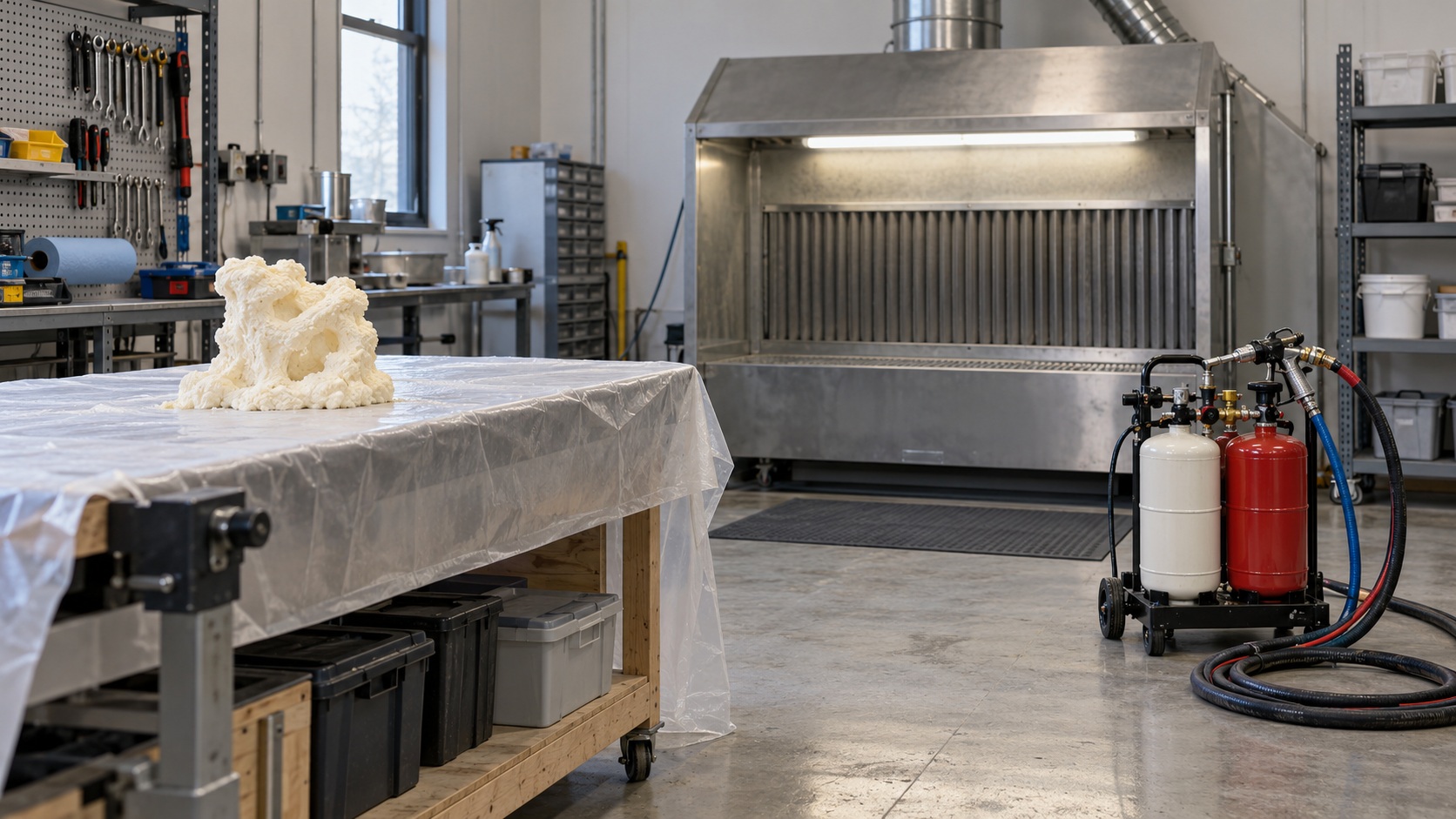
Plan the Spray Operation Before the Sculpture
Spray foam turns a liquid product into an expanding solid, which is why it appeals to artists building irregular volumes. That transformation is also the reason its handling cannot be judged by the finished material’s appearance. Application, reaction, trimming, and cleanup are different stages with different exposure questions. A one-component can of sealant is not interchangeable with a two-component kit or a professional high-pressure system. Before opening a product, identify exactly what it is, obtain its current instructions and safety data sheet, and decide whether the studio can meet them. If the necessary isolation, ventilation, training, or protective equipment is unavailable, build the form from another material or have the spray operation performed by an appropriately equipped specialist.
A: No. Product chemistry, application method, and instructions must be identified separately.
A: No. Airflow route, containment, exhaust destination, and the assessed task matter.
A: No. Protection must be selected for your product and operation by competent assessment.
A: Use the manufacturer's scenario-specific reoccupancy guidance and the established release process.
A: It is not by itself evidence for full cure or unrestricted occupancy.
A: Do not assume so; follow personal-exposure directions rather than improvising solvent washing.
A: Stop further work and ask the manufacturer before covering or moving the application.
A: Do not improvise reactions; obtain the specific waste-management instructions.
A: Cutting or sanding creates a new task that requires its own assessment.
A: Consider carved or assembled stock, or commission the spray stage from an equipped specialist.
Identify the System and Its Intended Use
Start with the product, not a tutorial made with a similar-looking can. Record the manufacturer, product name, component count, expiration information, and intended applications. Download the safety data sheet for every component and any specified cleaner. Keep the application guide as well: it often contains practical limits that are not explained by a hazard summary alone. Check whether the proposed artistic use falls outside the instructions and ask the supplier when the answer is unclear.
Describe the actual job to the supplier. Building a thick freestanding mass may be quite different from filling a narrow construction gap. The amount applied, permitted pass thickness, substrate, temperature, and surrounding conditions can affect the reaction. Do not assume that a small sculpture makes a product’s requirements irrelevant. If the manufacturer cannot support the proposed method, the project needs a different construction approach rather than an improvised exception.
Understand Why Exposure Control Matters
Polyurethane systems can involve isocyanates and other ingredients whose hazards must be assessed during use. OSHA’s isocyanates overview describes respiratory and skin concerns, including sensitization. A previously tolerated exposure does not prove that another exposure is acceptable. Do not use odor, familiarity, or the absence of immediate irritation as a substitute for the specified controls. People who are not spraying can still be affected by work occurring nearby.
In an art building, think beyond the person holding the applicator. An assistant may enter to move a light; a neighbor may share a doorway; someone may arrive after the artist leaves. Build a communication plan around those predictable events. Name the person who controls access and the person who releases the area for its next use. Put the work period and restricted period on the room schedule before materials arrive.
Substitution is worth considering early. A carved core, mechanically assembled sheets, or a fabricated shell may achieve the same outline without a spray reaction in the studio. Compare the complete process rather than just the cost of the can. A method requiring fewer exposure controls may be more practical for a one-off art project, even if shaping takes longer. Avoid transferring an industrial operation into a shared room merely because its consumables fit on a small table.
Ventilation Needs a Deliberate Route
An open window does not establish a controlled airflow pattern. Air may cross the operator’s breathing zone, enter a corridor, or reach another occupied room. Identify where clean replacement air enters and where contaminated exhaust leaves. Consider doors, adjacent spaces, and outdoor air intakes. The ventilation arrangement should be appropriate to the product and task, with competent advice when needed. Do not guess a universal fan size or air-change target for every studio and spray system.
EPA’s spray polyurethane foam ventilation guidance discusses isolation, exhaust, and management of the work area. Treat it as background for planning, not a certificate that a household fan makes any installation adequate. A room with a simple floor plan can still have complicated pressure relationships. Shared heating or cooling equipment can also move contaminants beyond the apparent boundary of the job.
Arrange isolation and any necessary HVAC changes with the building’s responsible personnel. Do not disable a system casually or compromise another required building function. Confirm how the arrangement will be restored after the operation and how the area will remain controlled during curing. A plan that depends on a door staying shut should account for deliveries, emergencies, and the people who normally use that door.
Ventilation should be ready before dispensing begins and maintained for the product-specific period afterward. Keep the equipment and access arrangement under supervision according to the plan. If power fails, an exhaust route is obstructed, or another occupant reports an unexpected exposure, stop the operation and follow the established response. Continuing to finish one last pass is not a useful trade when the control the process depends on has failed.
Protection Must Match the Assessed Task
Gloves, clothing, eye protection, and respiratory protection need selection for the actual products and operation. A dust mask does not become protection against every chemical exposure because it covers the face. Similarly, a glove’s color says nothing dependable about its resistance to a particular ingredient or cleaner. Use the manufacturer’s guidance and a competent hazard assessment. Account for the helper’s work and cleanup, not just the moment of application.
In workplaces, respiratory protection can involve medical evaluation, fit testing, training, maintenance, and a written program as applicable. OSHA’s spray-foam respiratory protection guidance explains why selecting a respirator is more involved than choosing a cartridge from a shelf. Do not copy a photograph of another worker’s equipment as a specification. If the required program or equipment is beyond the studio’s capability, that is a reason to change the process.
Application Limits Belong in the Sculpture Plan
Use an expendable trial to confirm artistic behavior only after the safety arrangements are established. The trial can reveal expansion, adhesion, surface form, and the space needed around the work. It cannot waive the instructions. Protect surrounding surfaces using materials and methods compatible with the product, and keep ignition sources controlled as directed by the labeling. Do not spray near an unassessed heat source simply because the desired sculpture is small.
Build the geometry around the permitted application method. If a large mass requires a core and limited passes rather than a deep pour, incorporate that core into the design. Respect waiting periods between passes and the specified environmental limits. Do not improvise a mixing ratio, add water or solvent, or combine leftovers from different products. Instructions for one kit should not be borrowed to interpret another system’s reaction.
Keep the operator’s route and emergency access clear. Place consumables where they can be reached without crossing wet material or pulling hoses across another person’s workstation. Make sure an unexpected expansion will not obstruct the exit or seal equipment in place. These practical details are part of exposure prevention because a hurried recovery from a foreseeable mess can create unnecessary contact.
For a multi-day build, identify each application batch on a separate working record. Otherwise an assistant may trim a newly applied region believing it belongs to yesterday’s cured work. Keep those notes outside the restricted area so the schedule can be checked without entering it. A shared studio can use a simple location drawing to identify each treated region and its application date. Give the responsible supervisor access to that drawing and the relevant instructions. This prevents a later shift from relying on the appearance of a surface or a remembered conversation when deciding which operation may begin. If the sculpture contains several different foam products, map them separately; the earliest permitted operation on one region does not establish the timing for another.
Dry to Touch Is Not the Reentry Decision
A firm surface does not establish that the entire application has reached the specified condition or that the surrounding area is ready for unprotected occupants. Follow the product-specific distinction between trimming time, cure time, protected-worker reentry, and reoccupancy. EPA’s information on potential SPF chemical exposures directs users to the manufacturer for scenario-specific guidance. Avoid presenting a single waiting period as appropriate for every product and room.
Schedule curing as occupied space that remains unavailable, not as leftover time after the artist finishes. Tell the next user when the room may be released and who makes that determination. If the specified conditions were not achieved, or the material has an abnormal appearance or behavior, contact the manufacturer before proceeding. Painting over an uncertain application or moving it into a shared exhibition space does not resolve the underlying question.
Cleanup Is Another Chemical Operation
Plan cleanup before dispensing. Have the specified tools, compatible collection materials, waste containers, and current instructions available. A cleaner that removes uncured foam from equipment can have hazards of its own and may not be suitable for skin. Read its label separately. Do not assume that the product needed to clean the applicator is also the correct response to personal contact or a spill.
For skin or eye exposure, follow the product’s first-aid directions and obtain medical advice as indicated. Do not improvise solvent washing on the body. If someone develops breathing difficulty or another serious reaction, stop exposure, follow emergency procedures, and seek immediate medical attention. Bring the product identification to the clinician without bringing a leaking or contaminated container into an occupied treatment area.
Separate uncured residue, cleaners, contaminated absorbents, and pressurized containers from ordinary clean foam offcuts. Ask the local waste program or an appropriate waste contractor how the specific materials should be managed. Household collection arrangements may not accept business-generated waste. EPA’s household hazardous waste guidance warns against disposal to drains or the environment. Do not puncture or burn containers as a studio shortcut.
After the specified cure, trimming and sanding still need their own assessment for dust and contact. Do not move immediately from spraying controls to an uncontrolled cloud of particles. Maintain housekeeping through methods appropriate to the material, and keep waste contained. Record which product formed the core so future fabricators do not unknowingly heat, abrade, or chemically treat an unidentified material during later revisions.
Close the Job With a Clear Handover
Keep a brief job record: product references, instructions consulted, application dates, relevant environmental conditions, restricted access period, and any deviations. This is particularly useful when several artists share a facility. The record should be intelligible to someone who did not watch the application. It can explain why a room remains restricted, identify which cleaner was used, and help the manufacturer respond if the foam behaves unexpectedly.
For the finished artwork, document the hidden spray material and any restrictions that affect later work. A future repairer may see only paint and assume that heat cutting or a solvent adhesive is appropriate. State where the sprayed material lies, what other layers cover it, and where the product information is stored. The artwork’s appearance should not be the only clue to its construction.
Review the operation after completion. Was access control workable? Did the application fit the permitted method? Was waste collection arranged before cleanup began? Use the answers to improve the next project or decide that the process does not suit the facility. A successful object is not the only outcome worth measuring; a repeatable, well-controlled operation matters too.
Make Capability the Starting Point
Use spray foam only when the product, space, controls, and people fit the operation. When they do not, changing the fabrication method is a sound artistic production decision.