Preserving an Object That Keeps Changing
Maintaining a foam sculpture is not simply a matter of keeping its paint clean. The visible surface may be attached to a cellular core, adhesives, reinforcement, and an internal support, all aging on different schedules. A caretaker can reach the paint but not necessarily the material that gives it shape. Even identifying the foam may be difficult when the artist bought an unmarked block years earlier. Preservation begins by treating the sculpture as evidence: what it is made from, how its condition is changing, and which qualities must survive for it to remain the same artwork. The aim is to reduce avoidable loss while acknowledging that some material changes cannot be reversed by a routine studio repair.
A: Cleaning addresses soiling, not the underlying chemical or structural changes of aging.
A: A treatment that stiffens the object may preserve shape while changing an essential quality.
A: No. Enclosures alter local conditions and need assessment for the specific material.
A: Do not present an unconfirmed cause as though it were a direct observation.
A: Document and retain associated fragments when appropriate pending professional advice.
A: No. Appearance cannot establish that all deterioration mechanisms have stopped.
A: Do not use improvised flame tests; begin with records and specialist advice.
A: Set intervals according to condition, exposure, and events such as moves.
A: Padding and other contact materials can change, compress, or become unsuitable over time.
A: Documentation, artist interviews, samples, and detailed images preserve crucial knowledge.
Establish What Must Be Preserved
The same physical change can mean different things in different artworks. A yellowing surface may contradict a carefully specified white, or it may belong to a work whose aging was anticipated. A yielding texture might be essential to a sculpture’s meaning even if hardening it would make it easier to handle. Before choosing treatment, describe the work’s significant properties: color, contour, softness, tool marks, scale, assembly, and the relationship between original material and replaceable parts.
When possible, consult the artist while those decisions can still be discussed directly. Ask whether repainting is permitted, whether a damaged element can be remade from a pattern, and whether visible repairs are acceptable. Record the answers with dates and enough context to interpret them later. A casual remark about touching up a touring prop should not automatically become permission to replace the surface of a unique collection object. Ownership alone does not supply the missing artistic intent.
Preservation objectives should also fit the object’s role. A temporary event piece may need documentation and a planned retirement rather than indefinite stabilization. An acquired artwork may justify specialist analysis and carefully limited intervention. These are different commitments, not different levels of respect. Writing the objective down prevents a succession of well-meaning caretakers from making incompatible decisions because each assumed a different future for the sculpture.
Identify Materials Without Sacrificing Them
Begin with records rather than destructive experiments. Search invoices, fabrication photographs, supplier correspondence, retained offcuts, and original coatings containers if they remain available. A commercial name is useful but may not identify every component in a laminated construction. Note uncertainties explicitly. Describing an unknown core as a confirmed polymer can misdirect later cleaning or conservation decisions. Avoid home identification tests involving flame, heated tools, or solvents on the artwork.
A conservator may use examination and analytical methods to distinguish materials when the answer affects treatment. The Getty Conservation Institute’s plastics preservation project addresses identification and deterioration as conservation research problems, which is an important reminder that appearance alone can be misleading. A cellular structure is a physical form, not a complete chemical identification. Sampling, where justified, should be planned to answer a defined question with the least necessary loss.
Build a Condition Record That Can Reveal Change
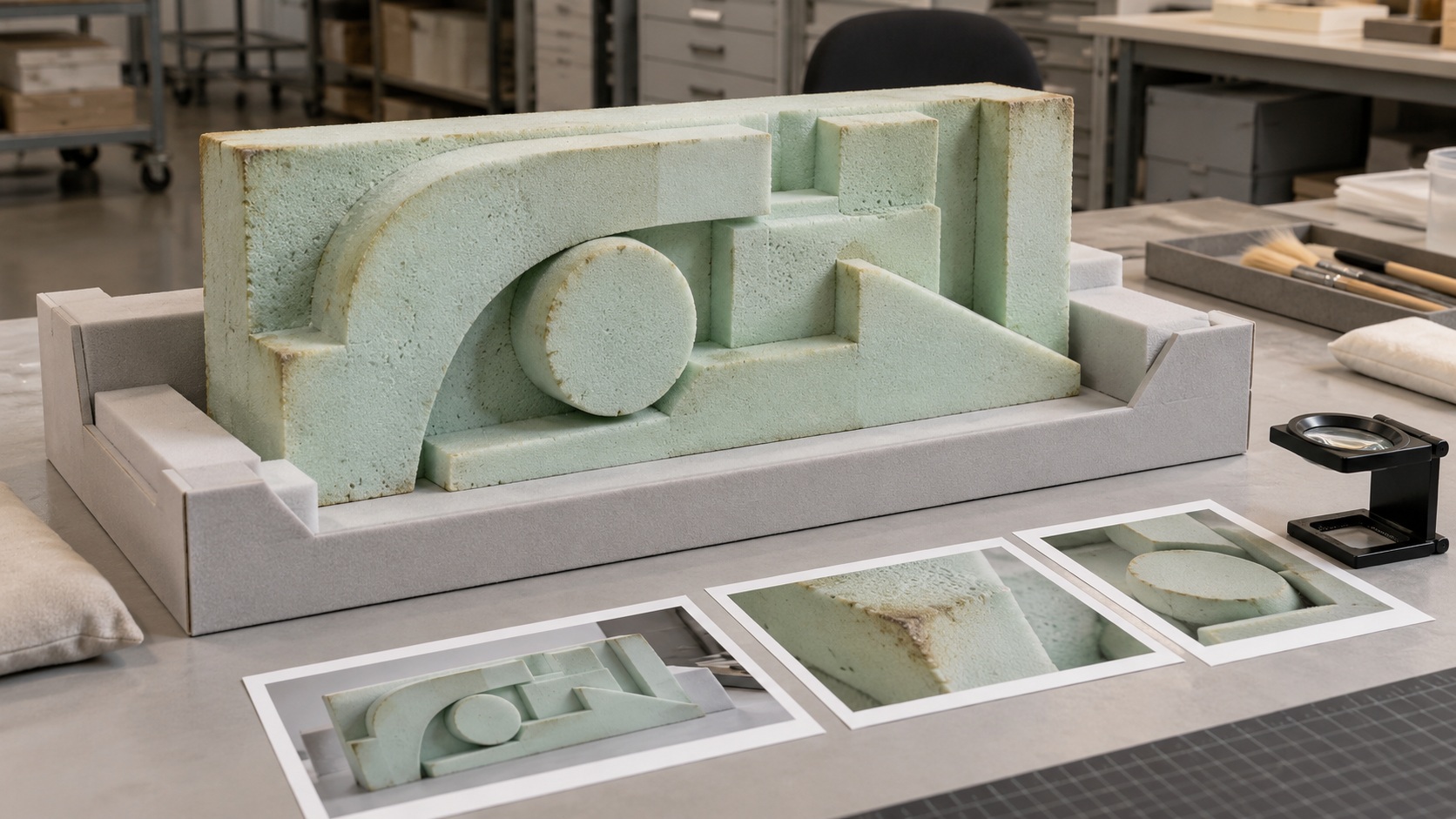
Photograph the sculpture systematically before trying to improve its appearance. Include overall views, vulnerable projections, seams, the underside, attachments, and any existing losses. Use consistent orientation and lighting so later images are comparable. A close photograph of a crack is more useful when a wider view shows where that crack lies. Keep the original files and dates rather than relying only on compressed pictures pasted into a report.
Describe observations separately from explanations. Powder beneath a surface is an observation; a diagnosis of polymer degradation is an interpretation that may require further evidence. Record color shifts, tack, distortion, detachment, loose hardware, and particles without forcing them into one cause. Comparing such records over time can reveal whether a condition is stable, seasonal, associated with moves, or progressively worsening. That distinction should influence the urgency and nature of intervention.
Map previous repairs as well as current damage. A hard patch may respond differently from the surrounding core, and a new crack beside it may relate to that discontinuity. Documenting old treatment helps the next specialist avoid mistaking repair material for original construction. If the past treatment is unknown, mark the uncertainty. Do not scrape or peel a suspicious region merely to make the record more complete.
Choose review intervals according to observed vulnerability and use. A work showing active loss may need more frequent attention than a stable object in controlled display. Review it after transport, installation, or an environmental incident as well as on the ordinary schedule. The purpose is early detection, not repeated handling for its own sake. Where inspection itself threatens fragile material, plan views and supports that allow examination without unnecessary movement.
Control Exposure Before Reaching for Treatment
Reducing unnecessary exposure can preserve options without altering the artwork. Consider light, temperature, moisture, pollutants, dust, and mechanical contact together. A move away from a sunny window may help with light exposure but place the object near a heater or in a busy passage. Evaluate the proposed location as a whole. Different plastics have different sensitivities, so avoid assigning a single universal environment or guaranteed lifespan to every foam sculpture.
The Canadian Conservation Institute’s guidance on rubber and plastic objects provides background on preventive care. In practice, a conservator should help tailor controls to an identified material and its condition. Do not assume that sealing a deteriorating object inside an improvised airtight box is beneficial. Enclosures change the local environment as well as excluding dust, and the choice of enclosure materials and ventilation needs informed assessment.
For a studio or small collection, useful progress may begin with simple management: reduce unnecessary display hours, keep environmental records, avoid contact with unsuitable packing, and train people who work near the object. These measures do not claim to stop chemical aging. They reduce preventable stresses and make later changes easier to interpret. A good preventive plan also assigns someone responsibility for checking that the agreed arrangement remains in place.
Cleaning Can Remove the Surface You Want to Keep
Dust on foam may sit within a rough texture, adhere to a tacky coating, or mingle with loose original particles. Those situations demand different responses. Brushing a powdering surface can remove original material alongside dirt. Rubbing may polish a matte finish or drive grime into open cells. Liquids can interact with coatings, adhesives, or exposed cores in ways that are not apparent from a product’s household cleaning claims. Treat cleaning as an intervention, not as a neutral preliminary step.
For valuable or deteriorated work, seek a conservator’s assessment before cleaning. If a maintenance procedure has already been approved, follow its tools, contact limits, and stopping conditions exactly. Keep a record of what was done and where. Stop if material transfers, the surface changes sheen, particles detach, or an unexpected response appears. Do not escalate automatically from a dry attempt to a stronger chemical cleaner because the first method failed to produce a uniform color.
Cleaning can also change the historical reading of a work. A slightly uneven surface might record the artist’s original application rather than later dirt. Compare early photographs and sheltered regions before deciding that uniformity is the correct goal. Removing every dark passage can erase intentional modeling or evidence of manufacture. Establish a documented endpoint that respects the object instead of pursuing the appearance of a newly fabricated replacement.
Where professional treatment includes tests, map the trial areas and record their appearance under consistent light. Small experiments can otherwise become invisible to the next person, who may repeat them or misinterpret the resulting variation. Record any delayed response as well as the immediate result. A method should not be expanded solely because the first contact looked satisfactory while the surface was still wet or temporarily altered.
Sometimes the most appropriate response is to leave the soiling in place and improve protection from future deposition. A better dust cover for storage, an adjusted cleaning route around the display, or reduced nearby fabrication can prevent additional contamination without contacting the artwork. These choices may seem less dramatic than treatment, but they can preserve vulnerable texture that would otherwise be lost in pursuit of cleanliness.
Support the Object Without Imprinting It
A sculpture can slowly change shape while appearing to rest securely. A narrow support may concentrate pressure; an unsupported span may sag; a packing material may adhere to a vulnerable finish. Storage therefore needs a deliberately designed support arrangement. Follow the geometry of robust regions, distribute contact appropriately, and avoid asking delicate ornament to steady the whole object. A custom mount may be more important than a more elaborate outer box.
Keep the object accessible enough that examination does not require dragging it across its support. Plan how hands, lifting equipment, or a removable tray reach the load-bearing regions. Document the unpacking order, particularly when temporary braces must be removed at a particular stage. The person who returns the work to storage should not have to infer the correct arrangement from impressions in aging padding.
Inspect the storage materials themselves. Padding that was appropriate when installed may later compress, shed, or change condition. It should not be treated as permanent merely because it came from a museum supplier. Record when contact materials were introduced and review them with the object. Where material identification or compatibility is uncertain, a conservator can help select a support system that does not trade one preservation problem for another.
Retain detached fragments in a clearly associated container when advised, with their locations documented. Tiny pieces may help reconstruct a loss or identify the structure of a failing layer. Do not press them back into place with an available household glue. A hurried attachment can obscure fracture surfaces and make a later treatment more difficult. Containing the loss, documenting it, and obtaining advice can be the most constructive immediate response.
Repair Is Not the Same as Reversing Aging
A filler can restore an outline, and an adhesive can reconnect pieces, but neither necessarily restores the original properties of deteriorated foam. Strengthening treatments may change softness, appearance, or future treatability. The Netherlands Cultural Heritage Agency’s publication PUR Facts examines polyurethane foam conservation as a specialized subject. It should not be reduced to a universal recipe for coating every unstable sculpture.
Set treatment goals narrowly enough to evaluate them. Is the purpose to secure a loose fragment for display, reduce continued particle loss, or prepare the work for a necessary move? Consider whether non-treatment alternatives could achieve the same goal. A changed mount, reduced handling, or a different display orientation might avoid adding material to an already complicated composite. Document both the chosen action and the alternatives considered.
After treatment, preserve the record of products, methods, locations, dates, and observed effects. Keep photographs before, during, and after the work. State what remains uncertain and what the next caretaker should monitor. A visually seamless result is not sufficient evidence that every underlying process has been resolved. Honest limitations make the treatment record useful long after the person who performed the work is no longer available.
Preserve Knowledge Alongside Material
Foam conservation depends on informed restraint, stable support, repeatable observation, and a clear account of artistic intent. Keep those records with the object so future decisions begin with evidence rather than another guess.