
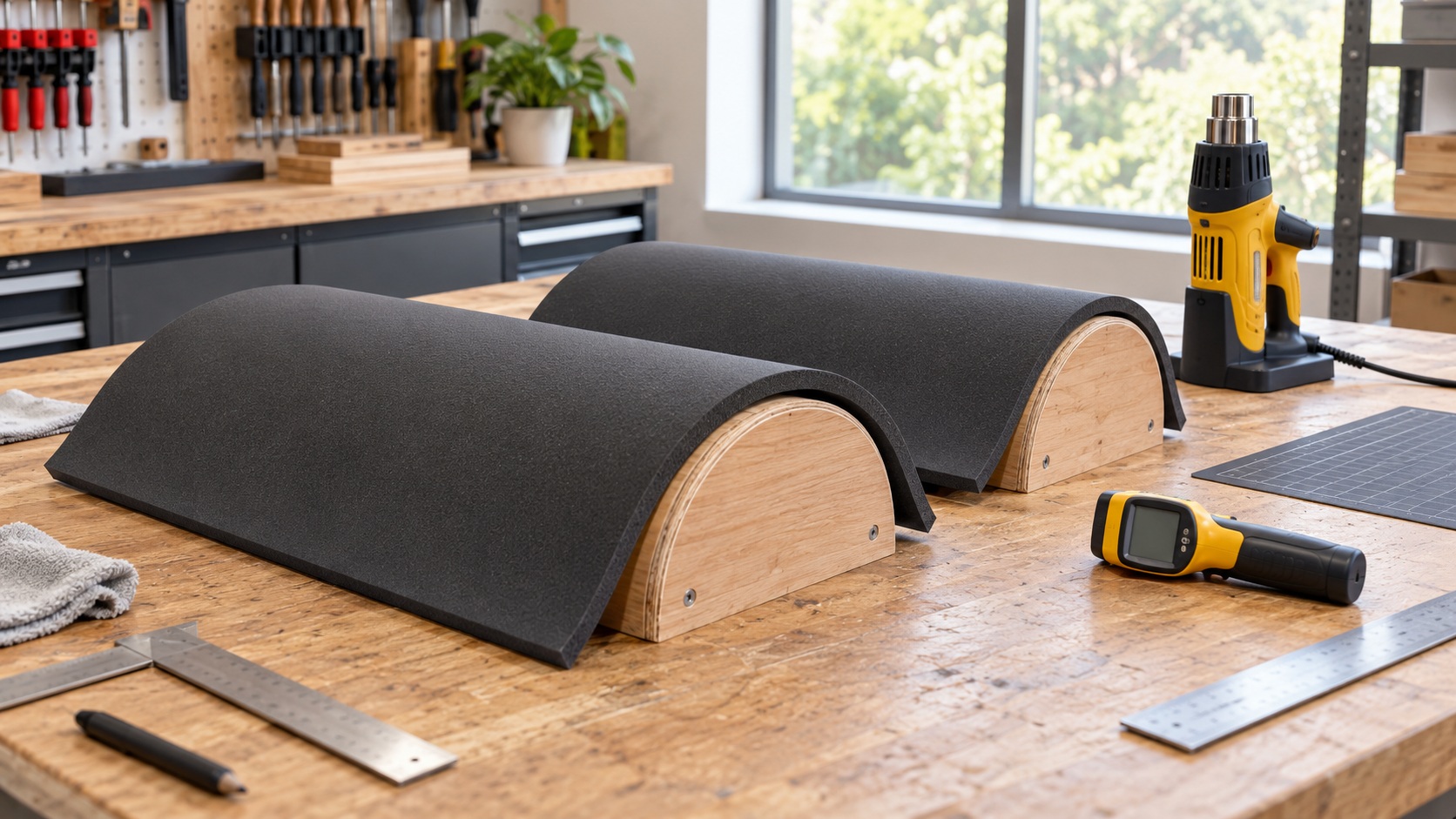
A Temperature Number Needs a Material and a Method
There is no universal heat setting that makes all foam suitable for shaping. A number on a heat gun describes the tool’s output setting, not necessarily the temperature of the workpiece, and a product’s maximum service temperature is not a forming instruction. The important guidelines belong to an identified grade, a specified heating method, a thickness, and a controlled process. Before attempting a curve, establish whether the material is intended for thermal forming at all. If its identity or processing information is missing, use cutting, segmentation, or another cold construction method. Successful shaping should come from a documented process rather than from bringing an unknown foam close to visible damage and hoping that point marks a useful limit.
A: There is no universal setting; use supported guidance for the exact grade and process.
A: No. Intended service conditions and fabrication instructions answer different questions.
A: No. Lack of smoke does not establish controlled exposure or material integrity.
A: Do not use unknown material for a process that depends on identified thermal behavior.
A: They demonstrate product and method specificity, not interchangeable recipes.
A: No. An instrument needs an appropriate measurement method and cannot supply missing process support.
A: Stop and review the supported procedure rather than escalating an uncertain operation.
A: Assess the final support and material choice before adding finish.
A: Not automatically; coatings and adhesives change the assembly being heated.
A: Consider carving, segmented panels, patterned darts, laminations, or appropriate mechanical restraint.
Separate Four Different Temperature Questions
The tool setpoint is the first number. It may describe air leaving a nozzle or the controller setting of a forming oven. The workpiece temperature is another number, influenced by distance, airflow, heating time, support, and geometry. A thin edge may respond before a thick center. Even when both numbers are measured correctly, they do not mean the same thing. A tutorial that supplies only a dial position leaves much of the actual process unspecified.
A recommended forming condition is a third kind of information. It comes from guidance for processing a particular product by a particular method. A service-temperature limit is a fourth: it describes an intended condition of use, often with qualifications, rather than permission to heat the material for fabrication. Keep these categories separate in your notes. Copying the highest number from a data sheet into a tool controller is not a sound way to create a forming recipe.
Finally, decomposition or ignition information is not a practical target. A material can distort, lose useful properties, or generate unwanted emissions before a dramatic visible event occurs. Do not use the absence of smoke as proof that the process is adequately controlled. The aim is to remain within supported processing conditions with the necessary controls, not to discover by experiment how close the foam can get to a destructive threshold.
Consider an assistant handed a note saying only 150 degrees. Without units, material grade, heating method, and the source’s qualifications, that note is not an instruction. The assistant should stop and retrieve the complete process record. Record who approved the method and which stock was used for its trial. When a replacement delivery arrives, compare its identification before assuming the previous process applies. A visually similar sheet should not inherit approval through proximity on the same storage rack. This simple handover test is useful: if the record cannot distinguish an approved operation from an unrelated one, it needs clarification before anyone energizes the equipment.
Identify the Exact Grade Before Heating
Start with traceable stock and keep the packaging or purchase record. Broad descriptions such as craft foam, insulation foam, or packaging foam do not establish polymer, additives, facing, adhesive layers, or intended processing. Color is not a dependable identification method. Two black sheets can have different formulations, and a reclaimed panel may include a coating that behaves differently from its core. Unknown scraps are better reserved for uses that do not depend on thermal behavior.
Request the current technical guidance and safety information from the supplier. Describe the proposed thickness, curve, heating equipment, and any coating already present. Ask whether the recommendation applies to the stock you actually have, not merely to the brand family. If the supplier does not provide a supported forming method, do not create one by averaging numbers from unrelated products. The missing information is a reason to change the fabrication plan.
Read Real Examples Without Turning Them Into Universal Rules
Ottobock lists its specific Plastazote Beige 617S7 padding material as thermoformable at 110 degrees Celsius, or 230 degrees Fahrenheit, with the stated hotplate or convection-oven methods. That is a product-specific example, not a temperature recommendation for every polyethylene foam. An artist still needs the complete processing information, an appropriate workspace, and the current instructions for the exact material and equipment.
By contrast, Zotefoams’ TIS 16 for conductive Azote grades gives a suggested hot-air preheating temperature of 150 degrees Celsius within its discussion of those named materials. It also supplies grade-dependent heating guidance and warns about overheating. Those details demonstrate why a single detached number is inadequate. They are not an invitation to apply that value to an unidentified craft sheet.
The difference between the examples is useful even if neither product suits the artwork. Product formulation and method matter. So do the qualifications surrounding the numbers. Keep the full source reference with any approved process record and check for newer guidance before repeating the job. A screenshot of a temperature without its product heading, revision, and method can become misleading when circulated among studio assistants.
Write units explicitly. Confusing Celsius with Fahrenheit produces a very different thermal condition, and a digital controller may retain the units chosen by its last user. Confirm the display before starting. Avoid shorthand such as medium heat unless it accompanies an approved equipment-specific procedure. The goal is a record another trained person can interpret without guessing which tool, scale, or material the original operator meant.
Plan the Exposure Controls First
Heating a plastic is a processing operation with potential emissions, not just a way of making it softer. Review the safety information for the material and the proposed process. Obtain competent advice on ventilation and any other needed controls. The UK Health and Safety Executive’s guidance on plastics processing emphasizes controlling fumes and avoiding overheating. A window or the fact that the work occurs briefly does not by itself establish adequate control.
Keep food preparation and art processing separate. Do not repurpose an oven used for meals as an unassessed plastics-processing appliance. Choose equipment intended and maintained for the task, with the necessary temperature control and working arrangement. The same principle applies to a heat gun: its nozzle, airflow, power supply, stand, and shutdown procedure belong in the plan. Check the equipment instructions instead of treating a familiar shape as evidence that every model operates alike.
Consider nearby materials as well as the foam. Solvent-containing products, loose scraps, packaging, and combustible bench coverings may be incompatible with a hot operation. Clear the work area and maintain access to exits and suitable emergency arrangements. If a coating or adhesive is already present, evaluate the complete stack. A supported process for bare stock does not automatically apply to a painted, glued, or laminated assembly.
Make a Forming Trial Representative
Once the material, method, and controls are established, prepare an expendable specimen that represents the difficult part of the artwork. Match thickness, layering, curve depth, support, and edge conditions. A narrow strip does not necessarily predict the behavior of a broad panel. The trial should answer whether the approved process produces the required geometry and surface quality, not whether improvised heating can force a reluctant material to move.
Prepare the form or jig before heating so the softened material does not require an improvised transfer. Eliminate sharp contact points and provide the intended cooling arrangement. Think through how tools and hands move without entering the hot airflow or contacting hot equipment. Suitable thermal protection should follow the task assessment and equipment instructions. Never use the body as a forming mold for a studio experiment with heated stock.
Measurement Has Limits of Its Own
If the process requires workpiece temperature measurement, choose an appropriate instrument and method through competent guidance. A non-contact reading can be affected by the surface and measurement setup. A contact sensor can also disturb a soft surface or report only its local condition. Do not assume that buying an infrared thermometer turns an unsupported recipe into a validated process. Measurement is useful when its meaning and limitations are understood.
Record location as well as value. A reading at the center of the panel does not necessarily represent a thin edge, a hidden layer, or the region nearest the nozzle. Repeatable placement helps compare trials. Keep the instrument’s operating instructions and relevant calibration or verification information with the equipment. Where the process cannot be monitored adequately using the studio’s available tools, seek specialist fabrication rather than replacing evidence with touch or smell.
Time belongs beside temperature in the record. Longer exposure is not automatically equivalent to a modest setpoint change, and heating a thicker part can create a different temperature distribution. Follow the supported method and avoid improvising repeated heating cycles to recover a failed result. If the work does not respond within the specified conditions, stop and review identification, thickness, equipment behavior, and process suitability before trying again.
Note the environment and setup that materially affect repeatability: support position, approved equipment configuration, stock dimensions, and cooling arrangement. The record need not become an elaborate research report. It should contain enough information to explain why a successful trial is relevant to the final piece and to prevent someone from transferring it casually to a different foam. A brief, precise record is more useful than an impressive photograph of a heated curve.
Recognize When to Stop
Unexpected scorching, discoloration, collapse, unusual emissions, or abnormal equipment behavior calls for stopping the operation. Follow the equipment’s shutdown instructions and the established emergency plan. Do not put your face closer to investigate a smell, continue heating to smooth a damaged area, or carry a hot suspect piece through occupied space without a plan. If exposure or injury occurs, use the applicable first-aid directions and obtain medical help as needed.
Set the failed specimen aside in an appropriate controlled location once the situation is resolved and the material can be handled according to the plan. Photograph the result and record what happened. Do not disguise the failure with paint and proceed to full production. The trial has provided useful information: something about the proposed material-method combination or its implementation needs reconsideration.
After cooling, inspect for thickness changes, tears, surface damage, and springback. A curve that looks convincing while restrained may relax when released. Check it again in its intended support arrangement before coating or assembly. If retaining the shape requires a permanent frame, include that frame in the design rather than asking adhesive seams or decorative paint to carry an unplanned restoring force.
A Cold Method May Fit Better
Many sculptural curves can be achieved through segmented panels, carved stock, laminated contours, darts, or mechanical restraint using a suitable material. These approaches have their own tool, dust, and adhesive considerations, but they avoid making thermal processing a requirement. Compare the complete workflow. For a small studio producing one object, a slightly longer cold construction can be more manageable than establishing equipment and controls for an unsupported heating operation.
Include appearance in that comparison. A segmented seam may be acceptable as a design feature, or a carved form may preserve a texture that heating would flatten. The best method is not necessarily the one shown most often in a short tutorial. It is the method that produces the required artwork with identified materials, workable controls, and a result the team can repeat without improvisation.
Keep the Number Attached to Its Evidence
Use only product-specific, method-specific thermal guidance. When the material or process is uncertain, change the construction approach instead of turning an unsupported temperature into a promise of safety.


