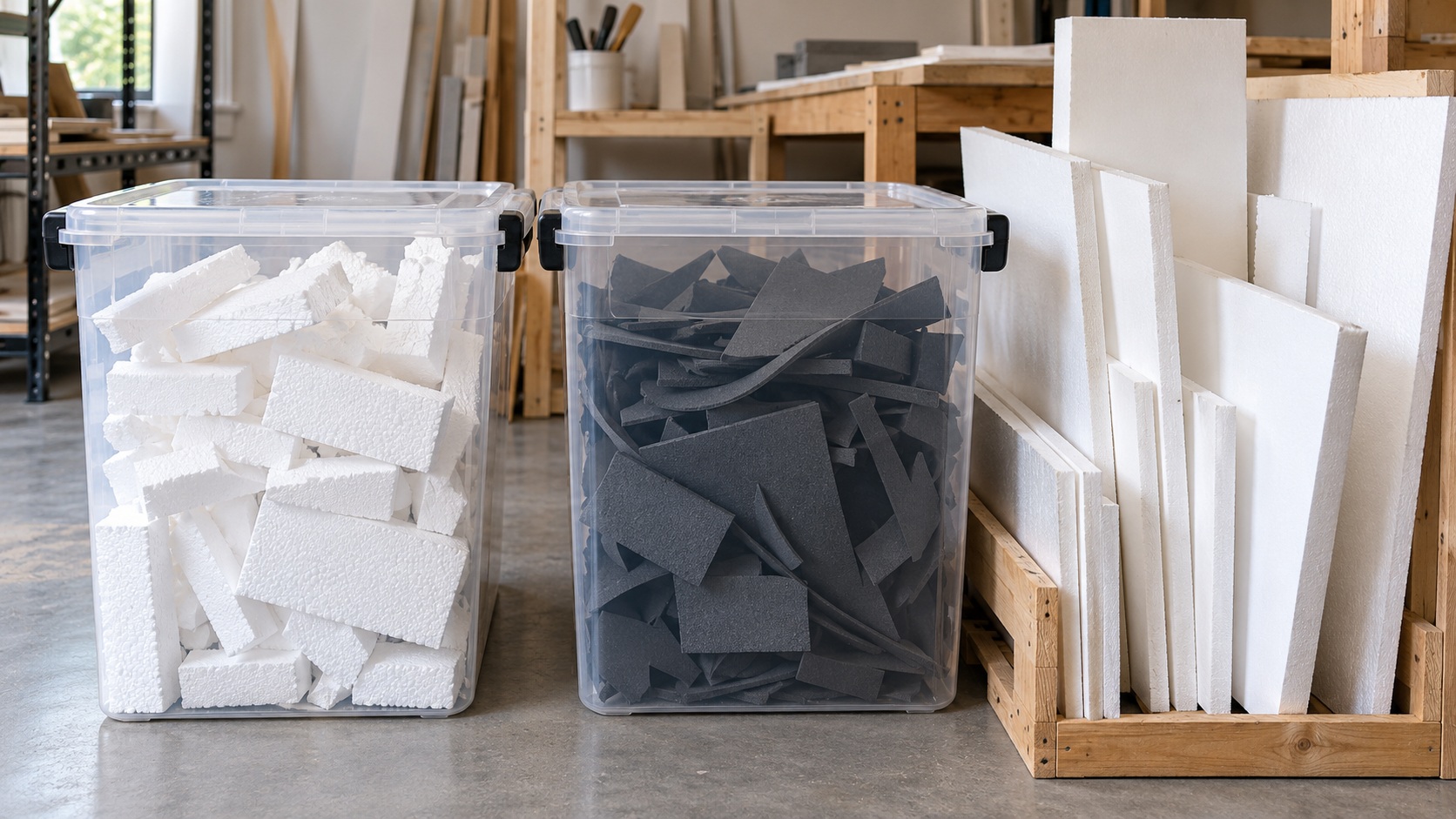
There Is No Single Hazard-Free Foam Bin
A bag of clean carving offcuts, a painted scenic panel, an uncured spray-foam container, and solvent-soaked cleanup materials are not the same waste. Calling all of them foam can send the wrong material to a recycler or conceal a chemical-handling problem. Environmentally responsible disposal begins with identifying what remains and keeping useful streams separate before the studio floor becomes a mixture. No method is universally hazard-free, and a recycling symbol does not guarantee local acceptance. The practical aim is to prevent avoidable waste, contain loose fragments, preserve accurate product information, and use a receiving facility that has agreed to take the actual material. That requires a little planning before fabrication, not a hopeful trip to a collection site after everything is bagged.
A: No. Confirm acceptance with the actual local receiver.
A: No. Similar appearance does not establish compatible material or contamination status.
A: Do not improvise chemical volume reduction; it creates additional handling and waste questions.
A: No. Identify and assess the materials separately.
A: Only if the program confirms that your generator type and waste are eligible.
A: Ask the appropriate service for product- and condition-specific instructions.
A: Do not use improvised puncturing or crushing as a studio disposal method.
A: Only retained material that has a realistic reuse plan is likely to displace new stock.
A: An informed recipient who agrees to the object's condition, use, and storage needs.
A: Report confirmed quantities and destinations without implying that all impacts disappeared.
Classify by Construction and Condition
List the materials the project will generate. Clean uncoated expanded polystyrene may be one stream; polyethylene sheet offcuts may be another. Adhesive-covered fragments, painted shells, and reinforced panels belong on separate lines because their added layers can change acceptance. Keep product records available so a waste service can identify the material without relying on a photograph of white crumbs. When identification is uncertain, say so rather than choosing the most convenient category.
Condition matters alongside identity. Unused liquid components are different from a fully reacted solid, and a container that no longer dispenses may still hold material or pressure. An old contaminated offcut should not enter a clean-stock reuse rack merely because its core once matched the new material. Establish simple staging areas that keep clean reusable pieces, potential recycling, ordinary residual waste, and materials needing specialist advice from becoming mixed.
For a shared studio, make the categories understandable to people who did not buy the products. A bin marked only foam is too vague when several polymers and processes coexist. Use product names or clear material descriptions, and identify the responsible project contact. Do not expect a volunteer at the end of an installation to reconstruct weeks of chemical and coating choices from the appearance of the final debris.
This sorting plan should fit the space and the collection schedule. Large light offcuts can overwhelm a small room long before their mass becomes significant. Arrange suitable containers and a realistic removal interval, while keeping exits and work areas clear. Separate staging is useful only if it remains manageable; a neglected pile beside a recycling bin is not an effective waste system.
Prevent Waste While the Stock Is Still Useful
Lay out major shapes before cutting and compare orientations. A modest adjustment to a seam or module size may let several parts share one sheet efficiently. Keep clean offcuts large enough to serve a defined future use, with material identification attached. A smaller study, test coupon, pattern support, or approved replacement piece can often be made from stock that would otherwise be discarded. Reuse is most practical when the next user knows what the piece is.
Do not preserve every crumb in the name of sustainability. Set a minimum useful size or a project-specific reason for retention, then review the rack periodically. Indefinite storage can occupy valuable space without displacing any new purchases. Track whether saved material actually gets used. A small organized supply of identified offcuts can produce more real benefit than an overflowing mixed collection whose contents no one trusts.
Ask the Recycler About the Exact Material
Confirm acceptance before preparing a shipment. Ask about polymer, form, color, contamination, minimum quantity, packaging, fees, hours, and whether the program accepts your type of generator. A site collecting clean packaging blocks may not take insulation board, loose beads, painted sculpture, or flexible foam. The fact that one item is technically recyclable does not establish that a particular facility has the equipment or market to handle it.
EPA’s guide to common recyclables explains that plastic identification symbols are not a guarantee of local recycling. For a concrete example of local restrictions, Washington Ecology’s Recycle Right guidance excludes polystyrene foam from its ordinary recycling-bin advice. That example should not be mistaken for a rule covering every jurisdiction or every specialist drop-off program.
Send photographs and product details when a receiving facility requests them. Ask specifically whether adhesive films, facings, labels, or paint must be absent. Do not assume that scraping a coated object makes it equivalent to clean manufacturing scrap; the receiver should decide whether the prepared material meets its requirements. Keep a dated record of the answer, particularly for a large project or a program whose acceptance rules change.
Contain Fragments Without Creating More
Loose foam can escape during collection, loading, or transport. Use containers appropriate to the receiving facility’s instructions and close them before moving the material. Work indoors or in a controlled area where fragments can be recovered. Protect waste from wind and avoid overfilling bags so they tear during handling. Inspect the loading route and vehicle after collection rather than assuming the last visible bag contains every piece.
Do not solve a volume problem by grinding, burning, melting, or dissolving foam in an improvised studio process. Those actions introduce new equipment, emission, chemical, or fire questions and may create a waste the intended receiver cannot accept. Commercial densification is a specific operation, not a reason to heat scrap with an available tool. If compacting is requested, obtain the facility’s approved preparation instructions and use appropriate services rather than inventing a shortcut.
Cleanup should preserve containment. Avoid sweeping fragments out of a doorway or using compressed air to move dust into the surrounding environment. Select collection methods suitable for the actual material and equipment. Include the waste from cutting and sanding in the plan, not only the large pieces visible at the end. Fine residues mixed with coatings or adhesives may need different consideration from the original clean board.
A lidded staging container can help prevent accidental mixing by visitors or adjacent projects, but it needs a clear description and a designated destination. Inspect containers when they are moved or exchanged. If a bag includes an unexpected bottle, aerosol, or wet residue, pause and resolve the contamination before collection. The receiving service should not have to discover a chemical container hidden inside a load described as clean foam.
Keep Chemical Residues Out of Solid-Offcut Streams
Spray components, cleaners, adhesives, and contaminated absorbents need their own product-specific assessment. Read the disposal sections of the current safety information, then contact the relevant local program or a qualified waste service. Do not mix residues to save container space or attempt an improvised reaction to make them appear solid. Keep identification and original labels available. An unknown jar creates a harder and potentially more expensive problem than an identified leftover product.
EPA’s household hazardous waste guidance advises keeping hazardous products in their original labeled containers and avoiding mixing. It also cautions against disposal practices that can pollute the environment. Use that as a starting point for household materials, not as permission for a commercial studio to use any household collection event. Generator status and local acceptance must be confirmed separately.
Do not pour leftovers into drains, onto soil, or into stormwater systems. Do not deliberately evaporate a cleaner as a disposal strategy. If a container is damaged or leaking, follow the product and local response guidance and obtain qualified assistance as appropriate. Do not handle an unknown leak merely to make the storage shelf tidy. Keeping people away and supplying accurate product information may be the correct immediate contribution.
Pressure and Residue Need Separate Attention
Aerosol cans and spray kits should be managed according to their actual condition and the applicable program. Do not puncture, crush, burn, or refill containers as an improvised art-shop operation. A can that feels light may still contain pressure or chemical residue. Ask the receiving service what it considers empty and how partially used containers must be presented. Do not borrow a rule for beverage cans to interpret a reactive or pressurized product.
State programs can differ. Washington Ecology’s aerosol-can guidance illustrates that business-waste handling depends on the jurisdiction and the contents. Avoid treating a general online recommendation as a complete legal determination for your studio. Tell the service where the waste was generated, whether it came from household or business activity, and which products remain inside.
Plan the Final Sculpture’s Disassembly
The easiest time to improve end-of-life sorting is during design. Removable mechanical connections can sometimes let a support frame, an electronic component, and a foam body leave separately. A permanent composite skin may make separation impractical. That does not automatically make the construction wrong, but it should be an acknowledged trade-off. Avoid promising that the whole finished object is recyclable merely because one starting material has a recycling route.
Create a short material map for the owner. Identify foam types, coatings, adhesives, reinforcement, hardware, and any components that need separate handling. Explain which connections are intended to come apart and which should not be forced. A deinstallation team working to a deadline needs practical information, not a general sustainability statement. Provide the map with the installation record while the construction details are still known.
Reuse of a finished object also needs agreement. A recipient should know its condition, intended use, and restrictions; an oversized decorative form is not automatically suitable for children’s play or public interaction. Ask whether the receiving organization can store and use it before delivering it as a donation. Moving an unwanted object to another institution without a realistic plan can transfer disposal costs rather than prevent waste.
Measure the Result Honestly
Keep simple records of stock purchased, useful offcuts reused, materials accepted for recycling, and residual waste collected. Record quantities in units the receiving service actually measures, and avoid converting a bag count into an invented weight. If an expected recycling route rejects a load, retain that information and change the preparation or design next time. A rejection is useful evidence about the system’s real limits.
Environmental claims should match those records. Reduced purchasing through verified reuse is different from material sent to a recycler, and both differ from an unconfirmed intention to recycle. Describe what happened without suggesting that any route eliminates all impacts. The strongest improvement may be a simpler construction, fewer incompatible layers, or a project sized to available stock rather than a dramatic-sounding disposal technique after production.
For recurring productions, compare jobs of similar scale. A smaller waste total may simply reflect a smaller commission rather than better material efficiency. Relate the result to the amount of work produced and the fabrication choices made. This helps identify changes worth repeating without overstating what one unusually tidy project demonstrates.
Share the practical findings with the next designer: which foam grade was accepted, how it had to be packaged, and which bonded layers caused rejection. Keep this information dated because collection programs change. Studio knowledge can reduce repeated mistakes, provided it remains a record of verified experience rather than an assumed permanent rule.
Give Every Stream a Confirmed Destination
Identify materials early, keep clean stock separate, contain fragments, and confirm the receiver’s requirements. Responsible foam disposal is a documented routing decision, not a universal promise that waste is harmless or recyclable.