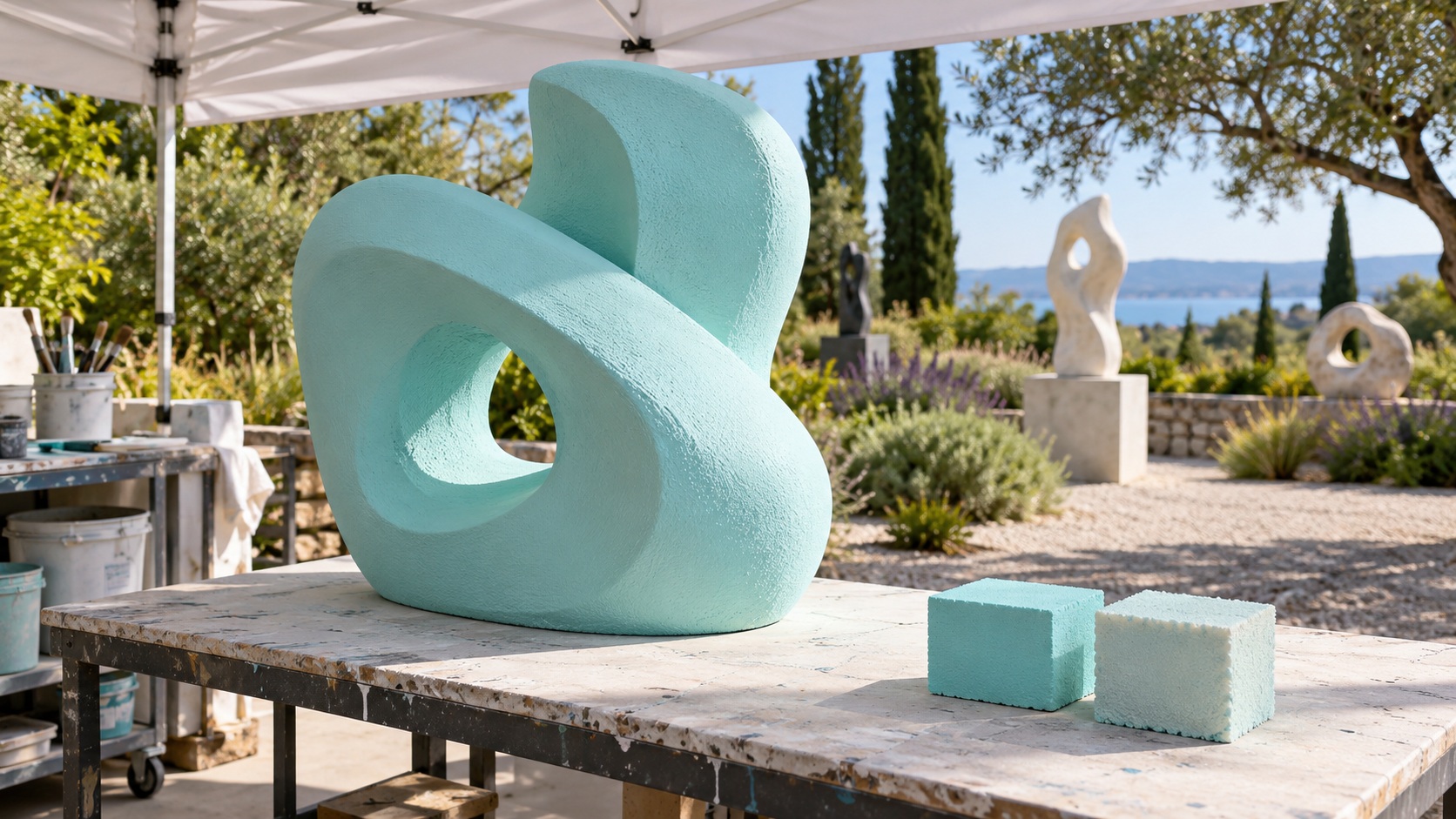
Two Different Exposure Problems
Sunlight can change a foam sculpture while also exposing the people installing and maintaining it to ultraviolet radiation. Those are connected site-planning problems, but they are not the same mechanism. A coating selected for an object is not sunscreen for its crew, and a comfortable temperature does not tell a worker how much UV is present. Nor does a yellowed surface prove that a sculpture has become a particular chemical hazard. Begin with the identified foam, its finish, and the actual display conditions. Then create separate plans for material protection and human sun exposure. Keeping those decisions distinct makes it easier to avoid exaggerated promises about a UV-proof artwork or equally exaggerated claims about what every weathered fragment means for health.
A: No. Identify the material and assess the actual handling or repair task.
A: No. Visible light and heating can matter too, depending on the construction.
A: No. Its optical properties, heating effects, contact, and drainage require review.
A: No. Confirm the complete system on the particular substrate and previous layers.
A: Shade can help, but use a complete personal sun-protection plan.
A: No. Temperature and UV exposure are different considerations.
A: Openings, attachments, and hidden finish defects may be missed from the front.
A: Have the substrate assessed before preparation or coating.
A: No. It helps comparison under documented conditions, not every future environment.
A: Inspection responsibility, repair triggers, approved methods, access requirements, and records.
Look at the Whole Exposure, Not Just the Forecast
An outdoor work may receive direct sun for only part of the day, but that pattern can change across the exhibition season. Nearby walls, glazing, pavement, and shade structures affect the setting. A photograph taken during a shaded morning site visit may conceal a long afternoon exposure. Visit at relevant times, consult site information, and document the proposed orientation before selecting a protection system.
Indoors does not necessarily mean unexposed. A sculpture near a window can receive substantial daylight, while a storage area may have lights left on for reasons unrelated to the object. Review both the intensity and duration of illumination with appropriate expertise. For collections, the Canadian Conservation Institute’s guidance on light, ultraviolet, and infrared distinguishes these agents rather than treating every lighting problem as UV alone.
For a curved sculpture, different faces can receive very different exposure. Mark the principal directions on the installation drawing and use them when naming condition photographs. Calling a defect the left side becomes ambiguous when the object is moved or photographed from behind. Directional records keep observations attached to the actual surface.
Survey the maintenance route too. A worker may spend longer in direct sun while preparing tools than while touching the sculpture. The object’s shaded location can therefore give a misleading impression of the crew’s working conditions. Include loading, preparation, access, and pack-out in the human exposure plan rather than considering only the final display position.
Ask who controls the site after installation. A venue may move furniture, change lighting hours, or relocate a temporary canopy without realizing that these changes affect the work. Include exposure-sensitive assumptions in the handover and request notification before significant changes. Protection depends partly on continuity of site management, not only on the initial specification.
Recognize Changes Without Inventing a Diagnosis
Possible changes include yellowing, fading, surface chalking, brittleness, and cracking, but their appearance depends on the material and construction. A colored paint may change before the core is visibly affected. A deteriorating adhesive might contribute to a lifted edge. A dirty surface can also look different without the same mechanism. Record the observation and its location before deciding which layer has changed or what caused it.
The Canadian Conservation Institute’s plastics and rubbers care guidance describes varied responses to light and UV, including losses of useful properties. That supports caution about exposure, not a fixed timetable for every foam. Formulation, thickness, finishes, and conditions matter. A generic claim that all outdoor foam fails after a particular number of days would obscure those differences.
Compare exposed and sheltered regions carefully. A covered underside may provide a useful reference, but it may also experience different moisture or contact conditions. A retained sample stored separately can help, provided its storage is documented. Neither comparison substitutes for analysis when the decision is consequential. For original artwork or widespread deterioration, ask a conservator to assess the material rather than attempting a diagnosis through repeated rubbing or scraping.
Do not equate color change with a precise health conclusion. If particles are shedding, control contact and cleaning through an assessment of the identified materials and task. Avoid making dust during inspection simply to demonstrate that a surface is weak. The question of whether a person should sand, handle, or repair an aged object requires more information than a photograph of its yellowing.
Reduce Exposure Through Placement
Relocation may be more dependable than adding another surface product. A shaded display position, a shorter outdoor season, or a protected orientation can reduce exposure without altering the sculpture. Consider how shade moves and whether it introduces a different problem, such as water dripping from a roof edge or restricted access for inspection. Evaluate the site as an operating environment rather than as a pleasing background for the opening-day photograph.
For an indoor exhibition, reduce unnecessary lighting hours and keep the object away from unsuitable daylight positions where practical. Consult conservation guidance for sensitive works and lighting design for the space. A transparent screen can change some parts of the light exposure, but it should not be assumed to eliminate all deterioration. Filters and glazing have specific properties, maintenance needs, and limits.
Temporary covers require care too. A cover can abrade projections, trap water, or alter heating conditions if chosen or installed poorly. Select a system appropriate to the material, support it so it does not damage the surface, and inspect it during use. Do not assume that any sheet of plastic is beneficial merely because it lies between the sculpture and the sky.
Choose a Coating as a Complete System
Ask the foam and coating suppliers about the exact substrate, primer, reinforcement if any, finish, and exposure. A product labeled for exterior use is not automatically compatible with exposed foam or with a previous repair. Confirm application conditions and curing instructions. For original artwork, discuss whether coating or recoating is acceptable before treating it as routine maintenance. A protective intention does not erase the possibility of changing texture, color, or historical surface.
Test the whole proposed stack on representative material. Include an edge, a joint, and a curve instead of evaluating only a flat color sample. Check whether the system adheres and preserves the intended appearance under the specified conditions. Keep the test record with the material references. A successful small trial establishes evidence about that combination; it does not create a guarantee against all weathering or replace the supplier’s limitations.
Heat Can Complicate a Sunlight Problem
Dark finishes and nearby reflective surfaces can influence solar heating. That is distinct from UV chemistry, even though both occur in sunlight. DuPont’s technical guidance for Styrofoam XPS with dark coverings and reflective surfaces addresses a specific insulation system’s exposure concerns. It illustrates why a cover or finish must be assessed in context rather than treated as an uncomplicated barrier.
Do not transfer building-product instructions wholesale into an art specification. A freestanding sculpture may have cavities, adhesive layers, and attachment details that differ from the documented assembly. Describe those differences to the supplier and obtain qualified advice when heat or structural performance affects the installation. Choosing a paler finish may be an artistic possibility, but it is not a universal substitute for checking material limits and the complete construction.
Look for local conditions that make the proposed location unusual: concentrated reflections, a sheltered recess, or a nearby exhaust. Record them in the site survey. If a work becomes distorted, investigate the actual material and environment instead of attributing every change outdoors to ultraviolet light. Accurate diagnosis matters because reducing UV alone will not necessarily solve a heat-driven deformation problem.
Include the installed support in that review. A finish may remain attractive while an attachment region changes shape or a joint opens. Access to the back and underside makes those problems easier to detect. If inspection requires moving a large fragile object each time, modify the installation plan before the exhibition begins. Material protection is more useful when it can be maintained without creating new handling damage.
Protect the People Doing the Work
For crew members, use current public-health guidance on sun exposure. The CDC’s sun safety advice recommends protection when the local UV Index is three or higher and describes shade, protective clothing, hats, sunglasses, and sunscreen. Treat these as complementary measures, not as permission to remain in direct sun indefinitely. The sculpture’s own finish offers no protection to a worker leaning over it.
Build the workday around actual tasks. Shade a preparation station, schedule exposed inspection where practical, and keep needed supplies close enough that protection is usable. A crew member balancing on access equipment should not have to improvise a sunshade that creates another hazard. Coordinate sun protection with the overall site safety plan, equipment instructions, and the demands of the task.
Sun exposure and heat stress also need separate attention. A cool or breezy day can still call for UV protection, while a hot shaded space can present heat-related concerns. Do not use comfort as a measurement of either risk. Follow the employer’s procedures and relevant guidance for outdoor work, and make arrangements for changing conditions before the installation team is committed to a long operation.
Make Inspection Specific Enough to Be Useful
Set a baseline after installation using consistent views and lighting. Mark locations where coating is thin, repairs exist, or attachments penetrate the surface. At each review, compare like with like: the same edge, the same seam, and the same reference view. Record the date, relevant exposure events, and changes observed. A general note that the object still looks fine is difficult to use when a later defect needs explanation.
Inspect after events that could disrupt protection as well as on the planned calendar. A cover shifting in wind, maintenance work nearby, or a relocation can change conditions quickly. Look at edges and undersides, not just the audience-facing surface. If the protective layer is damaged, obtain the approved repair method rather than covering the area with whichever paint is available.
Plan Renewal Without Erasing the Record
An outdoor finish may be intended to receive maintenance, but that work should have an agreed trigger and method. Specify who inspects it, who authorizes repair, and which product information must be consulted. Keep enough access and budget for the task. If renewal requires removing adjacent structures or booking specialized equipment, account for that before commissioning the display rather than discovering it after the first defect.
Do not repaint over loose or powdering material without assessment. The underlying layer may no longer provide a dependable surface, and aggressive preparation can remove original work. A conservator or qualified fabricator can help distinguish a manageable finish defect from a broader material problem. Record any removed layers, products applied, and changes in appearance so the next person understands what has happened.
Retirement or seasonal removal may be more appropriate than repeated intervention. Store the object using a support arrangement suited to its condition and keep the exposure history with it. Even when a temporary piece is eventually replaced, its record can inform the next construction. Honest documentation of how long a system served under stated conditions is more useful than claiming that an outdoor sculpture was permanently UV protected.
Protect Material and People Separately
Reduce unnecessary exposure, use a compatible protection system, and inspect the actual construction. Give the crew its own sun-protection plan; neither an object’s coating nor an unchanged surface proves that every risk is controlled.