Neither Tool Is a Universal Safer Choice
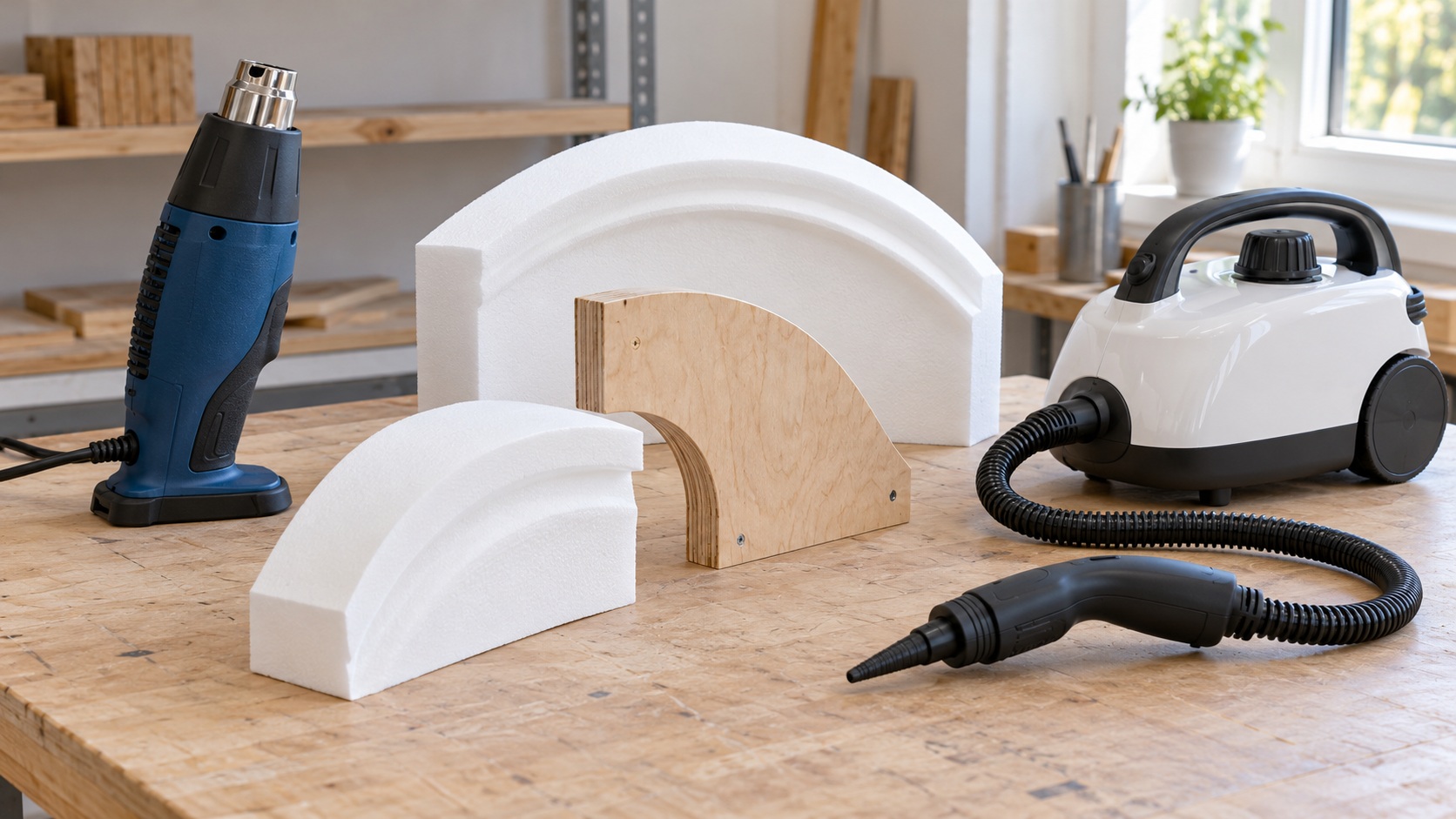
A heat gun and a steam unit deliver energy in different ways, so comparing them only by temperature misses the decision that matters. First establish whether the exact foam and its surface layers are suitable for the proposed thermal process at all. Then assess the equipment, emissions, burn hazards, electrical arrangements, workholding, and nearby people. Steam is not harmless because its feedstock is water, and hot air is not controlled merely because the tool has a low setting. For many sculpture details, a cold method or segmented construction is the better choice. The comparison should end with a justified process for a known material, not a general winner that artists apply to every foam they encounter.
A: No. Scalding, condensate, equipment, electrical, and material issues still require assessment.
A: No. Product suitability and actual workpiece conditions must be established.
A: Do not create an uncontrolled thermal exposure to resolve identity.
A: No. Visible smoke is not an exposure measurement.
A: Use suitable workholding that keeps hands out of hot output and contact hazards.
A: Adhesive and coatings may respond differently from the bare core.
A: Not by itself; scale, geometry, access, and heat or moisture accumulation change the task.
A: Do not assume particle protection controls thermal emissions; obtain task-specific advice.
A: Choose a supported alternative rather than inventing operating settings.
A: Neither universally. Select the complete process justified for the specific material and workplace.
Start With the Desired Change in Shape
Describe what you want the material to do: bend a sheet, soften a surface, close a small texture, or create an indentation. Those are different tasks, and some foams will not respond usefully to heat at all. A successful demonstration on a thin craft sheet does not establish a method for rigid insulation, flexible cushioning, or polyurethane tooling stock. Identify the commercial product before choosing equipment or searching for operating settings.
Ask the manufacturer whether the proposed thermal shaping is supported and what restrictions apply. Include any adhesive, primer, hardcoat, paint, fabric, or internal support already present. The complete assembly can behave differently from bare stock. If the answer is unclear, use a nonthermal method or a different documented material. Experimenting until a surface looks right does not establish that the resulting exposure or object is acceptable.
Understand What a Heat Gun Changes
A heat gun directs heated air toward a small area, but the tool’s setting is not a measurement of every point on the sculpture. Distance, movement, airflow, surface geometry, thickness, and time can create uneven results. A thin edge may change rapidly while a deeper section remains relatively unaffected. Treat this as a process requiring manufacturer-supported controls, not a recipe based on holding the nozzle a generic distance from any foam.
The nozzle and nearby surfaces can remain hot after the work stops. Prepare the proper resting arrangement and keep it clear of stock, packaging, loose clothing, and chemical containers. A tool laid on its side can direct heat toward something the operator is no longer watching. Follow its cooling and shutdown instructions, and restrict access while hot parts remain a contact hazard.
Hot-air shaping can also create an ignition or decomposition problem. The UK Health and Safety Executive discusses heat and fire concerns in its cellular plastics guidance. Do not assume that a flame-free tool cannot start a fire or that a subtle odor is a sufficient warning. The relevant material and workplace assessment must address what heating could release and what nearby items could ignite.
Steam Adds Moisture and Contact Hazards
A steam unit introduces hot vapor, hot equipment, and often hot condensate. Steam can cause scalds; the NHS explanation of burns and scalds distinguishes this injury mechanism from dry-heat burns.
Do not test output against a hand or hold the foam in the path while directing the wand. The fact that the input is water does not remove the need for a burn assessment and suitable equipment instructions.
Condensate may collect in recesses, run down the workpiece, or wet the floor. A sculpture with a skin, fabric, adhesive joints, or internal cavities can retain moisture where it is difficult to observe. Ask whether those materials tolerate the proposed process. Drying time and inspection become additional steps, and a finished-looking outer surface does not prove the internal assembly has returned to the condition needed for coating or storage.
Follow the steam unit’s instructions for filling, pressure release where relevant, cooling, and maintenance. Do not open a hot reservoir, substitute an improvised hose, defeat a control, or use damaged fittings. Equipment designed for cleaning is not automatically approved for sculptural forming, especially if the task involves enclosures or attachments the manufacturer did not anticipate. Obtain suitable advice rather than converting a domestic device into a pressure system.
Steam also brings water close to electrical equipment and cords. Arrange the work area according to the equipment instructions and applicable electrical requirements, with competent assistance where needed. Keep runoff away from connections and other tools, and do not treat an absorbent towel as the entire electrical risk control. The moisture pathway belongs in the setup plan before the unit is energized.
Heating Chemistry Is Not the Same as Cold Handling
A foam accepted for ordinary cold handling has not automatically been accepted for thermal processing. Heating can introduce decomposition products and change the exposure route. SafeWork NSW identifies hot processing of polyurethane materials among activities that can involve isocyanate exposure. Use that warning to ask product-specific questions, not to invent a universal temperature below which every foam is harmless.
For coated or repaired objects, the foam may not be the only source of concern. A thin finish can be heated strongly before the underlying material changes visibly. Obtain information on each layer and any processing restrictions. Unknown salvage, unidentified coatings, and unresolved cure are reasons to exclude thermal shaping. Avoid close-range sniffing, informal burn tests, and smoke observation as methods of finding a workable setting.
Compare the Complete Workflows
Compare setup, operation, cooling, cleanup, and storage rather than the seconds during which the tool touches the job. A heat gun may require a controlled hot-rest area and assessment of emissions; a steam process may add runoff control, drying, and reservoir handling. Both require workholding and clear access. Write the sequence so the person evaluating the method can see where hands go and when another person might encounter the equipment.
Consider the geometry of the piece. A large light panel can move under airflow or handling, while a narrow curved part can direct runoff unpredictably. Fixtures must hold the shape without placing hands near hot output. Do not ask an assistant to pinch the material while the operator heats it. If suitable restraint cannot be arranged, choose another forming method rather than relying on coordinated reflexes.
Look at who shares the room. Others may enter the work zone after the active process appears finished, touch a hot nozzle, or stand where emissions and vapor travel. Establish boundaries and communicate cooling or drying restrictions. Separate chemical application and storage from thermal work. A tool comparison that ignores the neighboring paint bench may miss the most important change in risk.
A Trial Needs Limits and Stop Conditions
Only trial a thermal method when the material and equipment information support doing so and the controls are in place. Use a representative sample that includes the real layers and thickness. Record the equipment, permitted settings, fixture arrangement, and observations. Include the sample identity so results cannot migrate to visually similar but undocumented stock. Do not extrapolate from a small coupon to a full assembly without considering scale, heat accumulation, access, and the ability to maintain controls.
Define stop conditions before starting. Unexpected odor, discoloration, smoke, surface collapse, adhesive movement, unusual equipment behavior, or ineffective capture should interrupt the trial. Do not continue in order to find out how far the problem develops. Withdraw as appropriate, follow the relevant emergency procedure, and obtain qualified advice. A failed sample is information about an unsuitable process, not a challenge to overcome with faster hand movement.
Judge the result after the sample has cooled or dried as required. Check shape retention, surface integrity, seams, and compatibility with the next finishing stage. A bend that appears successful while warm may not remain accurate, and a softened skin may conceal damage. Document both the desired result and any limitations so the eventual instruction does not become a vague recommendation to heat gently.
Record any extraction configuration used during the trial as well. Keep the trial distinct from an exposure evaluation. A visually successful part does not establish acceptable airborne conditions. Appropriate ventilation and, where needed, exposure measurement require competent assessment. Neither an open window nor the absence of smoke certifies the process. Avoid presenting a homemade demonstration as proof that one tool is categorically safer for all foam sculptors.
Use Protection That Fits the Actual Hazards
Choose eye, face, hand, clothing, and respiratory protection through the assessment of the specific method. Protection against a hot surface is not automatically protection against a chemical contaminant, and a particle mask is not a universal answer to thermal emissions. Equipment must allow secure control without exposing skin or interfering with the task. Follow the tool instructions and obtain qualified advice on any required respiratory program.
Maintain practical first-aid and emergency arrangements. Workers should know how to stop the operation, summon help, and follow appropriate burn or exposure guidance. Serious injuries or breathing difficulty require urgent medical assistance. Do not keep working after symptoms because the sample is nearly finished. Record the material, operation, and timing so responders or clinicians have useful information rather than only a broad reference to foam art.
Cold Methods Often Solve the Real Problem
A curve can sometimes be built from segments, cut from a thicker blank, laminated from suitable layers, or designed into the support structure. A texture may be produced mechanically or through a compatible coating system instead of heating the core. Evaluate those routes against the visual brief. The extra seam or preparation time may be a reasonable trade for avoiding an unsupported thermal process.
Choose alternatives with their own controls in mind. Cold sanding introduces dust, cutting introduces sharp-tool hazards, and lamination introduces adhesive handling. The advantage is not that another method has no risks, but that its risks may be better understood and easier to control in the available studio. Compare complete processes rather than using the word cold as another blanket safety label.
Buying an appropriately formed component or outsourcing a specialized operation can also be efficient. Include the time needed for equipment, ventilation, training, trial work, cooling, drying, and rejected pieces when comparing cost. A tool that appears inexpensive may require a process the studio should not attempt. Make the choice before the deadline turns a poorly supported experiment into the only remaining plan.
Write Down the Decision, Including a Decision Not to Heat
Document the material identity, intended result, available evidence, controls, and chosen method. If thermal shaping is excluded, state why and provide the approved alternative. This prevents another worker from reopening the question casually when a different tool arrives. Store the relevant supplier advice with the project and keep restrictions attached to any leftover material that might be reused.
Revisit the decision when the product, coating, geometry, equipment, or workplace changes. A previous result belongs to the conditions under which it was obtained. Good process notes make those boundaries visible. They help a team reproduce a justified technique while recognizing when a new question needs investigation rather than inheriting confidence from an unrelated successful job.
Choose the Supported Method
Heat guns and steam units offer different hazards, not a universal ranking. Use a documented process for known materials, and select a nonthermal route when compatibility, exposure control, or equipment suitability remains unresolved.