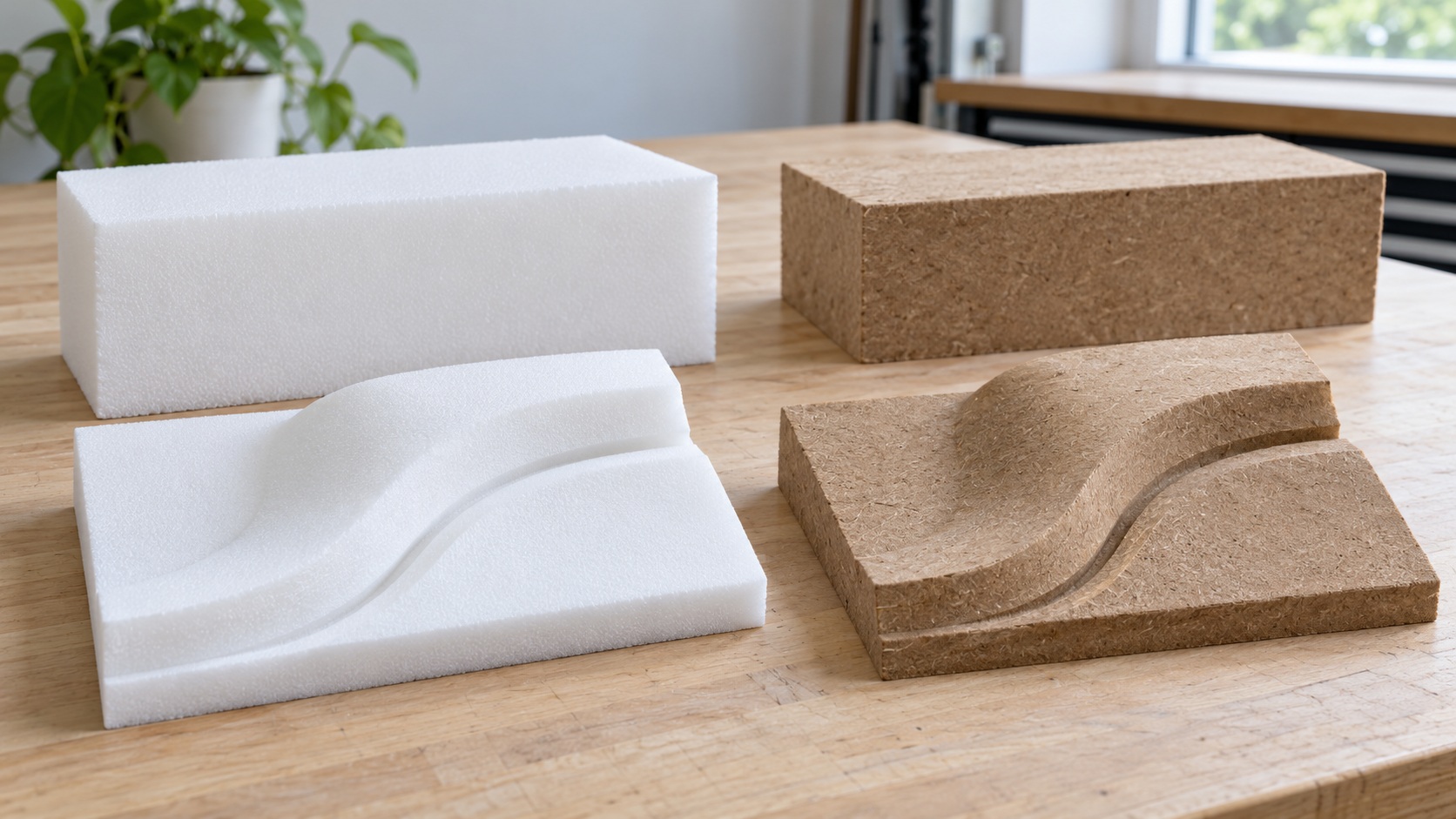
Make the Stone Effect Lighter Without Making Its Claims Heavier
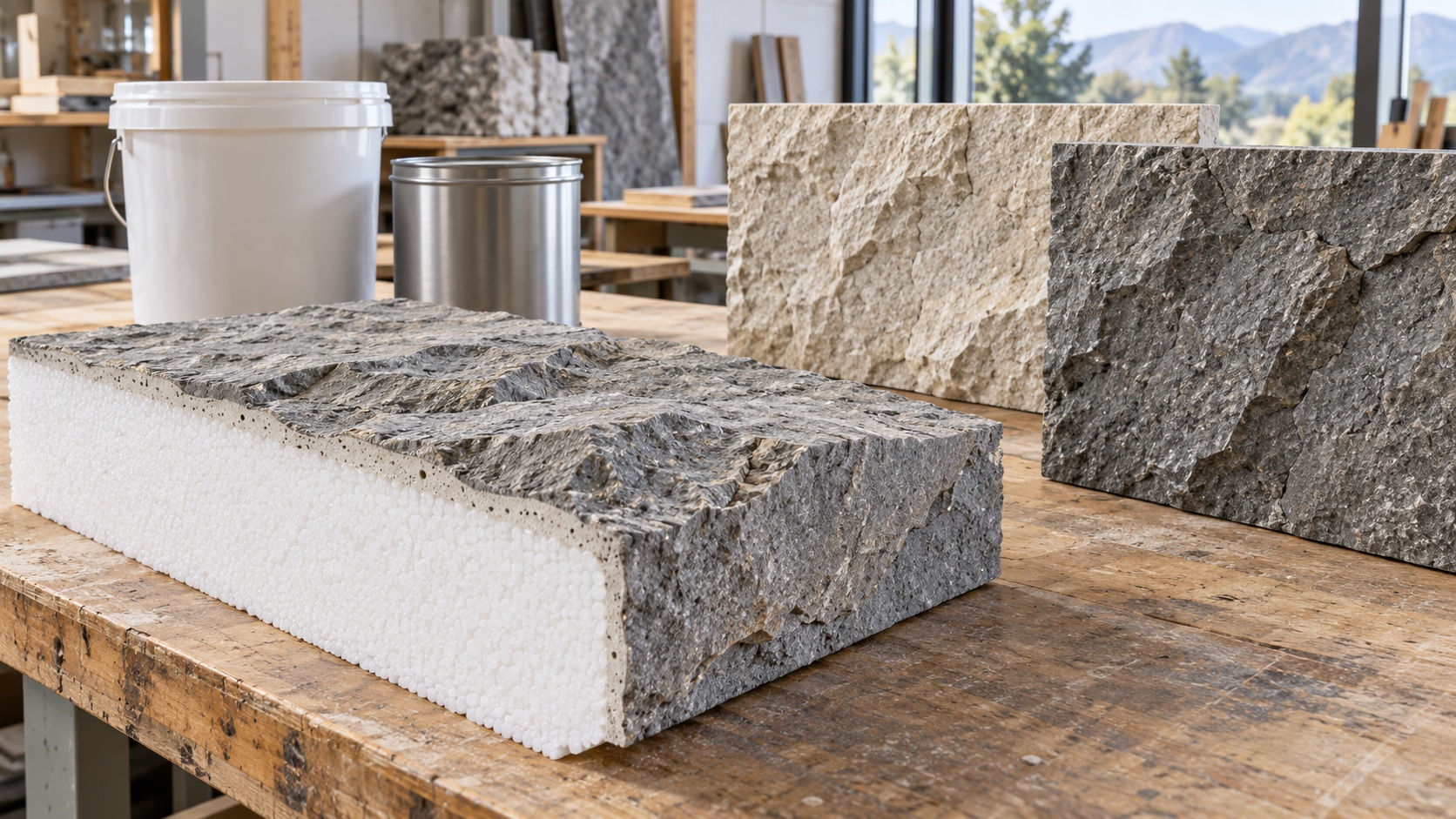
A thin stone-like shell over a foam form can provide substantial scenic volume with less mineral material than a solid casting of the same outside shape. That construction may also accommodate recycled ingredients, but the two ideas should not be confused. A lightweight aggregate may be virgin material, and a recycled aggregate may add weight. Binder choice, shell thickness, attachment, curing, finish, and service life determine whether the whole assembly works. Start with the intended appearance and use, then select a documented system appropriate to the foam and environment. Do not treat a bag of reclaimed powder as a universal substitute in an established mix. A successful scenic casting has to retain detail, remain attached, survive its expected handling, and meet the project’s requirements before its recycled-content percentage becomes meaningful. The useful environmental comparison is an accepted durable object, not the largest amount of waste material that can be stirred into a batch.
A: No. Recovered content and density are separate properties that need separate evidence.
A: No. The intended substrate, thickness, cure, and assembly behavior must fit the product.
A: It can replace interior bulk that is not needed for the scenic form, within an appropriately designed shell-and-support arrangement.
A: Do not assume compatibility or exposure acceptability; use documented guidance for the actual material and system.
A: Mass and volume percentages can give very different impressions when ingredient densities differ.
A: Not unless the complete construction is designed and assessed for that intended loading.
A: The actual core, preparation, joint, edge, shell thickness, and full decorative finish.
A: No. Opening powders and later trimming or abrasion may still create relevant exposure.
A: No. Confirm acceptance of the complete cured combination with a real receiving organization.
A: A bounded documented result such as reduced unnecessary bulk or extended service through a compatible local repair.
Identify the Binder Behind the Stone Name
Scenic casting stone can refer to substantially different products: gypsum-based casting materials, cementitious systems, polymer-modified mineral mixes, and resin-bound surfaces. Their mixing, curing, moisture behavior, working time, and application methods differ. Identify the actual product rather than assuming that every powder resembling plaster can serve the same role over foam.
Read the manufacturer’s intended substrates and uses. A product designed for a supported indoor casting may not be suitable as a thin exterior skin on a large foam core. A rigid shell can also respond differently when its substrate yields locally. Ask about the complete assembly and proposed thickness. Do not infer approval from a successful cast made in a separate mold.
Keep decorative appearance separate from structural function. A surface that resembles masonry does not automatically support a person, fixture, or overhead attachment. Have supports and connections designed for the actual load and installation. The foam can establish volume while another part carries forces, but that division must remain explicit in fabrication and handover records.
Separate Recycled Content From Low Density
Ask what the recycled ingredient is, where it comes from, and whether the stated proportion is measured by mass or volume. A dense mineral fraction can contribute substantial mass while occupying relatively little volume. An airy filler can do the opposite. Compare figures using the same basis before claiming that one formulation contains more recovered material than another.
Determine whether the ingredient replaces binder, aggregate, or another component. These roles are not interchangeable. A supplementary cementitious material in an engineered concrete product is a different proposition from random crushed casting waste added to a scenic mix. Supported industrial uses should not be generalized into permission to improvise an unknown powder blend.
EPA’s coal combustion residuals reuse information discusses specific beneficial-use contexts such as encapsulation in concrete. It does not validate every artistic mixture or uncontrolled handling method. Obtain documentation for the actual supplied product and keep the environmental claim tied to its established use.
Consider the source consistency. Reclaimed material can vary in particle size, moisture, contamination, or previous coating. A supplier-controlled recycled ingredient is different from sweepings collected from several unrelated projects. Traceability helps both performance evaluation and waste planning. If the source is unknown, do not conceal that uncertainty beneath an attractive recycled-content label.
Use the Core to Reduce Unneeded Bulk
Determine where the foam replaces material that contributes only volume. A large scenic boulder may not need a solid mineral interior to communicate mass visually. Plan a suitable shell-and-support arrangement instead. The resulting weight depends on the complete geometry and finish, so estimate and eventually measure the assembly rather than relying on the lightness of the bare foam.
Keep core shape, shell thickness, and intended handling connected. A thin shell over an unsupported projection presents a different problem from the same material over a broad backed surface. Do not reduce thickness below product requirements simply to achieve a lower weight. Resolve the design with the responsible fabricator or qualified designer where performance demands it.
Design the Interface Before Applying the Mix
Confirm whether the selected system is intended to adhere directly to the foam or requires a specified preparation or intermediate layer. Use only supported methods and materials. A rough-looking surface does not independently establish adequate bonding. Likewise, an adhesive that bonds the foam does not automatically remain compatible with the wet mineral or resin-bound layer above it.
Include a joint and an exposed edge in the sample. Those locations reveal movements and local thickness changes that a broad flat face may hide. Plan how a modular assembly’s scenic joint relates to its structural connection. A coating should not be expected to bridge every moving division without an appropriate design.
Keep connectors accessible and free of uncontrolled buildup. A beautiful mineral finish can make a previously serviceable fastener unreachable or alter a registration fit. Mask or otherwise protect interfaces using the accepted method. Measure critical clearances after the sample’s full finishing sequence rather than assuming that the bare core dimensions remain unchanged.
Document the layer sequence with a small cross-section sample where practical. This helps future repairs distinguish the core, interface, shell, and decorative finish. Without that information, a later worker may remove an essential layer while trying to correct a superficial scuff, or add an incompatible repair over a weak existing bond.
Evaluate a Mix Through Representative Samples
Begin with the supplied system’s instructions, including proportioning, mixing, application, cure, and any limits on additives. If recycled content is introduced outside the supported formulation, obtain appropriate guidance rather than assuming a small percentage is harmless to performance. Keep experiments out of production until their intended role and evidence are accepted.
Test a sample with the relief, corners, and local thickness of the real object. Fine aggregate may retain small detail differently from a coarse lightweight addition. A change that reduces mass can also change texture, workability, edge quality, or finishing effort. Record those outcomes together instead of describing the lightest sample as the winner automatically.
Compare total material use at an accepted surface condition. A mix needing repeated patches and additional sealing can consume more than its initial application suggests. Include rejected batches and unused mixed residue. These records can reveal a straightforward improvement such as better batch sizing without requiring an unsupported lifecycle calculation.
Respect Wet and Dry Processing Hazards
Cement-containing products can affect skin and eyes, and dry processing of mineral materials can create hazardous dust. The HSE’s cement guidance describes dermatitis, burns, and concerns from cutting cured material. Review the exact product safety data and process before mixing, application, trimming, or sanding.
Do not assume a recycled ingredient is free of exposure concerns. Its previous use, composition, and contamination may matter. Avoid making powder from unidentified cured waste as an informal recovery technique. Appropriate material selection and controlled processing are more defensible than creating a new dust-generating operation simply to keep scraps out of a bin.
Use the ventilation, dust controls, protective measures, and cleanup methods suitable for the product and task. A water-based mixing stage does not eliminate dust during opening bags or later abrasion. Keep waste collection from dispersing settled material. Retain safety information with the production record so repairs do not introduce a less controlled process than the original build.
Follow cure and handling instructions rather than treating a hard-looking face as ready. Do not improvise heat acceleration around a foam assembly. Supporting the piece appropriately during cure can help preserve geometry, but the arrangement must maintain the conditions the product requires. The deadline should be built around the process rather than used to redefine it.
Finish Stone Through Form and Color
Let the large carved or molded planes carry the impression of stone. Surface grit alone cannot make an unchanged rectangular block read as a natural boulder. Choose a coherent reference for fracture, layering, or weathering, then use the shell to preserve that relief. Excess finish can fill recesses and round the edges that make the reference recognizable.
Choose color and sheen around the intended setting. A restrained base with selective variation often reads more convincingly than black outlines around every recess. Test the full finish under the installation light. The recycled ingredient’s natural color may influence the result, but it should not force a coating schedule that undermines the initial material-saving objective.
Compare Durability and Recovery Together
Evaluate the actual service environment: indoor display, repeated packing, visitor contact, or outdoor exposure. A product suitable for one condition may require a different system for another. Obtain the appropriate evidence and project assessment. A mineral-looking skin is not a universal weatherproofing or fire-performance claim for the complete foam object.
Plan local repair access and keep compatible materials identified. Replacing a small worn edge can be preferable to discarding a large reusable form, but only when the repair can recover the intended performance. Do not hide a failed bond beneath another decorative layer. Record damage mechanisms so the next revision addresses the cause rather than merely the visible mark.
Ask a real receiver about the finished composite at retirement. Foam bonded to mineral shell, reinforcement, pigments, and sealers may not fit either a clean foam stream or an accepted mineral recovery stream. Recycled content going into the product does not establish recyclability coming out. Keep those claims separate in project communication.
Where separation is a realistic goal, design and test it before production. Record the labor, material condition, and residue involved. A hypothetical ability to chip the shell off later is not the same as an achievable recovery method. Reuse of the intact object may be the more practical route, but it too needs storage, identification, and a credible next use.
Document the Complete Scenic System
Keep product names, supplied recycled-content evidence, proportions where relevant, substrate preparation, layer sequence, cure conditions, and finish samples together.
Include the final mass and the intended handling points. This record lets another fabricator distinguish a supported proprietary system from an experimental shop mixture without guessing from the surface appearance.
Report limited achievements accurately. You may know that a shell used less mineral material than a solid version, that a supplier documented a particular recovered ingredient, or that a local repair extended a form’s service. Those are useful specific outcomes. Avoid turning them into universal low-impact, harmless, or fully recyclable claims unless the complete evidence supports that language.
Keep Batches Consistent Across Modules
A large installation may use several batches across similar surfaces. Retain the accepted sample and record the supplied material lot where available. Compare new batches before applying them across a whole module, especially when a recovered ingredient contributes visible texture or color. Local variation may suit natural stone, but it should remain within the intended composition.
If variation is unacceptable, discuss it with the supplier before inventing corrections. Extra pigment, water, binder, or filler can change more than appearance. A documented supported adjustment is preferable to a series of undocumented shop fixes that leave adjacent modules with different behavior beneath matching paint.
Make Less Bulk Do the Right Job
A waste-smart scenic stone assembly combines purposeful foam volume, a supported shell system, traceable ingredients, and a realistic service plan. Choose recycled content for a verified role, preserve the intended relief, and judge the result by usable life rather than a headline percentage.