
Why Foam Recycling Matters More Than Ever
Foam is everywhere, even when most people do not notice it. It protects appliances during shipping, cushions takeout containers, insulates buildings, preserves cold-chain deliveries, and appears in everything from furniture padding to packaging inserts. Because it is lightweight, durable, and inexpensive, foam has become one of the most widely used materials in modern life. Yet those same advantages create a major waste problem. Foam takes up a huge amount of physical space relative to its weight, making it difficult and expensive to collect, transport, and process after use. As cities, manufacturers, and consumers look for smarter ways to manage waste, foam recycling has become an increasingly important part of the broader conversation around sustainability.
A: No. Recycling depends on the foam type, its cleanliness, and whether local programs or specialty facilities accept it.
A: It is lightweight, bulky, often contaminated, and expensive to transport unless it is compacted first.
A: Sometimes, but many curbside systems do not accept it. Local recycling rules should always be checked first.
A: Clean packaging foams such as certain EPS and PE materials are among the most commonly recovered streams.
A: It is a machine that compresses loose foam into dense blocks or logs so the material is easier and cheaper to ship.
A: It can be reprocessed into plastic feedstock and used to make products such as frames, trim, insulation components, and packaging items.
A: Usually much less. Food residue, tape, labels, and mixed materials can make recycling more difficult or uneconomical.
A: It is a process that breaks foam polymers into reusable chemical components or purified feedstock for future manufacturing.
A: Often yes, because they generate larger volumes of cleaner foam that are easier to collect and process efficiently.
A: One of the biggest advances is better densification and recovery technology, along with smarter system design across the supply chain.
Understanding What Foam Recycling Actually Means
Foam recycling refers to the collection, sorting, densification, and reprocessing of foam materials so they can be turned into new products instead of being sent to landfills or incinerators. The term covers several different materials, including expanded polystyrene, extruded polystyrene, polyethylene foam, polyurethane foam, and specialty industrial foams. Not all foams are recycled in the same way, and not all are accepted in curbside recycling systems. That is one reason foam recycling is often misunderstood. Many consumers assume all foam is unrecyclable because it is hard to place in the correct waste stream, while others mistakenly think any foam with a recycling symbol can go in a blue bin. In reality, foam recycling depends heavily on material type, contamination level, and access to specialized collection systems.
Why Foam Is So Difficult to Recycle
The biggest challenge with foam is its physical structure. Most foams are made mostly of air, which means they are bulky but very light. A truck filled with loose foam may appear full, but it often carries surprisingly little actual material by weight. This makes transportation inefficient and expensive. Recycling systems are often designed around materials like cardboard, aluminum, or rigid plastics that have higher value and density. Foam does not fit neatly into that model. It can also break apart easily, scatter in the environment, and become contaminated by food residue, tape, labels, dirt, or mixed materials. All of these factors reduce its recycling value and increase processing costs.
The Different Types of Foam in the Waste Stream
Not all foam is the same, and that matters a great deal for recycling. Expanded polystyrene, often seen in protective packaging and some food containers, is one of the most recognizable forms. Extruded polystyrene is denser and more uniform, often used in building insulation. Polyurethane foam is commonly found in mattresses, cushions, and upholstered furniture. Polyethylene and polypropylene foams are used in specialty packaging, athletic gear, and industrial applications. Each of these materials behaves differently during collection and reprocessing. Some can be mechanically compressed and remolded, while others require chemical treatment or are far harder to recover at scale. This diversity is one reason the public conversation about foam recycling can feel confusing.
The Collection Problem Starts at the Bin
One of the most significant barriers to foam recycling is simply getting the material into the right stream. Many municipal recycling systems do not accept foam through curbside pickup because the material can clog sorting equipment or fail to move efficiently through automated systems. Even when communities do accept certain forms of foam, participation can be low because residents are unsure what is allowed. Clean protective packaging may be recyclable, while food-soiled foam containers are often rejected. Drop-off programs can work, but only if residents know they exist and are willing to transport the material themselves. That friction reduces recovery rates and leaves large volumes of recyclable foam out of the system.
Contamination Makes a Hard Problem Even Harder
Clean foam has recycling potential, but contaminated foam often becomes uneconomical to process. Food residue, grease, paint, adhesives, and mixed materials can reduce quality or make batches unsuitable for recycling. A foam takeout container stained with sauces may look small and harmless, but in large numbers it can create major complications for processors. Packaging foam that is taped to cardboard or mixed with plastic film also requires extra labor to separate. Because foam already has a low value-to-volume ratio, every additional step makes the economics more difficult. This is one reason commercial and industrial foam waste is often easier to recycle than household foam. Businesses can generate larger volumes of cleaner, more consistent material.
Why Economics Drive Almost Every Recycling Decision
Recycling is not just an environmental issue. It is also a business decision shaped by transportation costs, equipment investment, labor, material purity, and market demand for recovered resin. Foam recycling struggles when these variables do not line up. It may cost more to collect and densify foam than the recycled output is worth in a given market. That does not mean recycling is impossible. It means success often depends on scale, proximity, and specialized infrastructure. In regions where foam densifiers, buyers, and end markets are nearby, recycling becomes far more viable. In areas without those links, landfill disposal can remain the cheaper option, even when it is environmentally less desirable.
How Mechanical Foam Recycling Works
Mechanical recycling is one of the most established approaches for processing foam. In this method, clean foam is collected, sorted by resin type, and then densified or compacted to remove air and reduce volume. The material may be shredded, melted, compressed, or extruded into denser forms that are easier to transport. Once processed, the recycled resin can be used to manufacture items such as picture frames, trim boards, insulation products, office supplies, and other plastic goods. Mechanical recycling works best when the incoming foam is relatively clean and uniform. It is especially effective for post-industrial scrap and certain packaging streams where contamination is limited.
Densification Is a Game-Changer for Transport
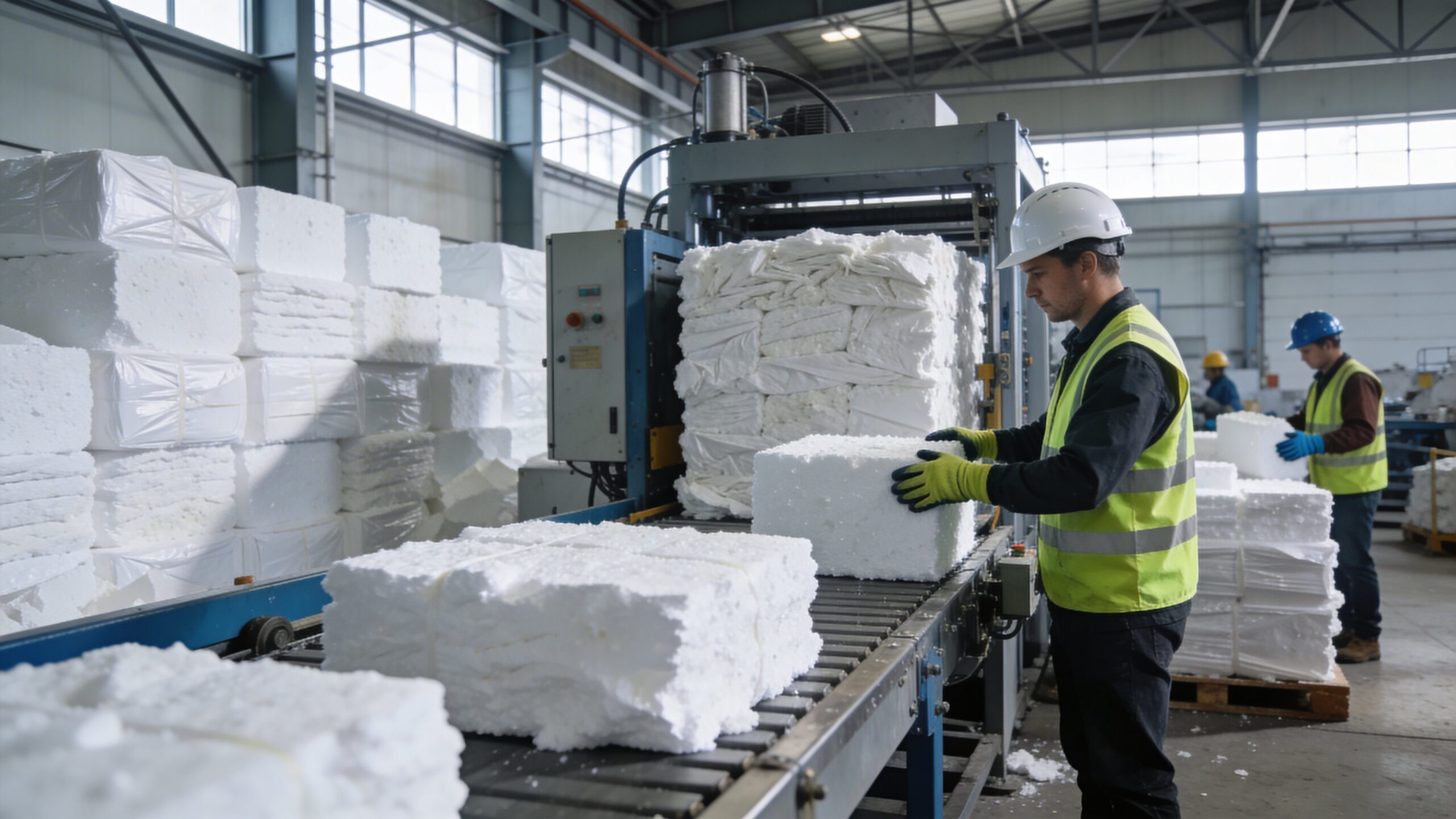
A major innovation in foam recycling has been the development of densification equipment. Densifiers compress bulky foam into compact blocks or ingots, dramatically increasing the amount of material that can be shipped economically. This changes the logistics equation. Instead of hauling truckloads of mostly air, processors can transport concentrated material with far greater value per load. Some densifiers use heat, while others rely on cold compaction. Portable systems have also made it possible for warehouses, retail distribution centers, and recycling hubs to process foam closer to the point of generation. This innovation has helped unlock recycling opportunities in sectors where foam waste volumes are high and space costs matter.
Chemical Recycling Is Expanding the Possibilities
Mechanical recycling has limits, especially when foam is mixed, degraded, or contaminated. That is where chemical recycling technologies are attracting attention. These processes break foam polymers down into smaller molecular components that can be purified and used again as feedstock for new materials. Depending on the material and the process, methods may include depolymerization, dissolution, solvent-based purification, or other advanced conversion techniques. Chemical recycling is still developing and can be expensive, but it offers a possible route for materials that are difficult to recycle mechanically. It also supports the idea of circularity by recovering material value at a deeper level rather than simply downcycling it into lower-grade products.
Dissolution Technology Is Changing Foam Recovery
One especially promising area of innovation involves dissolution systems that use carefully selected solvents to reduce foam volume and separate usable polymer from contaminants. This can make some difficult streams easier to handle and more economical to transport. The process can create a dense resin concentrate without relying entirely on heat-based melting or simple compaction. In the right applications, dissolution can preserve material quality and open the door to higher-value reuse. The challenge, of course, is ensuring the process itself is safe, efficient, and environmentally responsible. Solvent recovery, emissions control, and overall energy use must be carefully managed if dissolution is to become a scalable long-term solution.
Design for Recycling Is Becoming More Important
A major shift in modern materials thinking is the idea that products should be designed with end-of-life recovery in mind. For foam, that means simplifying material combinations, reducing problematic additives, improving labeling, and creating packaging systems that are easier to separate and recycle. A foam insert bonded to multiple plastic films, labels, or coatings may perform well in transit, but it becomes much harder to recover later. By contrast, mono-material designs or systems with clearer disassembly pathways can improve recyclability. Manufacturers are increasingly being pushed to think beyond performance and cost and consider what happens after the product has served its original purpose.
Extended Producer Responsibility Could Reshape the Market
Policy is also playing a growing role in foam recycling. Extended producer responsibility programs shift some waste management costs upstream to manufacturers, brand owners, or distributors. In theory, this encourages companies to redesign products, support recovery systems, and invest in recycling infrastructure. For foam materials, such policies could help solve the long-standing problem of who pays for collection and processing. Municipalities often struggle to justify those expenses, especially for difficult materials. If producers are required to contribute financially or operationally, the economics of recycling may improve. Policy alone will not solve every problem, but it can help align incentives across the supply chain.
Commercial Recovery Programs Often Lead the Way
Many of the most successful foam recycling efforts start in commercial settings rather than residential ones. Retailers, manufacturers, appliance stores, furniture distributors, and logistics centers often generate large quantities of relatively clean foam packaging. Because the material is concentrated in one place, it is easier to collect, densify, and ship. Some businesses now operate closed-loop or semi-closed-loop programs in which packaging foam is returned, compacted, and sold into manufacturing streams. These programs show that foam recycling can work when the material is clean, volumes are predictable, and infrastructure is available. They also highlight an important lesson: scaling foam recycling may require targeted systems rather than one-size-fits-all municipal models.
Recycled Foam Can Become Valuable New Products
A common misconception is that recycled foam has little practical use. In fact, once properly processed, recovered foam resin can become a raw material for a range of products. Depending on the polymer type and processing method, recycled content may go into frames, moldings, insulation components, packaging products, composite lumber, consumer goods, and industrial materials. In the case of flexible foams such as polyurethane, recovered material can also be turned into bonded carpet underlay or other cushioning products. End-market development is essential because recycling only works if someone wants to buy the output. As manufacturers seek more recycled content and circular material solutions, demand for recovered foam could grow.
Innovation Is Not Only About Machines
When people think about recycling innovation, they often imagine new equipment or futuristic chemistry. Those matter, but process innovation is equally important. Better collection systems, clearer consumer education, smarter logistics, digital tracking, and improved partnerships between waste haulers and processors can all raise recovery rates. Even something as simple as standardized labeling can reduce contamination and improve sorting accuracy. Innovation in foam recycling is not just about inventing entirely new technology. It is also about improving the links between product design, disposal behavior, transportation, and end-market manufacturing. In many cases, the biggest gains come from making the whole system work better together.
Consumer Awareness Still Has a Long Way to Go
Public confusion remains one of the biggest obstacles to foam recycling. People often want to recycle foam but do not know how. They may place it in curbside bins where it is not accepted, or they may throw away recyclable protective packaging because they assume all foam belongs in the trash. This disconnect shows how important education is. Clear local guidance, visible drop-off programs, retailer take-back options, and consistent terminology can all help. The term “foam” covers too many materials for vague messaging to work. Better communication about what is accepted, what must be clean, and where it should go is essential if collection rates are going to improve.
The Environmental Stakes Are Too Big to Ignore
Foam waste creates environmental pressure in several ways. Because it is lightweight and easily fragmented, it can escape waste systems and contribute to litter and microplastic pollution. In landfills, it occupies significant volume for long periods. When burned without proper controls, certain materials can generate harmful emissions. Foam production also relies on fossil-based resources, which makes material recovery more important from a climate and resource-efficiency standpoint. Recycling is not a perfect answer, and reducing unnecessary foam use where possible still matters. But for the foam that remains essential in packaging, insulation, and product protection, better recovery systems can reduce waste and conserve valuable materials.
What the Future of Foam Recycling Could Look Like
The future of foam recycling will likely be shaped by a mix of material innovation, smarter policy, targeted infrastructure, and stronger collaboration between industry and communities. More local densification hubs could make transport practical. Better packaging design could reduce contamination and simplify recovery. Advanced recycling processes could open new pathways for harder-to-handle materials. Retail and industrial take-back programs could continue to expand, especially where clean foam volumes are high. Perhaps most importantly, the industry may move toward a more realistic understanding of how recycling works best: not as a single universal solution, but as a network of systems tailored to different materials and waste streams.
Foam Recycling Is a Challenge Worth Solving
Foam recycling sits at the intersection of convenience, waste, innovation, and responsibility. It is difficult for good reasons. The material is bulky, diverse, contamination-prone, and often poorly understood. Yet it is also too common and too resource-intensive to ignore. Across manufacturing, logistics, construction, packaging, and consumer waste systems, the push to recycle foam is driving smarter technology and more creative problem-solving. What once looked like a low-value nuisance stream is increasingly being seen as a design and infrastructure challenge that can be addressed with the right tools. Foam recycling may never be simple, but it is becoming more achievable, more strategic, and more important in the transition to a more circular economy.


