When a Light Object Needs Heavy Protection
Fragility becomes a limitation when protecting a sculpture demands more effort than the material saves. Foam makes it possible to build a huge form without the mass of stone, but a narrow horn can still snap during an ordinary doorway turn. A theatrical object may be easy for an actor to lift yet too vulnerable for a crowded backstage rack. These are not necessarily signs of poor craftsmanship. They can be a mismatch between what the object must do and the kinds of contact its material can tolerate. The useful question is not whether foam is weak in general, but where its weakness conflicts with the intended experience. A protected exhibition piece, a frequently handled teaching model, and a climbable public object require fundamentally different decisions. It also helps to distinguish a work that deliberately communicates vulnerability from one that is expected to conceal all evidence of use. In the first case, an exposed cellular edge or yielding form may be essential to the experience. In the second, every nick can undermine the intended illusion of a solid object. Those two commissions might begin with identical blocks yet demand very different support and maintenance arrangements. Neither should inherit a generic promise that foam is easy to repair. Repair is only useful when someone can perform it, the necessary materials remain available, and the result respects what made the object worth keeping. That practical definition keeps the discussion connected to the sculpture rather than to the price of its raw material.
A: No. It may be an intentional artistic quality, provided its consequences are understood.
A: Its length may have amplified an incidental force at a narrow connection.
A: It can change the failure mode, including introducing cracking or detachment.
A: Small models help composition, but full-scale trials reveal actual grips and reach.
A: No. Hybrid construction can preserve the form while assigning demanding details elsewhere.
A: Unmanageable handling, inaccessible packing, or unacceptable repair needs may outweigh low mass.
A: They also affect proximity, accessibility, and the intended relationship with the artwork.
A: Only when the complete seating structure has been designed and assessed for that purpose.
A: Not necessarily; original workmanship and artistic intent may make the object irreplaceable.
A: Compare service life, expected contact, cases, labor, repairs, and replacement permissions.
Define Fragility by the Consequence of Contact
A dented corner on a temporary scenic wall may be easy to repair and almost invisible from the audience. The same dent on a sharply modeled portrait can interrupt an essential contour. Fragility therefore includes the sensitivity of the artwork’s appearance, not just the force required to break it. Fine surface texture, exposed bead structure, crisp lettering, and thin edges can make a small physical change disproportionately important. Evaluate damage at the distance and lighting under which the object will actually be seen.
Reversibility also changes the consequence. A detachable ornament made from a saved pattern may be replaced between performances. An original hand-modeled feature with a unique finish cannot be treated as an interchangeable spare. Ask who can perform a repair, how long the work can be unavailable, and whether the repaired surface will still satisfy the artist. Calling a material practical without answering those questions hides the cost of maintaining the illusion.
For an early design review, describe plausible contact instead of an abstract toughness requirement. A sleeve brushes an edge; a case lid closes near a tip; a visitor places a palm on a ledge. These scenarios reveal different vulnerabilities and suggest different responses. They also keep evaluation proportional. A piece intended to remain behind a barrier does not need to survive the same handling as a model passed around a classroom, although its installation still needs deliberate planning.
Slender Forms Create Leverage
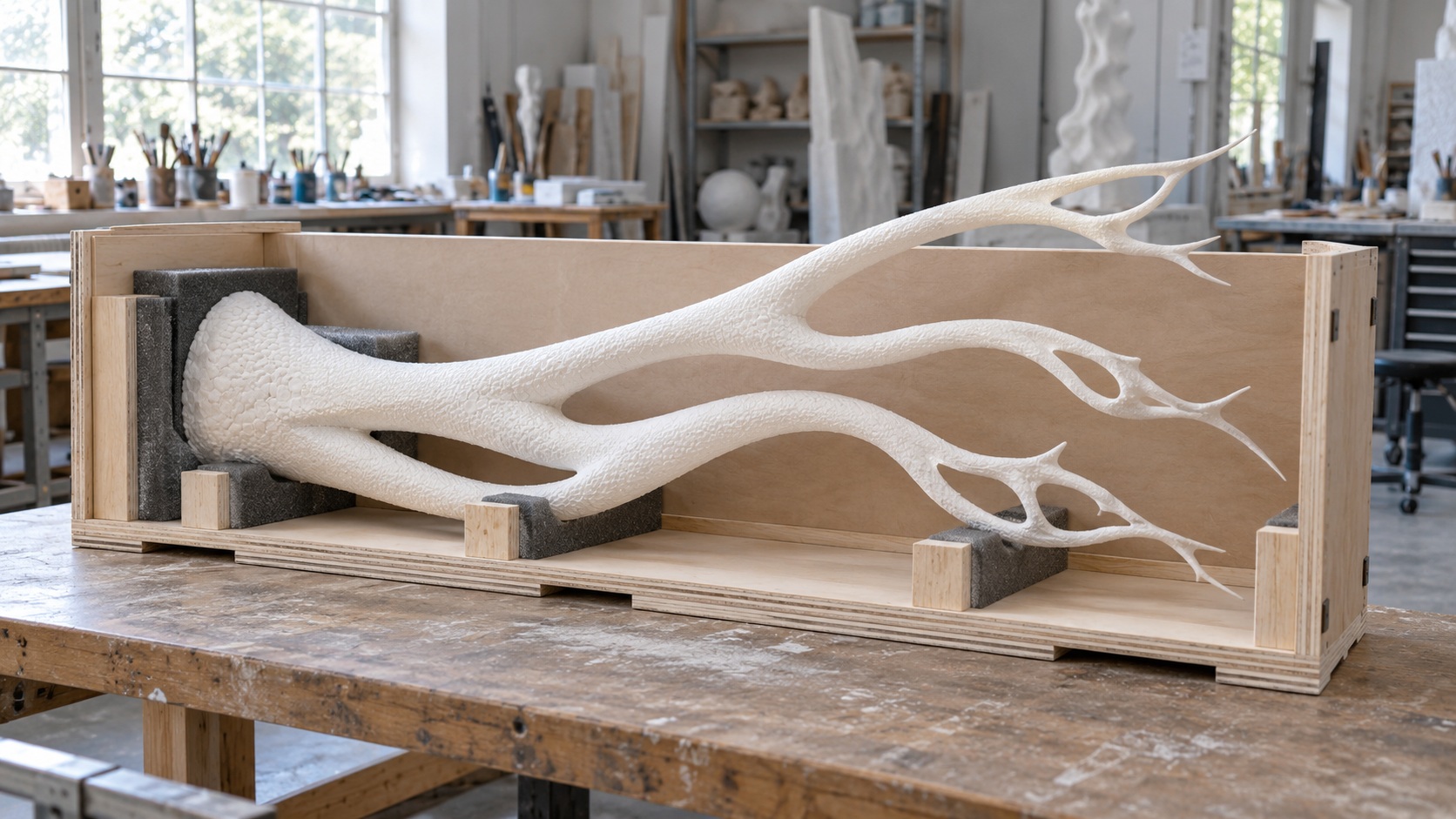
Foam’s generous volume can encourage extravagant shapes: branching antlers, feathers, fingers, or open lattices. The problem often arrives where a long element meets a narrow root. A small push at the free end produces a bending demand at that junction. Carving a deep decorative groove across the root can reduce its remaining section further. An artist may discover that the most visually elegant transition is also the point most likely to fail during an entirely ordinary move.
Changing the silhouette can help more than changing the foam grade. Shorten an exposed lever, broaden a concealed junction, join a projection to a neighboring form, or divide the assembly so the vulnerable part travels separately. Each choice has an artistic cost, so make it while the design is still negotiable. If a proposed reinforcement would substantially change the meaning or appearance, consider a different fabrication material for that element. Foam does not have to perform every role merely because it makes the main volume efficiently.
Repeated Touch Is Different From One Accident
A surface may survive a deliberate demonstration yet degrade through dozens of small encounters. Fingers repeatedly finding the same edge can polish paint, compact the core, or loosen a thin skin. Handles can become progressively less comfortable to use as the finish wears. For an interactive object, examine the repeated gesture itself. The natural gripping position may be different from the one shown in the installation instructions, especially when users have different hand sizes or limited reach.
Prototype those interactions at full scale. A small maquette cannot tell you where a visitor braces a hand while leaning to inspect a detail. Observe willing testers using an expendable version without coaching every movement, then inspect the contact regions. Record the difference between desired interaction and actual interaction. Where users consistently touch the same unintended surface, a redesign is often more dependable than a larger warning label.
There are also projects for which a touchable foam surface is the point. A soft sculpture may invite compression, and wear may be accepted as part of its life. That should be an explicit artistic and operational decision. Specify the permitted contact and the replacement or maintenance arrangement. Do not promise an untouched appearance while simultaneously encouraging unrestricted handling. The contradiction will eventually be resolved by the object, usually at the owner’s expense.
A Shell Can Exchange One Weakness for Another
Adding a rigid covering may reduce small dents but introduce edge chipping, visible seams, or detached areas. A hard layer over a yielding core behaves differently from the same layer over a rigid backing. At a thin projection, reinforcement can also add enough weight to change the load at its root. The resulting object may feel reassuring in the hand without having become dependable in every relevant direction. Judge the assembly through representative details rather than the hardness of a flat sample.
Compare a protected block, an exposed corner, and a narrow transition built with the same system. Include whatever fastening arrangement the final piece will use. The exercise is not a competition to find the toughest specimen; it is a way to learn which failure remains likely and whether the consequence is acceptable. If a skin makes repairs more invasive or turns a soft edge into a sharp broken fragment, that trade-off belongs in the decision before fabrication proceeds.
Transport Can Set the Real Design Limit
A sculpture may spend most of its life standing quietly and receive its greatest demands during a few minutes in transit. Doorways, stairs, elevators, loading platforms, and vehicle restraints all shape what can be moved without contact. Measure the full route, including turns and the space needed for carriers’ hands. An object that fits an opening geometrically may still be impossible to maneuver while supporting it at the intended locations. Include the packaging envelope when evaluating vehicle capacity.
Build transport divisions around robust connections rather than cutting the sculpture wherever a crate happens to end. A joint that is hidden in display but accessible during assembly can spare a fragile projection from repeated doorway risks. Repeatedly forcing a delicate part into a tight foam-lined cavity is not a dependable packing strategy. A removable cradle, an opening case side, or an individually secured module may reduce contact during insertion and removal.
Document the order of operations. If one component must be removed before a lifting strap is attached, make that sequence unmistakable in the handover. Numbering cases and photographing the packed configuration can reduce improvisation, but the physical arrangement should still be intuitive. Packing instructions cannot compensate for a cavity that only closes when an ornament is pushed aside. When the transport system is more complicated than the artwork’s owner can reasonably manage, simplify the object or reconsider the material.
Where Foam Should Stop
Using foam for a large decorative volume does not establish that the object can support a person, arrest a fall, serve as a guard, or hold an overhead load. Those functions need separately designed and assessed structures. A visitor who sees a broad horizontal surface may interpret it as a seat even when the artist intended a cloud. Where foreseeable use creates a consequential load, obtain qualified design advice and address access, stability, attachment, and the supporting substrate as a complete assembly.
Hybrid construction is often the sensible answer. A durable handle can connect directly to an internal frame while the surrounding foam provides visual mass. A slender ornament can use a different material without changing the overall reading. The division should be honest in the drawings and maintenance information. Concealed structure is not a problem; concealed assumptions about what carries the load are. The person installing or repairing the work needs to know which elements are decorative and which must remain intact.
Decide Whether Protection Changes the Work
Barriers, vitrines, elevated bases, and controlled access can greatly change the viewing relationship. A sculpture conceived as intimate may lose something when visitors cannot approach it. A highly reflective enclosure may compete with the surface. Even a simple instruction not to touch can conflict with a deliberately tactile form. Protection therefore belongs in the artistic discussion, not only in the facilities checklist after the object is complete.
Try the proposed display arrangement with a full-size stand-in. Walk around it, consider accessible sightlines, and examine what happens during cleaning and installation. A barrier that protects a projecting tip from visitors may leave it exposed to the cleaner’s equipment. A larger plinth may improve separation while creating an awkward edge in circulation. For fragile collection objects, conservation professionals can help reconcile access and preservation. The Canadian Conservation Institute’s note on rubber and plastic objects offers useful background on care, but display decisions still require knowledge of the actual sculpture.
Some artists will choose controlled deterioration, repair visibility, or periodic remaking. Others will want maximum retention of the original surface. Neither intention can be inferred from the material’s low purchase price. Record the choice explicitly, especially for commissioned or acquired work. A cheap starting block can become an irreplaceable artwork through the labor and decisions invested in it, and its treatment should reflect that distinction.
Compare the Whole Cost of the Choice
Foam can reduce carving time and shipping weight while increasing expenditure on reinforcement, cases, handling labor, and repairs. Compare those costs over the planned project, not only at purchase. A touring object that needs two extra handlers and a specialized crate at every venue may be less economical than a somewhat heavier alternative. Conversely, a large temporary display with a single controlled installation may gain very little from an expensive permanent construction.
Ask fabricators to identify the assumptions behind a proposal. Does the quoted finish tolerate occasional contact, or only protected display? Are vulnerable parts replaceable, and are patterns included? Who owns the packing design? What happens when the show changes venues? Answers should be concrete enough to become an operating plan. Fragility becomes manageable when its consequences are known and funded; it becomes a serious limitation when those consequences surprise the owner after acceptance.
Choose Deliberately
Keep foam where its lightness and shaping freedom matter. Change the geometry, handling, display, or material wherever an ordinary encounter would impose an unacceptable loss.